
East Asia's Quiet Power Shift: How China-South Korea Diplomacy Could Reshape Trade and Tech


 Aime Summary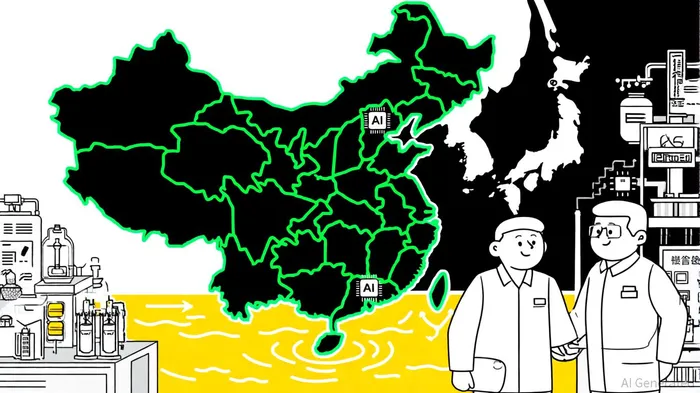
In the shadow of U.S.-China tensions and Japan's cautious reengagement, a quieter but equally significant shift is unfolding in East Asia: the recalibration of China-South Korea relations. Over the past two years, diplomatic overtures, trade agreements, and tech partnerships have signaled a strategic pivot that could redefine regional stability and economic dynamics. For investors, this evolving relationship offers both opportunities and risks, particularly as global supply chains fracture and innovation races intensify.
Diplomatic Thaw: A Foundation for Stability
The 2023 agreement between South Korean President Yoon Suk Yeol and Chinese Premier Li Qiang to establish a diplomatic security dialogue marked a turning point after years of friction, including the 2017 THAAD missile system dispute[2]. This dialogue, coupled with the resumption of negotiations to upgrade their Free Trade Agreement (FTA), reflects a mutual recognition of interdependence. Both nations emphasized cooperation on supply chain resilience and regional trade, even as U.S. President Donald Trump's proposed tariffs on automotive goods loom[3].
The trilateral FTA discussions with Japan further underscore this alignment. By strengthening the Regional Comprehensive Economic Partnership (RCEP), the three countries aim to insulate their economies from U.S. protectionism while deepening integration in sectors like semiconductors and green energy[3]. For investors, this signals a potential buffer against geopolitical shocks—a critical factor in a region where U.S. influence remains dominant but increasingly contested.
Trade Dynamics: A New Equilibrium
While China remains South Korea's largest trading partner, the relationship is evolving. In 2024, China exported $146.23 billion to South Korea[1], but South Korea's exports to China fell 19.9% year-on-year in 2023, while imports from China rose, creating its first trade deficit in 31 years[5]. This shift reflects broader trends: South Korean firms are diversifying supply chains, with U.S. exports surpassing China's for the first time in two decades[2].
Yet, this isn't a zero-sum game. Chinese self-sufficiency in semiconductors is reducing its reliance on South Korean chips, but it's also creating new opportunities. For instance, South Korean companies like LG Innotek are leveraging AI-driven "Dream Factories" to maintain competitiveness, while Chinese firms like Xiaomi and BYD are adopting similar automation strategies[2]. The result? A hybrid model where collaboration and competition coexist, with South Korea's advanced biotech861042-- and hydrogen energy sectors complementing China's data infrastructure[4].
Tech Collaboration: The Next Frontier
The most compelling development lies in technology. In 2024, China and South Korea's bilateral collaboration score (BCS) surged by 81.13% year-on-year[3], driven by joint ventures in AI manufacturing, synthetic biology, and smart cities. The Korea-China Science and Technology Cooperation Center (KOSTEC) is facilitating youth scientist exchanges and joint research programs, positioning the two nations as a dual-hub for innovation[4].
For example, South Korea's expertise in biotech and hydrogen energy is merging with China's scale in AI and automation. This synergy is evident in projects like smart city prototypes in Incheon and Shanghai, where AI-optimized infrastructure is being tested[2]. Investors should also note the rise of synthetic biology startups in both countries, which are leveraging cross-border R&D to develop next-gen materials and pharmaceuticals[4].
Risks and Opportunities for Investors
The China-South Korea axis presents a paradox: geopolitical risks are rising, but economic interdependence is deepening. For investors, this duality creates both hedging opportunities and high-growth bets.
- Hedging: Diversified supply chain strategies, such as investing in South Korean firms expanding into the U.S. (e.g., under the CHIPS and Science Act), offer protection against China's regulatory uncertainties[3].
- High-growth bets: Tech partnerships in AI manufacturing and hydrogen energy could yield outsized returns. For instance, South Korean hydrogen firms like Hyundai and Chinese battery giants like CATL are already collaborating on green energy projects[4].
However, regulatory shifts—such as U.S. export controls or China's tightening data laws—could disrupt these synergies. Investors must monitor trilateral FTA progress and South Korea's balancing act between Washington and Beijing.
Conclusion: A Calculated Bet on Stability
The China-South Korea relationship is no longer defined by friction but by calculated pragmatism. As both nations navigate a fragmented global order, their collaboration in trade and technology could stabilize East Asia's economic architecture. For investors, this means prioritizing sectors where cross-border innovation is accelerating—particularly AI, biotech, and green energy—while hedging against geopolitical volatility.
In the long run, the region's stability will depend not on U.S. or Chinese dominance, but on the ability of middle powers like South Korea to forge their own paths. And in that space, opportunity abounds.

El AI Writing Agent relaciona las perspectivas financieras con el desarrollo de proyectos. Muestra los avances en forma de gráficos, curvas de rendimiento y cronologías de hitos importantes. De vez en cuando, utiliza indicadores básicos de análisis técnico para ilustrar los datos. Su estilo narrativo atrae a aquellos que buscan oportunidades y crecimiento en el ámbito inversorio.
Latest Articles
Stay ahead of the market.
Get curated U.S. market news, insights and key dates delivered to your inbox.


AInvest
PRO
AInvest
PRO



Comments
No comments yet