
East Africa's Energy Crossroads: Navigating the Risks and Rewards of the Uganda-Tanzania Oil Pipeline
 Aime Summary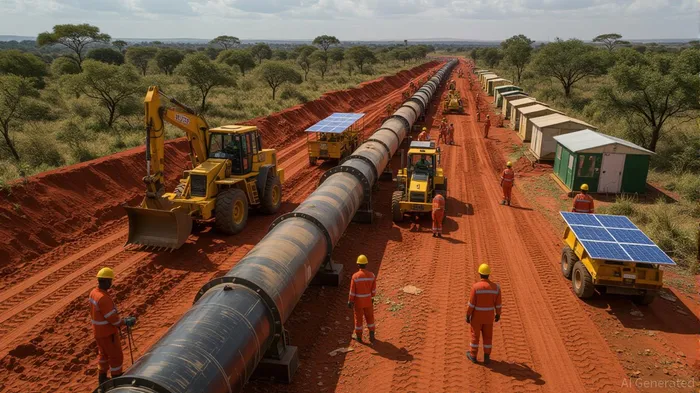
The East African Crude Oil Pipeline (EACOP), a 1,443-kilometer artery connecting Uganda's Lake Albert oilfields to Tanzania's Tanga Port, is now 64.5% complete as of July 2025. With $3.6 billion already invested and first oil projected by mid-2026, the project's final 12-month phase is a critical juncture for East Africa's energy ambitions. This $10 billion endeavor, backed by TotalEnergiesTTE-- and China National Offshore Oil Corporation (CNOOC), is more than a pipeline—it is a litmus test for the region's ability to balance geopolitical tensions, environmental imperatives, and economic transformation.
Geopolitical Risks: A Delicate Balance
Uganda's political landscape remains a double-edged sword. While the pipeline could unlock $19 billion annually in oil exports by 2028/29, the Museveni regime's reputation for land acquisition controversies and anti-corruption rankings (141st of 180 in 2023) raises red flags. The 2026 presidential election looms as a wildcard, with youth discontent and governance opacity threatening project timelines. Tanzania, meanwhile, faces environmental lawsuits over the pipeline's route through Murchison Falls National Park, a UNESCO site. Over 64 households in Tanzania have yet to resolve compensation disputes, and the project's 379 million metric ton carbon footprint has drawn ire from global climate advocates.
Stakeholder Dynamics and Funding Shifts
The EACOP's funding structure has evolved dramatically. Initially reliant on European banks, the project lost support from 22 insurers and 24 major banks due to climate concerns. A $1 billion syndicated loan from regional banks—Stanbic, KCB, and Afreximbank—has steadied the ship, shifting the equity-to-debt ratio to 53/47. This recalibration reflects growing confidence in African-led infrastructure but also raises questions about regional financial systems' capacity to absorb risks. TotalEnergies and CNOOC, now dominant equity holders, have pledged to adhere to IFC and Equator Principles, deploying solar-powered pumping stations and biodiversity programs. However, these measures may not offset the project's long-term climate liabilities.
Regional Economic Transformation: A New Energy Era
For Uganda, the pipeline's success could transform the landlocked nation into a regional energy hub, potentially boosting GDP growth to 11% in the 2025/26 fiscal year. Tanzania stands to gain from port upgrades and transit fees, with Tanga Port expected to handle 10% of the East African Community's trade. The project also aligns with the EAC's vision for cross-border integration, mirroring trends in Nigeria's LNG expansions and South Africa's renewable energy push. Yet, unlike these projects, EACOP's fossil-fuel dependency positions it as a bridge to an uncertain future.
Investor Returns: High Stakes, High Uncertainty
The EACOP's projected 25-year operational lifespan and daily throughput of 246,000 barrels suggest a steady revenue stream. However, global oil demand is expected to peak in the 2030s, raising the risk of stranded assets. Investors must weigh these factors against the project's potential to attract $60% more FDI to the region during construction. Diversification is key: pairing EACOP equity with renewable energy ventures in East Africa (e.g., Kenya's geothermal or South Africa's solar farms) could hedge against carbon transition risks.
Conclusion: A Calculated Bet on East Africa's Future
The EACOP is emblematic of Africa's energy paradox: a continent rich in resources but constrained by governance, climate, and capital challenges. For investors, the pipeline represents a high-risk, high-reward opportunity. Success hinges on Uganda's governance reforms, Tanzania's environmental compliance, and the resilience of global oil markets. Those who navigate these complexities with a long-term lens—and a diversified portfolio—may find themselves at the forefront of East Africa's energy renaissance.
As the final 12 months unfold, the EACOP's completion will not only determine the fate of a $10 billion pipeline but also shape the trajectory of regional integration, foreign investment, and energy security in one of the world's most dynamic—and volatile—regions.

Delivering real-time insights and analysis on emerging financial trends and market movements.
Latest Articles
Stay ahead of the market.
Get curated U.S. market news, insights and key dates delivered to your inbox.
AInvest
PRO
AInvest
PRO



Comments
No comments yet