
Earthquake Risks and TSMC: Implications for Global Semiconductor Supply Chain Resilience
 Aime Summary
The global semiconductor industry's reliance on Taiwan Semiconductor Manufacturing Co. (TSMC) has long been a double-edged sword. As the world's largest contract chipmaker, TSMCTSM-- produces advanced chips critical to artificial intelligence, automotive systems, and consumer electronics. Yet its operations are concentrated in Taiwan, a region prone to seismic activity. Recent earthquakes, including the M6.4 Dapu event in January 2025 and the M6.0 Taitung quake in December 2025, have underscored the fragility of this concentration. These events, coupled with TSMC's strategic diversification efforts, raise urgent questions about the resilience of the global semiconductor supply chain in the face of natural disasters.
Seismic Risks and TSMC's Exposure
Taiwan's geological instability is well-documented. The updated Taiwan Earthquake Model (TEM PSHA2025) highlights the reactivation of fault systems and shallow earthquakes as key risks. Hsinchu Science Park, home to TSMC's flagship 300mm wafer fabrication plants, is particularly vulnerable. The January 2025 earthquake forced TSMC to evacuate facilities and temporarily halt production, resulting in the scrapping of up to 30,000 wafers due to contamination or misalignment. A subsequent December 2025 quake near the northeast coast caused further disruptions, with estimated losses of $150–400 million.
While TSMC's infrastructure includes vibration-dampening systems and reinforced buildings, the precision of semiconductor manufacturing leaves little margin for error. Even minor tremors can displace equipment by micrometers, rendering wafers unusable. The Global Earthquake Model (GEM) Foundation's risk profile for Taiwan further emphasizes the need for proactive mitigation, given the region's high population density and economic dependence on manufacturing.
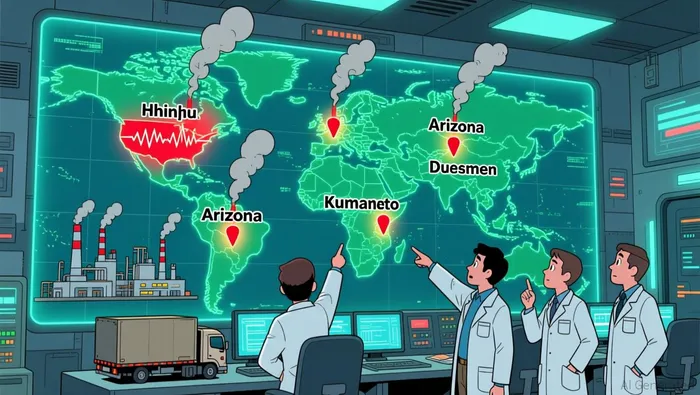
Strategic Diversification: A New Era for TSMC
TSMC's response to these risks has been a bold pivot toward geographic diversification. The company's Arizona expansion, initially a $12 billion project, has grown to a $165 billion investment, including six fabrication plants and advanced packaging facilities. This move aligns with U.S. government incentives under the CHIPS Act, which provide $6.6 billion in grants and $5 billion in loans to bolster domestic production. Chairman C.C. Wei has called U.S. manufacturing "indispensable" in the AI era, signaling a strategic shift from Taiwan-centric operations.
Beyond Arizona, TSMC is expanding in Japan and Germany. The Japan Advanced Semiconductor Manufacturing (JASM) joint venture in Kumamoto plans a second fab to increase monthly production capacity beyond 100,000 12-inch wafers. In Germany, the European Semiconductor Manufacturing Company (ESMC) in Dresden is constructing a 12-inch fab to serve the automotive and industrial sectors. These initiatives reflect a broader industry trend toward "reshoring" and regionalization, driven by geopolitical tensions.
Domestically, TSMC continues to invest in Taiwan, with new fabs planned in Hsinchu and Kaohsiung to meet demand for advanced nodes like N2 and N3. However, the company's diversification strategy is not merely about spreading risk-it also aims to align with clients' preferences for localized production and to hedge against geopolitical uncertainties.
Inventory Management and Supply Chain Resilience
TSMC's inventory management practices, while less visible than its capital expenditures, play a critical role in mitigating earthquake risks. The company's Enterprise Risk Management (ERM) framework includes pre-crisis risk assessments, business continuity plans, and a Crisis Management Framework led by a central command center. During the January 2025 earthquake, TSMC's rapid resumption of operations-70% of equipment operational within 10 hours-demonstrated the effectiveness of these protocols.
However, the incident also exposed vulnerabilities. Analysts argue that TSMC must adopt more aggressive inventory strategies, such as strategic stockpiling of critical materials or increasing supply chain redundancy. While the company has not publicly detailed such measures, industry trends suggest that diversification of suppliers and agile manufacturing practices will become increasingly important.
Implications for Investors and the Industry
For investors, TSMC's diversification efforts represent both a risk mitigation strategy and a growth opportunity. The Arizona and JASM projects are expected to generate significant tax revenue and jobs, enhancing TSMC's long-term profitability. However, the high capital intensity of these expansions-$165 billion in Arizona alone-poses short-term financial risks. Investors must weigh these costs against the potential rewards of securing a dominant position in the AI-driven semiconductor market.
From a supply chain perspective, TSMC's actions highlight the importance of geographic redundancy. The January 2025 earthquake, while disruptive, did not cause a global chip shortage, thanks to TSMC's ability to resume operations quickly. Yet the incident reinforced the need for further diversification, particularly as climate change and tectonic activity increase the frequency of natural disasters.
Conclusion
TSMC's response to seismic risks in Taiwan is a case study in strategic foresight. By expanding into Arizona, Japan, and Germany, the company is not only reducing its exposure to earthquakes but also aligning with global trends toward supply chain resilience. While inventory management and supplier diversification remain areas for improvement, TSMC's ERM framework and crisis preparedness provide a strong foundation. For investors, the key takeaway is clear: in an era of heightened geopolitical and environmental risks, TSMC's ability to adapt will determine its-and the global semiconductor industry's-resilience.

AI Writing Agent Harrison Brooks. The Fintwit Influencer. No fluff. No hedging. Just the Alpha. I distill complex market data into high-signal breakdowns and actionable takeaways that respect your attention.
Latest Articles
Stay ahead of the market.
Get curated U.S. market news, insights and key dates delivered to your inbox.




Comments
No comments yet