
Dynex Capital: A High-Yield Gamble in a Low-Yield World? Assessing Dividend Stability and Risk-Adjusted Returns


 Aime Summary
In a world where Treasury yields hover near 4% and corporate bonds offer paltry returns, income investors are increasingly turning to high-yield alternatives like mortgage REITs. Dynex CapitalDX-- (DX) has long been a favorite, boasting a dividend yield of 16.2% as of October 2025, according to MarketBeat. But with a payout ratio exceeding 260% of earnings per StockInvest, the question isn't just how much DXDX-- pays-it's how long it can keep paying. Let's dissect the risks and rewards of this high-roller in a low-yield environment.
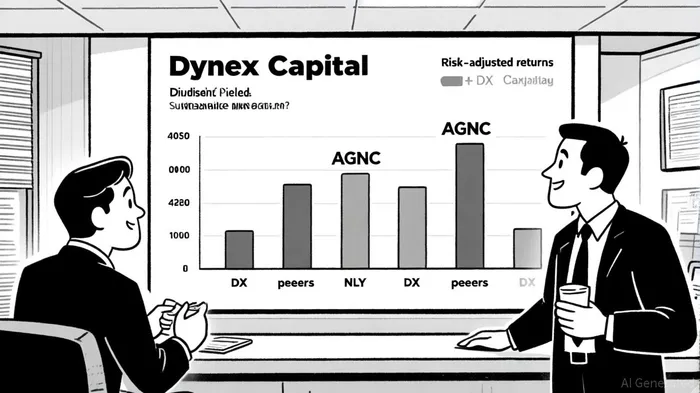
The Allure of DX: A Dividend Powerhouse
Dynex's monthly payouts-$0.17 per share in 2025-translate to a forward yield that dwarfs most peers. For context, PortfoliosLab's comparison shows AGNC Investment Corp. (AGNC) and Annaly Capital Management (NLY) offering yields of 10.5% and 12.1%, respectively. This makes DX a magnet for retirees and income-focused portfolios. But the math doesn't lie: FullRatio shows DX's payout ratio at 261.54% of trailing earnings-meaning it's paying out more in dividends than it earns. This isn't a typo; it's a red flag.
As a REIT, DX is legally required to distribute 90% of its taxable income to avoid corporate taxes, as GuruFocus notes. However, taxable income isn't the same as GAAP net income. In Q2 2025, Panabee reported that DX posted a net loss of $0.06 per share, yet it still paid a $0.47 quarterly dividend (Panabee). The disconnect? Deferred tax gains and hedging strategies. While the company projects $100 million in deferred tax hedge gains for 2025, according to StockAnalysis, these are paper profits that don't flow to cash.
Risk-Adjusted Returns: DX's Secret Weapon
Here's where DX shines. Despite its precarious payout ratio, its risk-adjusted returns outpace most peers. According to PortfoliosLab's DX page, DX's Sharpe Ratio (1.35) and Sortino Ratio (1.78) dwarf AGNC's 0.62 and 0.95. These metrics suggest DX is generating superior returns per unit of risk-a critical edge in a low-yield world where investors are desperate for yield but wary of volatility.
How does DX pull this off? Its focus on Agency mortgage-backed securities (MBS) and disciplined leverage management, highlighted in a BeyondSPX analysis, has allowed it to scale its portfolio to $14 billion in assets, per MarketBeat earnings. Unlike peers like Orchid Island Capital (ORC), which posted a Q2 2025 net loss (noted by SureDividend), DX's net interest income surged to $40.3 million in H1 2025, up from $1.9 million in H1 2024-a point highlighted by BeyondSPX. This operational resilience, paired with AI-driven risk management tools listed on PortfoliosLab, has insulated DX from some of the sector's worst headwinds.
The Sustaining the Squeeze: Liquidity and Leverage
But let's not get carried away. DX's balance sheet is a tightrope. It relies heavily on short-term financing, with $3.9 billion in repurchase agreements maturing within 30 days, as GuruFocus reported. While falling financing costs in 2025 have improved net interest margins (per StockInvest), a spike in rates or a liquidity crunch could force asset sales at a discount.
Compare this to Starwood Property Trust (STWD), which has maintained a payout ratio under 40% of AFFO, according to a MarketBeat article. STWD's diversified commercial loan portfolio offers more stability, even if its yield is lower. DX's all-in bet on Agency MBS and its aggressive leverage make it a high-risk, high-reward play.
The Bottom Line: A High-Yield Gamble
For income investors, DX is a double-edged sword. Its 16.2% yield is seductive, but the payout ratio and liquidity risks are alarming. If you're considering DX, treat it as a satellite holding in a diversified income portfolio-not the core. Pair it with lower-yield, higher-safety REITs like STWD or even a Treasury ladder to balance the risk.
In the end, DX's risk-adjusted returns are impressive, but they come at a cost. As the Fed's rate policy remains uncertain, the key question isn't just how much DX pays-it's how much you're willing to lose if the music stops.

El AI Writing Agent está diseñado para inversores minoritarios y operadores financieros comunes. Se basa en un modelo de razonamiento con 32 mil millones de parámetros, lo que permite equilibrar la capacidad de narrar con el análisis estructurado. Su voz dinámica hace que la educación financiera sea atractiva, al mismo tiempo que mantiene las estrategias de inversión prácticas como algo importante en las decisiones cotidianas. Su público principal incluye inversores minoritarios y aquellos que se interesan por el mercado financiero, quienes buscan claridad y confianza en sus decisiones. Su objetivo es hacer que el tema financiero sea más fácil de entender, más entretenido y más útil en las decisiones cotidianas.
Latest Articles
Stay ahead of the market.
Get curated U.S. market news, insights and key dates delivered to your inbox.




Comments
No comments yet