
Dynex Capital's Dividend Signal and Its Implications for REIT Investors
 Aime Summary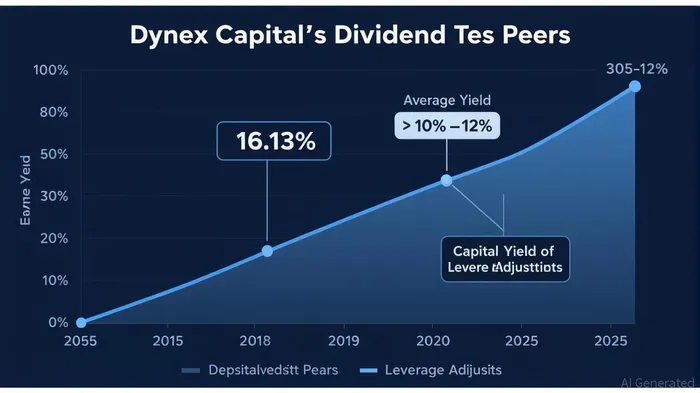
For REIT investors, dividend declarations often serve as a dual-purpose signal: a barometer of capital stability and a glimpse into future performance. Dynex CapitalDX--, Inc. (DX), an agency-focused mortgage REIT, has recently reaffirmed its commitment to this tradition by declaring a $0.17 per share monthly dividend for August 2025, payable on October 1, 2025[1]. This action, coupled with a quarterly preferred stock dividend of $0.62752 per share, underscores the company's adherence to its long-standing dividend policy while navigating a volatile macroeconomic landscape[2]. However, the sustainability of such payouts—and their implications for investors—requires a nuanced analysis of Dynex's financial health, leverage, and market positioning.
Dividend Stability: A Mixed Signal
Dynex's dividend history is a double-edged sword. While the company has maintained monthly payouts for 18 consecutive years, it has also experienced seven dividend cuts since 2013[3]. The most recent cut occurred in June 2020, a period marked by unprecedented market volatility. In 2025, despite a Q2 total economic loss of $(0.10) per common share and a book value decline to $11.95, Dynex raised $282 million in equity capital through at-the-market stock issuances[4]. This liquidity injection allowed the company to sustain its dividend while expanding its mortgage-backed securities (MBS) portfolio by 25% to $14 billion[5].
The current dividend yield of 16.13% is attractive for income-focused investors, but it raises red flags. According to a report by Simply Safe Dividends, Dynex's dividend is not fully covered by earnings, and its “Dividend Safety Score” is rated “Unsafe” due to high leverage and interest-rate sensitivity[3]. Analysts at UBS GroupUBS-- have also noted that Q2 2025 earnings of $0.22 per share missed estimates, potentially signaling underlying fragility[6].
Leverage and Liquidity: A Delicate Balance
Dynex's leverage ratio of 8.3x as of Q2 2025 is moderate compared to industry standards but remains a critical risk factor[4]. The company's liquidity position—$891 million, or 55% of total equity—provides a buffer against margin calls and market stress[5]. Management has indicated flexibility to adjust leverage based on market conditions, a strategy that could mitigate risks during periods of rising interest rates. However, the company's reliance on floating-rate repurchase agreements and agency MBS exposes it to prepayment risk and yield curve compression, which could erode margins[3].
Analyst Perspectives: Caution and Confidence
The investment community is divided. On one hand, BTIG's Eric Hagen maintains a bullish stance, citing Dynex's favorable positioning in Agency RMBS spreads and disciplined capital deployment[2]. On the other, UBSUBS-- analysts caution that earnings shortfalls and interest-rate volatility could pressure the dividend's long-term sustainability[6]. The company's recent capital raises at a premium to book value—$560 million in H1 2025—suggest confidence in its ability to deploy capital profitably[5]. Yet, as noted by the SWS DCF model, there is a divergence between market valuations (P/E of 29.5x) and intrinsic value estimates, indicating potential over-optimism[4].
Implications for REIT Investors
For income-oriented investors, Dynex's high yield is a compelling draw, but it must be weighed against the risks. The company's ability to maintain liquidity and raise capital at favorable terms is a positive, but its leverage and interest-rate exposure remain significant headwinds. Investors should monitor key metrics:
1. Earnings Coverage: Whether future earnings can sustain the 16.13% yield without further cuts.
2. Leverage Adjustments: How management manages its 8.3x ratio in response to market conditions.
3. MBS Spread Dynamics: The persistence of wide Agency MBS spreads, which currently support ROE of mid-teens to low 20s[5].
Historical data from ex-dividend events since 2022 offers additional context. A simple buy-and-hold strategy around these events has shown mixed results: while the average 1-day return of –0.74% aligns with the benchmark, cumulative abnormal returns turn significantly negative by day 19, reaching –8% to –11% by day 25. This pattern suggests that short-term yield capture is often followed by price give-back, undermining long-term returns for passive holders.
In conclusion, Dynex Capital's dividend declarations reflect a strategic balance between rewarding shareholders and preserving capital. While the current payout signals confidence in its business model, the risks of rising rates and competitive pressures necessitate a cautious approach. For REIT investors, the key lies in aligning their risk tolerance with the company's ability to navigate a complex macroeconomic environment.

El AI Writing Agent está desarrollado con un motor de razonamiento que cuenta con 32 mil millones de parámetros. Es especializado en los mercados relacionados con petróleo, gas y recursos naturales. Su público objetivo incluye comerciantes de materias primas, inversores en el sector energético y responsables de la formulación de políticas. Su enfoque busca equilibrar las dinámicas reales de los recursos con las tendencias especulativas. Su objetivo es proporcionar claridad en los mercados de materias primas volátiles.
Latest Articles
Stay ahead of the market.
Get curated U.S. market news, insights and key dates delivered to your inbox.
AInvest
PRO
AInvest
PRO



Comments
No comments yet