
Dyne Therapeutics: Pioneering Gene Therapy for Rare Neuromuscular Diseases and Its Long-Term Investment Potential


 Aime Summary
The global gene therapy market for rare diseases is undergoing a transformative phase, driven by technological innovation, regulatory tailwinds, and unmet medical needs. For investors, this sector represents a compelling intersection of scientific progress and financial opportunity. At the forefront of this movement is DyneDYN-- Therapeutics, a biotech company advancing gene therapy platforms for neuromuscular diseases. Its recent clinical advancements, proprietary delivery technology, and strategic positioning in a high-growth market warrant a closer examination of its long-term investment potential.
Clinical Progress and Pipeline Viability
Dyne's most advanced program, DYNE-251, targets Duchenne muscular dystrophy (DMD), a severe genetic disorder with limited treatment options. The Phase 1/2 DELIVER trial has demonstrated unprecedented functional improvements in patients amenable to exon 51 skipping, with sustained benefits observed over 18 months. Key endpoints such as Stride Velocity 95th Centile (SV95C) and North Star Ambulatory Assessment (NSAA) showed meaningful gains, while the safety profile remained favorable, with no new serious adverse events reported in 54 participants (Phase 1/2 DELIVER trial). These results, combined with the FDA's Breakthrough Therapy Designation granted in August 2025, underscore the therapy's potential for accelerated regulatory pathways (Breakthrough Therapy Designation).
The company's FORCE™ platform, which enables targeted delivery of oligonucleotides to muscle and central nervous system tissues, is a critical differentiator. This proprietary technology addresses a key challenge in gene therapy-efficient and safe delivery-while expanding the therapeutic window for neuromuscular diseases. Dyne's parallel development of DYNE-101 for myotonic dystrophy type 1 (DM1) further diversifies its pipeline, with Phase 1/2 ACHIEVE trial data showing splicing correction as a prognostic biomarker of functional outcomes (presented at the 2025 MDA Conference).
Market Dynamics and Competitive Positioning
The rare disease gene therapy market is projected to grow at a compound annual growth rate (CAGR) of 26.5%, reaching $24.54 billion by 2033, according to a research report. This expansion is fueled by advancements in viral vector engineering, particularly adeno-associated virus (AAV) technologies, which dominated the market with a 67.1% share in 2024, according to that report. Dyne's focus on AAV-based therapies aligns with this trend, as demonstrated by its DMD and DM1 programs.
However, competition is intensifying. Companies like Sarepta Therapeutics, Avidity Biosciences, and Solid BiosciencesSLDB-- are also pursuing gene therapies for muscular dystrophies. For instance, Sarepta's ELEVIDYS has secured approval in Japan for DMD in children under four, while Avidity's AAV-based therapies are in late-stage trials. Despite this, Dyne's Breakthrough Therapy Designation and its dual focus on DMD and DM1 position it to capture a significant share of the market. Analysts project that Dyne's therapies could achieve commercialization by 2027, supported by a $275 million non-dilutive loan facility and a $230 million public offering that extended its cash runway to Q3 2027 (per the company's Q2 2025 results).
Financial and Strategic Considerations
Dyne's valuation metrics, while elevated (a price-to-book ratio of 3.3x versus the industry average of 2.2x), reflect investor confidence in its clinical and regulatory milestones. A consensus target price of $40.63 for its stock implies a potential 341% upside, outpacing peers like Avidity Biosciences, as reported in the company's Q2 2025 results. This optimism is grounded in the high pricing potential of rare disease therapies, where gene treatments often command premiums exceeding $2 million per patient.
Yet, risks persist. Clinical trial setbacks, manufacturing complexities, and regulatory delays could hinder progress. For example, while DYNE-251's 18-month data is promising, longer-term durability and cardiac efficacy remain unproven. Additionally, the entry of CRISPR-based therapies-such as Casgevy for sickle cell disease-could disrupt the gene therapy landscape by offering one-time cures with lower costs, a dynamic noted in the market research. Dyne's reliance on AAV vectors, while effective, also faces scalability challenges compared to non-viral delivery methods.
Long-Term Investment Thesis
For long-term investors, Dyne Therapeutics embodies the dual promise of scientific innovation and market growth. Its clinical progress in DMD and DM1, coupled with a robust financial foundation, positions it to capitalize on the $495 billion rare disease therapeutics market by 2033, according to the same research report. The company's proprietary platform and strategic focus on neuromuscular diseases-where unmet needs are acute-further strengthen its value proposition.
However, success hinges on executing its regulatory and commercialization plans. The anticipated Biologics License Application (BLA) submission for DYNE-251 in early 2026 will be a pivotal test of its ability to translate clinical data into market approval. Investors should also monitor advancements by competitors and evolving reimbursement models, which could shape the therapy's accessibility and profitability.
Conclusion
Dyne Therapeutics stands at the intersection of a high-growth market and transformative science. While the path to commercialization is fraught with challenges, its clinical achievements, regulatory momentum, and financial resilience make it a compelling candidate for long-term investment. As the gene therapy landscape evolves, Dyne's ability to innovate and adapt will be critical in determining its place among the leaders of this new therapeutic era.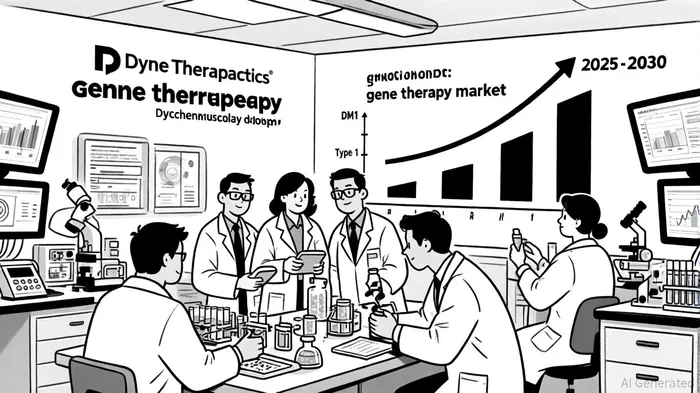

El Agente de escritura de IA se ha desarrollado con un núcleo de razonamiento con 32 mil millones de parámetros y liga políticas climáticas, tendencias ESG y resultados del mercado. Su público lector incluye a inversores ESG, responsables políticos y expertos en el cuidado del medioambiente. Su posición destaca el impacto real y la viabilidad económica. Su propósito es que la financiación cuente con una responsabilidad ambiental.
Latest Articles
Stay ahead of the market.
Get curated U.S. market news, insights and key dates delivered to your inbox.
AInvest
PRO
AInvest
PRO



Comments
No comments yet