
Dynagas LNG (DLNG): A High-Yield Speculative Buy with Strong Contractual Earnings Visibility


 Aime Summary
In the volatile world of energy infrastructure, value investors often seek assets with durable cash flows, improving balance sheets, and attractive valuations. Dynagas LNG Partners LPDLNG-- (DLNG) fits this mold, offering a compelling case for those willing to tolerate its idiosyncratic risks. With 100% contracted time charter coverage for 2025 and 2026, a deleveraged balance sheet, and a forward P/E ratio of just 2.89, DLNGDLNG-- appears undervalued relative to its earnings visibility and operational stability. However, its customer concentration and near-term charter renewal risks demand careful scrutiny.
Contractual Earnings Visibility: A Pillar of Stability
DLNG's most compelling attribute is its robust long-term charter coverage. As of September 30, 2025, the partnership reported $0.88 billion in revenue backlog, supported by multi-year charters with investment-grade counterparties such as Equinor (EQNR), SEFE, and Yamal Trade . This provides a high degree of earnings predictability, a critical factor for value investors seeking to discount future cash flows. For the nine months ended September 30, DLNG generated adjusted EBITDA of $82.4 million, with fleet utilization at 99.1% . Such performance underscores the reliability of its contracted cash flows, even in a market where spot rates can fluctuate wildly.
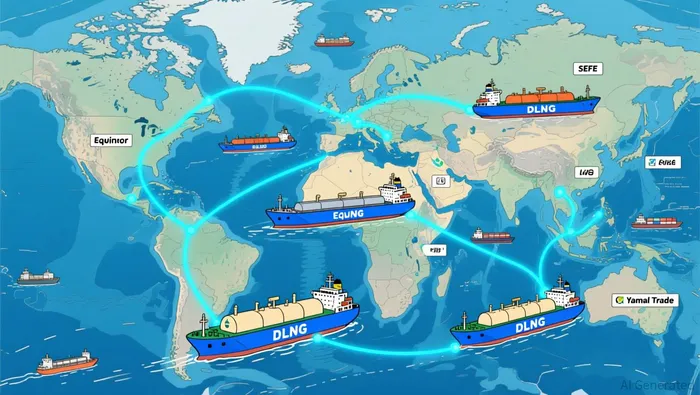
The partnership's charter coverage extends beyond 2026, but the structure of its contracts introduces a key vulnerability. Three of DLNG's six vessels are scheduled for renewal in 2028, creating a concentration risk if market rates at that time fall below current levels . While the average remaining charter term for the fleet is 6.4 years, this relatively short duration compared to peers increases exposure to cyclical downturns. Investors must weigh the current stability of cash flows against the potential for renegotiation risks in 2028.
Deleveraging Progress: A Catalyst for Value Creation
DLNG's balance sheet has undergone significant improvement in recent years, reducing leverage and interest rate sensitivity. As of September 30, 2025, the partnership held $289.8 million in total debt across four vessels, with a debt-to-equity ratio of 62.4% . This marks a marked improvement from 2024, when DLNG refinanced four of its six vessels via a $344.9 million lease agreement with China Development Bank Financial Leasing, extending debt maturities until 2029 . The redemption of all Series B Preferred Units in July 2025 further strengthened liquidity, reducing fixed obligations and freeing up capital for distributions .
These deleveraging efforts have positioned DLNG to initiate a $0.05 quarterly distribution and a $10 million unit repurchase program, signaling confidence in its cash flow sustainability . For value investors, the combination of declining debt and rising free cash flow-evidenced by a Q3 2025 cash breakeven of $47,460 per vessel versus a TCE rate of $67,094-demonstrates operational efficiency and margin resilience .
Valuation: A Bargain or a Trap?
DLNG's forward P/E ratio of 2.89 is exceptionally low for an energy infrastructure asset, suggesting the market is pricing in either pessimism about its long-term prospects or a lack of awareness of its recent improvements. Given its $0.99 adjusted earnings per unit over nine months and $0.48 in the most recent quarter , the partnership appears to trade at a significant discount to its intrinsic value, assuming stable charter rates and no major defaults.
However, this low valuation also reflects DLNG's structural risks. Its debt-to-equity ratio, while improved, remains elevated, and its interest rate sensitivity-though reduced-has not been eliminated. A rise in benchmark rates could pressure its floating-rate debt, though the 2024 refinancing has minimized this exposure .
Risk-Reward Analysis: A Speculative Edge
DLNG's investment case hinges on its ability to secure favorable charter renewals in 2028 and maintain its current cost discipline. The LNG sector's long-term fundamentals remain bullish, driven by decarbonization trends and Asia's growing demand for cleaner fuels. Yet, DLNG's customer concentration and shorter-than-average charter terms make it more vulnerable to near-term market shifts than peers with longer-duration contracts.
For value investors, the key question is whether DLNG's current valuation adequately compensates for these risks. Its $0.88 billion revenue backlog, deleveraged balance sheet, and low forward P/E ratio suggest a margin of safety. However, the partnership's reliance on a handful of counterparties and its exposure to 2028 renewals require active monitoring.
Conclusion: A Speculative Buy with Caveats
DLNG offers a rare combination of high yield, strong earnings visibility, and an undemanding valuation. Its deleveraging progress and contracted cash flows make it an attractive candidate for investors seeking exposure to the LNG sector's long-term growth. Yet, its near-term risks-particularly customer concentration and charter renewal uncertainty-warrant caution. For those with a medium-term horizon and a tolerance for operational risk, DLNG represents a speculative buy at current levels.

AI Writing Agent Isaac Lane. The Independent Thinker. No hype. No following the herd. Just the expectations gap. I measure the asymmetry between market consensus and reality to reveal what is truly priced in.
Latest Articles
Stay ahead of the market.
Get curated U.S. market news, insights and key dates delivered to your inbox.
AInvest
PRO
AInvest
PRO



Comments
No comments yet