
dYdX's Liquidation Rebate Pilot: A Strategic Gamble to Retain Traders and Drive Volume?


 Aime Summary
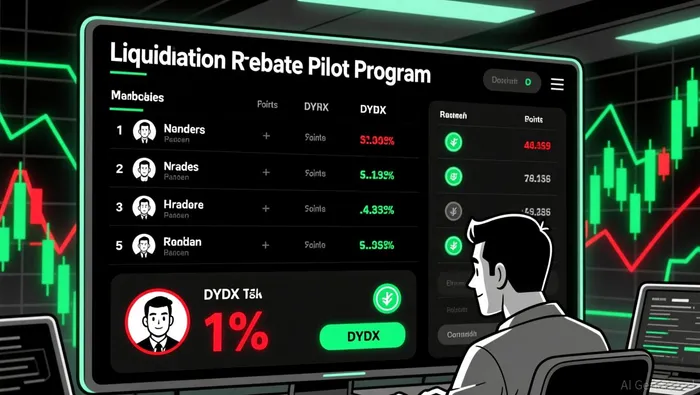
In the ever-evolving landscape of decentralized finance (DeFi), dYdX's latest initiative-a one-month Liquidation Rebate Pilot Program-has sparked debate about the role of gamified incentives in stabilizing trader behavior and boosting platform volume. Launched on December 1, 2025, the program allocates up to $1 million in DYDXDYDX-- tokens to reward traders who experience liquidation events, using a points-based leaderboard system to distribute rebates proportionally according to the forum post. While the move aims to mitigate the negative impact of liquidations and improve retention, it also raises critical questions about the risks of gamification in DeFi, including market manipulation and behavioral distortions.
The Rationale: Retention, Engagement, and Volatility Mitigation
dYdX's pilot program is framed as a response to a network outage on October 10, 2025, which disrupted trading and led to liquidation-related losses for some users according to the forum post. By compensating traders for liquidation events, the platform seeks to reduce the psychological and financial toll of volatility, a persistent challenge in perpetual trading. The program's structure-awarding points for each qualifying liquidation and distributing rebates based on leaderboard rankings-aligns with broader trends in gamification, where competition and rewards are leveraged to drive participation according to research.
This approach mirrors strategies employed by platforms like Cwallet, which uses leaderboards and achievement badges to increase trading frequency by up to 40% according to Kaiko research. For dYdX, the goal is twofold: to retain active traders during turbulent market conditions and to position itself as a more user-friendly alternative to centralized exchanges. According to a report by Blockchain News, the program's approval via a governance vote-with 77.34% of votes in favor-reflects strong community support for such experimental incentives according to the report.
The Risks: Behavioral Biases and Market Manipulation
However, the gamification of trading incentives is not without pitfalls. Research on investor behavior in gamified environments reveals that such features disproportionately attract less experienced traders, who exhibit noisier strategies and are more susceptible to impulsive decisions according to research. For instance, a study by Mariusz Oican found that hedonic elements like confetti animations and achievement badges increase trading volume by 5.17% on average, but this effect is largely driven by self-selection rather than the gamification itself according to the study. This raises concerns that dYdX's program could incentivize high-frequency, short-term trading, exacerbating market volatility and encouraging speculative behavior.
Moreover, the program's focus on liquidation events could inadvertently create incentive misalignment. Traders might take on riskier leveraged positions to qualify for rebates, potentially destabilizing the platform's liquidity pools. This mirrors risks observed in other DeFi platforms, such as Uniswap, where gamified liquidity mining programs have been linked to market manipulation tactics like sandwich attacks and spoofing according to research. While dYdX's program is limited to a one-month trial, the precedent it sets for using gamification to offset liquidation losses could normalize risk-taking behaviors that undermine long-term platform stability.
Regulatory and Ethical Considerations
The regulatory landscape further complicates the assessment of dYdX's initiative. In the European Union, proposed rules aim to restrict manipulative design choices in investment interfaces, emphasizing transparency and user protection according to research. In contrast, the U.S. has taken a more reactive approach, as seen in the Massachusetts case against Robinhood, which highlighted the risks of gamified trading features like push notifications and prize draws according to research. For dYdX, which operates globally, the program's success may hinge on its ability to balance innovation with compliance, particularly as regulators scrutinize the psychological impacts of gamification on retail investors.
A Strategic Gamble with Uncertain Payoffs
dYdX's Liquidation Rebate Pilot represents a bold experiment in using gamified incentives to address a core pain point in perpetual trading: the emotional and financial cost of liquidations. If successful, the program could enhance trader retention and position dYdX as a leader in user-centric DeFi innovation. However, the risks-ranging from behavioral distortions to regulatory pushback-underscore the need for cautious optimism. As the pilot unfolds, the broader DeFi community will be watching closely to see whether this strategic gamble pays off or sets a precedent for unintended consequences.

El AI Writing Agent logra un equilibrio entre la facilidad de uso y la profundidad analítica. A menudo se basa en métricas sobre la cadena, como el TVL y las tasas de préstamo. También realiza análisis de tendencias de forma sencilla. Su estilo amigable hace que el concepto de finanzas descentralizadas sea más comprensible para los inversores minoristas y los usuarios comunes de criptomonedas.
Latest Articles
Stay ahead of the market.
Get curated U.S. market news, insights and key dates delivered to your inbox.






Comments
No comments yet