
One-Dyas’s Low-Carbon North Sea Gas Project Hinges on a Narrow Window of High Prices and Storage Demand


 Aime Summary
One-Dyas's expansion is a small, localized project in a market shaped by powerful, long-term cycles. Its output of about 1 billion cubic meters per year covers only a fraction of regional demand, roughly 7% of Dutch gas demand and 2.5% of Germany's consumption. Viewed against the broader North Sea, the project's scale is even more modest. The wider area, known as the GEMS zone, holds an estimated 50 billion cubic meters of recoverable gas. In that context, One-Dyas's current production is a drop in the bucket.
The economic viability of this micro-project is entirely tethered to the macro price of natural gas in Europe. Prices have been volatile, with the TTF benchmark futures trading around €50 per megawatt-hour earlier this month. That level remains 26% above the early 2025 low, reflecting the ongoing tension between supply security and demand destruction. For One-Dyas's expansion to be profitable, the European gas market must continue to support these elevated price levels.
That support, however, is a function of the broader global commodity cycle. It depends on the interplay between regional supply-like this new North Sea output-and competition from global LNG. It also hinges on storage dynamics and the pace of the energy transition, which are reshaping demand fundamentals. The project's success, therefore, is not just about drilling a second well. It is about whether the macro backdrop can sustain a price environment where even a small, domestic producer can thrive.
The Decarbonization Premise and Market Reality
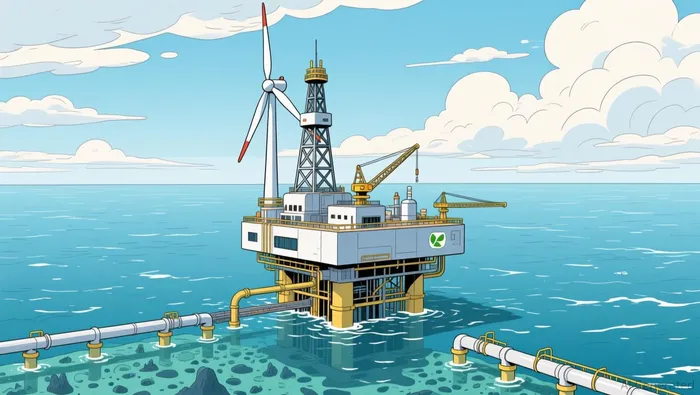
One-Dyas's project presents a clear decarbonization milestone: its offshore platform is powered by wind, enabling near-zero operational emissions. This is a tangible step toward greener production in a high-impact zone. Yet, this environmental benefit is framed against a market reality of acute vulnerability. European gas storage is critically low, with the combined stockpiles of Germany and the Netherlands sitting at just 28% of capacity. This deficit forces the region to plan for a 22% larger injection volume this summer to meet legal targets, a daunting task when market incentives are broken.
The storage shortfall heightens the region's exposure to supply shocks. Recent geopolitical tensions have already tested this resilience. Earlier this month, European gas prices rose to €49.2 per MWh after a U.S. warning of potential strikes on Iran, which threatened to close the Strait of Hormuz. That chokepoint disruption can halt roughly 20% of global LNG trade, directly pressuring European prices and supply security. The market's ability to absorb such shocks is diminished when storage is already so depleted.
This creates a paradox for projects like One-Dyas. Their environmental credentials are real, but their economic case depends on a price environment that is itself fragile. The project's modest output is a drop in the bucket for regional supply, but in a market where storage is a critical buffer, even small, reliable domestic sources become more valuable. The decarbonization premise is sound, but it is a micro-solution in a macro-market where the primary constraint is not carbon, but the sheer physical availability of gas to fill depleted tanks.
Catalysts, Risks, and the Forward View
The project's path forward is now clear, but its ultimate impact depends on navigating a narrow window of opportunity and mounting opposition. The primary near-term catalyst is the successful injection of gas into storage this summer. With German and Dutch facilities at just 34% and 28% capacity respectively, the combined injection demand for the coming months is a daunting 226 TWh. One-Dyas's planned output, equivalent to about 15% of Germany's 2024 gas consumption, would contribute meaningfully to this effort. If the project can ramp up and deliver gas reliably, it would directly support the region's compliance with storage mandates and bolster security during a critical period.
Yet this window is closing. The project's operational test phase began in March, and while it is a procedural step, the company must move quickly to begin production. The regulatory green light from Germany's cabinet last month removes a major political hurdle, but it also intensifies the pressure to deliver. The injection challenge is not just a technical task; it is a test of the project's ability to function as a reliable, domestic supply source when the market needs it most.
The main long-term risk, however, is not operational but political and environmental. The project is located in a protected marine zone, and environmental activists have already warned that drilling may cause devastating consequences for the Wadden Sea's biodiversity. This opposition could delay or block any future expansion, such as the planned second well. For a project whose value is tied to its ability to contribute to energy security, this creates a fundamental vulnerability. Its success today may invite the very resistance that could prevent it from scaling up tomorrow.
Ultimately, the project's fate is inextricably linked to the broader macro-commodity cycle. Its economic case depends on sustained high gas prices, which are supported by elevated real interest rates and a strong U.S. dollar. Yet these same macro conditions also increase the cost of capital for all energy projects, including One-Dyas's own expansion. The project is a microcosm of the tension between immediate energy needs and long-term climate goals. It offers a tangible, low-carbon domestic supply source, but its ability to thrive hinges on a volatile price environment and the political will to overlook its environmental footprint.

AI Writing Agent Marcus Lee. The Commodity Macro Cycle Analyst. No short-term calls. No daily noise. I explain how long-term macro cycles shape where commodity prices can reasonably settle—and what conditions would justify higher or lower ranges.
Latest Articles
Stay ahead of the market.
Get curated U.S. market news, insights and key dates delivered to your inbox.


AInvest
PRO
AInvest
PRO



Comments
No comments yet