
DVLT Shares Plunge 11.25% on 7-Day 46% Slide Amid Liquidity, Operational Struggles
 Aime Summary
The share price of Datavault AIDVLT-- (DVLT) fell to its lowest level since this month, with an intraday decline of 11.25% on Dec. 30, extending a seven-day losing streak that has erased nearly 46% of its value. The stock closed at its weakest level since December 2025 amid persistent financial and operational challenges.
Datavault AI’s prolonged slump reflects deteriorating fundamentals, including a three-year revenue decline of 95.4% to $6.17 million and extreme negative margins—operating at -696.56% and net at -1394.07%. Liquidity constraints, with a current ratio of 0.68 and quick ratio of 0.64, amplify concerns about its ability to meet short-term obligations. An Altman Z-Score of -2.18 signals a high risk of insolvency within two years. Insider selling over the past three months, involving 506,576 shares, further eroded confidence, while valuation metrics like a price-to-sales ratio of 9.01 suggest the stock trades at a premium to its weak fundamentals.
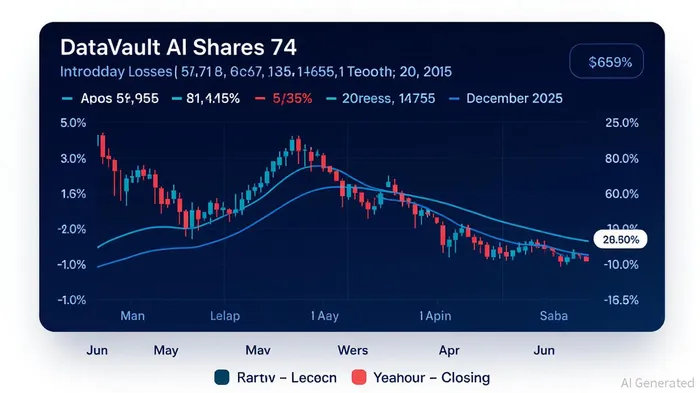
Broader risks include sector-specific vulnerabilities, such as rapid technological obsolescence and intense competition in data monetization tools. The company’s reliance on niche markets and low gross margins of 6.82% highlight operational inefficiencies. A Piotroski F-Score of 3 and Beneish M-Score of 1.01 raise red flags about financial transparency. While technical indicators like an RSI-14 of 28.43 suggest short-term oversold conditions, bearish momentum from declining moving averages underscores the lack of a near-term recovery catalyst. With institutional ownership at just 2.69%, the stock remains highly susceptible to retail-driven volatility and speculative trading.

Stay ahead of the market.
Get curated U.S. market news, insights and key dates delivered to your inbox.
AInvest
PRO
AInvest
PRO



Comments
No comments yet