
Dutch Firms Slash Jobs as Unemployment Stays Unchanged at 4.0%
 Aime Summary
- The Dutch unemployment rate remained unchanged at 4.0% in February 2026, consistent with the previous month.
- This reading is among the lowest in the eurozone, where the unemployment rate has also fallen to 6.2%, reflecting a generally strong labor market.
- Despite this resilience, Dutch firms are increasingly cutting jobs due to cost pressures and economic uncertainty, according to recent reports.
The Netherlands' unemployment rate of 4.0% in February 2026 reflects a tight labor market with minimal month-over-month changes. While the rate is consistent with the previous reading, it underscores a broader pattern of low unemployment that has persisted in the Netherlands over recent months. This stability contrasts with other European economies where unemployment trends have shown more fluctuation. The lack of a change in the unemployment rate may signal that the Dutch economy remains relatively insulated from broader European labor market pressures.
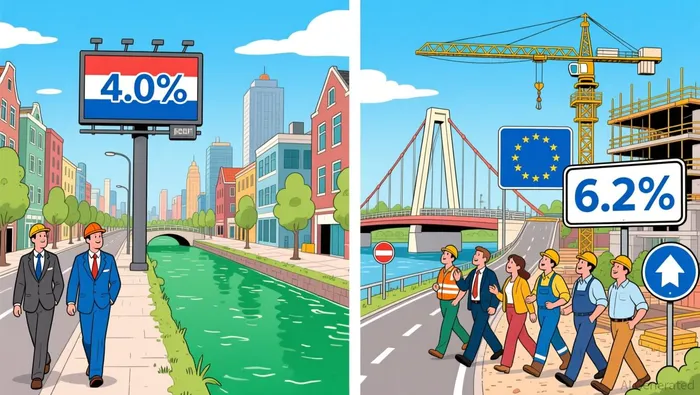
The Netherlands' low unemployment rate fits within a broader pattern of eurozone economic resilience. In the euro area, the unemployment rate has fallen to 6.2%, the lowest in recent years. This trend is supported by strong consumer spending and a robust services sector, which have helped maintain employment levels despite global uncertainties such as geopolitical tensions and trade disruptions. The Netherlands, as a major export-oriented economy, has benefited from this environment, though it is not immune to domestic challenges like rising costs and business restructuring.
Despite the stable unemployment rate, Dutch companies are actively cutting jobs in early 2026 as part of cost-cutting measures and reorganisation efforts. Reports indicate that over 350 companies have announced job cuts, with sectors like banking, education, and manufacturing particularly affected. While AI adoption is sometimes cited as a driver, experts emphasize that cost-cutting and economic uncertainty are the primary factors behind the trend. This highlights a key contradiction: a low unemployment rate can coexist with job cuts at the firm level, especially in a competitive and cost-sensitive environment like the Netherlands.
Investors and market participants should monitor the Dutch unemployment rate for signals about broader economic health and potential policy responses. A continued low unemployment rate may indicate strong labor demand and economic resilience, but it could also signal wage pressures or inflationary risks. Conversely, an uptick in unemployment could signal a slowdown in domestic demand or export activity. Given the Netherlands' role as a major European economy and trade hub, changes in its labor market could have ripple effects on eurozone-wide economic performance and policy decisions. As the European Central Bank (ECB) evaluates its rate path, domestic labor market data from the Netherlands will be one of several key inputs in its decision-making process.

Stay ahead of the market.
Get curated U.S. market news, insights and key dates delivered to your inbox.


AInvest
PRO
AInvest
PRO



Comments
No comments yet