
Dutch Bros' Q2 Earnings: Can This High-Flyer Replicate Starbucks' Legacy?
 Aime Summary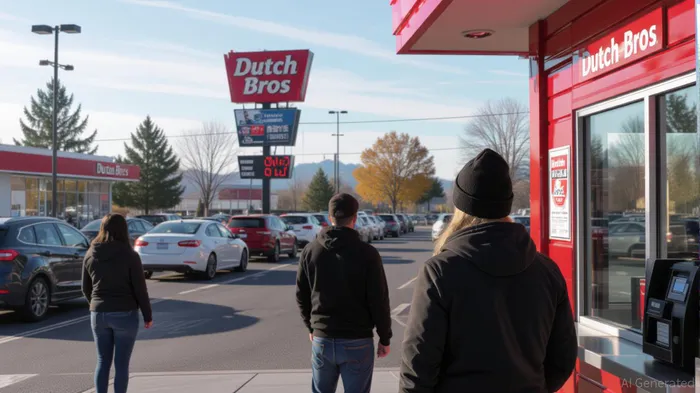
In the second quarter of 2025, Dutch Bros Inc.BROS-- (BROS) delivered a performance that turned heads in the quick-service beverage sector. Revenue surged 28% year-over-year to $415.8 million, with adjusted EBITDA jumping 37% to $89 million. Same-store sales growth of 6.1% system-wide and 7.8% for company-operated locations underscored the company's ability to drive transaction volume and customer loyalty. These results, coupled with a 18.84% premarket stock surge, have reignited debates about whether Dutch BrosBROS-- can replicate Starbucks' decades-long dominance in the coffee industry.
The Dutch Bros Model: Speed, Scale, and Stickiness
Dutch Bros' strategy hinges on three pillars: aggressive expansion, transaction-driven growth, and unit economics optimization. The company now operates 1,043 locations, with 725 company-owned shops and 318 franchised units. Its 2025 expansion plan—160 new stores—targets Sun Belt markets like Texas and Florida, where average unit volumes (AUVs) hit $2.05 million in Q2. This compares favorably to Starbucks' U.S. AUV of $1.8 million, despite Starbucks' 9,000+ U.S. locations.
Dutch Bros' “people-first” culture, where baristas are branded as “Broistas,” fosters a high-energy, personalized experience. The Dutch Rewards loyalty program now drives 72% of transactions, up from 66.7% in 2024, creating a flywheel effect of repeat visits. Meanwhile, digital initiatives like order-ahead (11.5% of transactions) and a planned 2026 consumer packaged goods (CPG) line aim to diversify revenue streams.
Starbucks' Legacy: Lessons and Lags
Starbucks' rise from 11 stores in 1971 to 38,000+ globally was fueled by its “third place” concept—a cozy, in-store experience that redefined coffee culture. Its historical revenue CAGR of 10.7% (2010–2024) masked recent struggles: 2024 saw a 2% global same-store sales decline, with China's 8% drop in average ticket sales exposing vulnerabilities in its premium pricing model.
Starbucks' recent “Back to Starbucks” strategy—focused on menu innovation and service speed—highlights its struggle to retain relevance among younger, on-the-go consumers. In contrast, Dutch Bros' drive-thru-centric model and $0.26 Q2 EPS (44% above estimates) suggest it's nimbly capturing this demographic.
Key Metrics: Dutch Bros vs. Starbucks
| Metric | Dutch Bros (Q2 2025) | Starbucks (2024) |
|---|---|---|
| Revenue Growth YoY | 28% | 0.56% |
| Same-Store Sales Growth | 6.1% (system-wide) | -2% (global) |
| Adjusted EBITDA Margin | 21.4% | 14.4% |
| Store Count | 1,043 | 38,000+ |
| EBITDA CAGR (2020–2025) | ~36% | ~7% |
Dutch Bros' financials tell a story of hypergrowth: its 37% EBITDA growth in Q2 outpaced Starbucks' 7% revenue growth for the year. However, Dutch Bros' P/E ratio of 172.5x and beta of 2.64 signal high volatility, contrasting with Starbucks' more stable valuation.
Risks and Realities
While Dutch Bros' metrics are impressive, scalability remains a question. Its aggressive expansion could strain unit economics if new stores underperform. Rising coffee costs (up 12% YoY) and ESG risks (ranked 433/436 in its industry) also pose challenges. StarbucksSBUX--, meanwhile, benefits from a diversified global footprint and a $1.8 billion cash balance, but its brand fatigue and labor costs (26.6% of revenue) are hurdles.
Investor Sentiment: Hype vs. Hurdles
Dutch Bros' stock surged 18.84% premarket after Q2 results, with analysts projecting $63–$92 price targets. However, its $10.36 billion market cap and 40% five-year revenue CAGR suggest investors are betting on a high-risk, high-reward trajectory. Starbucks, despite its recent struggles, retains a $65 billion market cap and a 58-year dividend streak, offering stability.
The Verdict: Can Dutch Bros Replicate Starbucks' Success?
Dutch Bros' Q2 performance demonstrates it has the tools to challenge Starbucks: a sticky loyalty program, efficient unit economics, and a culture that resonates with Gen Z. However, replicating Starbucks' global scale and brand equity will require navigating risks like market saturation and input cost pressures.
For investors, Dutch BrosBROS-- offers a compelling growth story but demands patience. Starbucks, while slower, provides a safer bet in a mature market. The key takeaway? Dutch Bros' model is scalable but not guaranteed. Its ability to balance expansion with profitability—and to address ESG concerns—will determine whether it becomes the next Starbucks or a cautionary tale of overhyped growth.
Investment Advice: Consider a diversified approach. Allocate a portion of your portfolio to Dutch Bros for its high-growth potential, but balance it with Starbucks' defensive characteristics. Monitor Dutch Bros' EBITDA margins and same-store sales trends closely, while keeping an eye on Starbucks' “Back to Starbucks” initiatives. The coffee wars are far from over, and the winner may depend on which strategy—speed or scale—resonates most with tomorrow's consumers.

Delivering real-time insights and analysis on emerging financial trends and market movements.
Latest Articles
Stay ahead of the market.
Get curated U.S. market news, insights and key dates delivered to your inbox.




Comments
No comments yet