
Dutch Bros Claims Top Spot in Market Volume Despite Sharp Turnover Decline and Earnings Caution
 Aime Summary
Market Snapshot
Dutch BrosBROS-- (NYSE: BROS) experienced a muted trading session on August 7, 2026, with the stock closing down 0.60% amid significantly reduced investor activity. The company recorded a trading volume of $0.38 billion, representing a sharp 56.08% decline from the previous day’s levels. Despite the contraction in turnover, BROS ranked first in total trading volume across the broader market for the day, suggesting that while participation from individual retail traders or smaller funds may have waned, institutional or high-volume entities remained the dominant force in determining price action. The stock’s performance came shortly after the release of its second-quarter 2026 earnings, which had initially sparked volatility. The slight dip in price reflects a market digesting the mixed signals from the earnings report: while top-line and bottom-line figures beat expectations, management’s revised guidance for the third quarter introduced an element of caution regarding near-term same-store sales growth.
Key Drivers
The primary catalyst for recent price action was Dutch Bros’ second-quarter 2026 earnings report, which delivered a complex narrative of strong financial execution tempered by cautious forward-looking statements. The company reported revenue of $550.85 million, surpassing the consensus estimate of approximately $525.4 million, and posted adjusted earnings per share of $0.33 against a consensus of $0.29. This beat was driven by a 32.5% year-over-year increase in revenue and a robust 8.3% rise in company-operated same-store sales. Management raised its full-year 2026 revenue guidance to a range of $2.1 billion to $2.13 billion and adjusted EBITDA guidance to $385 million–$390 million. These upward revisions underscored the company’s ability to scale operations effectively, with the CFO highlighting that the firm has secured approximately 90% of the pipeline required to reach its target of 2,029 shops by 2029. The acquisition of 44 new company-operated locations and the completion of a $63.5 million franchise acquisition in Phoenix further demonstrated aggressive expansion capabilities.
However, the positive earnings momentum was partially offset by a downward revision in third-quarter same-store sales estimates. Management lowered its Q3 same-store sales guidance to a range of 4%–5%, with the midpoint at 4.5%, which trailed the 5.3% consensus estimate. TD Cowen analyst Andrew M. Charles noted that this adjustment was primarily driven by harder year-over-year traffic comparisons and the lapse of a 1% price increase implemented in July 2025, rather than any deterioration in consumer demand or competitive pressure. The company also cited the anniversary of its recent food rollout, which may have inflated prior year’s comparable figures. This guidance miss contributed to the initial market volatility, as investors weighed the strong quarterly results against a potential slowdown in the immediate future.
Analyst sentiment remains broadly positive, with a consensus "Moderate Buy" rating and an average price target of approximately $77.15, implying significant upside from current levels. TD Cowen maintained its "Buy" rating with a $73 price target, citing stronger new shop productivity and better-than-expected company-operated same-store sales. Conversely, Royal Bank of Canada lowered its price target from $75 to $70, while Stephens reiterated its "Overweight" rating with an $80 target. This divergence highlights the debate surrounding the stock’s valuation, which trades at a premium with a price-to-earnings ratio above 100. Despite the high multiple, institutional ownership remains high at 85.54%, with major funds such as Marshall Wace LLP and Ninety One UK Ltd. increasing their stakes in recent quarters, signaling confidence in the long-term growth trajectory.
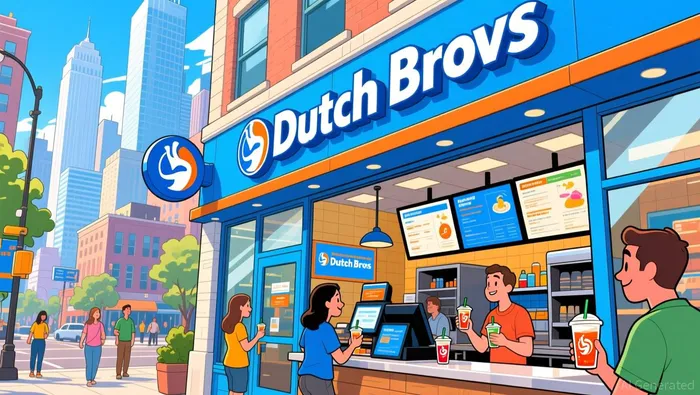
Operational improvements and strategic acquisitions are also key drivers underpinning the bullish case. The company’s "Dutch Rewards" loyalty program now accounts for 73% of transactions, and mobile orders represent 16% of the mix, providing a sticky customer base and valuable data for marketing. The successful rollout of food items to all company-operated stores has strengthened morning daypart sales, while the permanent addition of the "Myst" energy platform has diversified the menu. Furthermore, the agreement to acquire up to 65 former Salad and Go locations for $105 million offers Dutch BrosBROS-- with prime real estate to accelerate future openings in markets like Arizona, Nevada, Oklahoma, and Texas. These strategic moves are expected to enhance market penetration and drive system-wide same-store sales growth of 5%–6% for the full year.
Despite the positive fundamentals, some investors remain concerned about execution risks and cost pressures. Company-operated shop contribution margins declined slightly to 30.6% from 31.1% a year ago, due to higher coffee, food, and occupancy costs. Management expects about 60 basis points of cost-of-goods pressure and 50 basis points of occupancy pressure in 2026, which may squeeze margins despite anticipated sales leverage. Additionally, insider selling activity over the past three months, totaling approximately $243 million, has drawn attention, although these transactions were executed under pre-arranged 10b5-1 trading plans. While the stock faces near-term headwinds from guidance adjustments and valuation concerns, the long-term expansion strategy and strong brand engagement continue to attract institutional support.

Stay ahead of the market.
Get curated U.S. market news, insights and key dates delivered to your inbox.


AInvest
PRO
AInvest
PRO




Comments
No comments yet