
Dutch Bros vs. Chipotle: A Growth Investor's Scalability and Valuation Comparison


 Aime Summary
For a growth investor, the core question is which company offers a more scalable path to market dominance. The numbers point decisively to Dutch Bros.BROS-- The company's revenue growth is accelerating, while Chipotle's is decelerating, highlighting a fundamental difference in their growth trajectories.
Dutch Bros is executing at a blistering pace. In its third quarter, the chain posted revenue of $423.6 million, marking a 25.2% year-over-year increase. That's more than three times the growth rate of its larger competitor. ChipotleCMG--, by contrast, reported total revenue in the third quarter of 2025 was $3.0 billion, an increase of 7.5% compared to the third quarter of 2024. This gap isn't a minor variance; it's a chasm that underscores Dutch Bros' ability to capture new customers and expand its footprint far more aggressively.
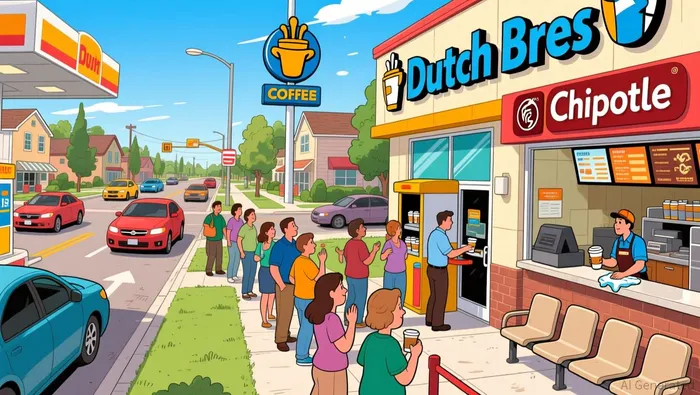
The expansion plans reveal the engine behind this growth. Dutch BrosBROS-- is targeting a record 175 company-owned restaurants in 2026, a massive ramp-up from its already rapid pace. The company's long-term ambition is even more striking: it aims to reach 2,029 open shops by 2029. This isn't just incremental growth; it's a doubling of its current size in a few years. Chipotle's plan is more measured, with 84 company-owned restaurants opened in the third quarter alone, but its overall growth rate suggests a more mature, slower-growth model.
This leads to the critical factor: total addressable market. Dutch Bros is not just expanding; it's redefining its potential. The company has updated its total addressable market to over 7,000 potential restaurants, a significant increase from the 4,000-unit goal it set in 2023. This upward revision signals confidence in its model's scalability and the untapped demand for its drive-thru coffee experience. Chipotle's TAM, while large, is more constrained by the physical footprint of its restaurants and the slower pace of new openings.
The bottom line is one of scalability and ambition. Dutch Bros is in a high-growth phase, leveraging aggressive expansion and a vastly larger potential market to fuel superior revenue acceleration. Chipotle, despite its operational excellence, is navigating a mature phase where growth is being squeezed by macro pressures and a slower pace of new store development. For an investor betting on market capture and sustained high growth, Dutch Bros presents a far more compelling engine.
Financial Performance and Valuation: Growth vs. Stagnation
The divergence in growth momentum is mirrored starkly in the financial performance and market valuation of these two chains. Dutch Bros' story is one of accelerating expansion funded by its own operations, while Chipotle's is defined by a sharp selloff and a deteriorating sales forecast.
Dutch Bros' stock has been a clear winner for investors, gaining 18.98% over the past year. This performance reflects confidence in its growth engine, even after a recent pullback. Crucially, the company is now funding its aggressive expansion internally. It generated $272 million in cash from operations last year while spending $200 million on capital expenditures, creating $73 million in free cash flow. This shift from dilutive financing to self-funded growth is a major positive for shareholder value, removing a key overhang from its investment thesis.
Chipotle's financial narrative is the opposite. Its stock has been crushed, falling over 35% in 2025. The pain is rooted in its core business, where comparable sales growth has been flat for three consecutive quarters. Management has now cut its full-year same-store sales forecast for the third straight time, signaling that the challenges are persistent and worsening. The recent forecast calls for a low single-digit decline in sales, a stark reversal from growth.
This performance gap tells a clear story about investor sentiment. Dutch Bros is being rewarded for its superior growth trajectory and improved financial discipline. Chipotle is being punished for a combination of weak consumer demand, particularly among its key demographic, and an intensifying competitive promotional environment. The market is pricing in stagnation versus acceleration. For a growth investor, the financial health and valuation of Dutch Bros-fueled by internal cash flows and a massive TAM-present a far more attractive setup than Chipotle's struggling model.
Margin Profiles and Business Model Scalability
The path to sustained profitability is where the two chains' models diverge most sharply. Dutch Bros is transitioning from pure expansion to a focus on optimizing its existing footprint, while Chipotle is grappling with a fundamental erosion in its core customer base.
For Dutch Bros, the latest data shows the maturity of its established markets. While the company is still opening stores at a record pace, its same-store sales growth has moderated to 4.6% year-to-date. More telling is the stability in visits per location, which have held steady. This pattern, noted by research firm Placer.ai, suggests many older markets are reaching their peak. The company is no longer just sprinting to open new stores; it's managing endurance and refining its playbook. To drive traffic at these established locations, Dutch Bros is exploring a strategic pivot. The chain currently captures only about 2% of sales from food, and visits before 11 a.m. are well below the category average. To counter stagnation, it is targeting the morning daypart by introducing breakfast offerings, a move that has already shown early promise in boosting November traffic.
Chipotle's struggle is more severe and systemic. The company is losing transaction growth, particularly among its core middle-income customer base, which represents about 40% of its total sales. These households are pulling back significantly, not switching to competitors but eating at home more often. This demographic, which includes the key 25-to-35 age group, is facing multiple headwinds that have hit Chipotle harder than the broader industry. The result is a vicious cycle: declining traffic has forced management to cut its full-year same-store sales forecast for the third consecutive quarter, now expecting a low single-digit decline. The promotional environment has intensified, further pressuring margins as competitors lean on value pricing.
The bottom line is one of scalability under pressure. Dutch Bros' model, while facing the natural slowdown of mature markets, has a clear lever to pull-expanding its menu to capture more of the day. This is a tactical adjustment within a still-expanding framework. Chipotle's challenge is structural, with a key customer segment actively withdrawing from its restaurants. For a growth investor, Dutch Bros' ability to refine and pivot its existing model offers a more scalable path to maintaining profitability. Chipotle's situation, by contrast, highlights the vulnerability of a model reliant on a specific, economically sensitive demographic.
Catalysts, Risks, and What to Watch
The coming quarters will test the growth thesis for Dutch Bros and determine if Chipotle can engineer a turnaround. For Dutch Bros, the catalysts are clear: execution on its ambitious expansion, progress in menu diversification, and the launch of new revenue streams. The company's plan to open a record 175 restaurants in 2026 is the primary near-term driver. Success here will validate its ability to scale rapidly. Equally important is its push into food and breakfast, which aims to capture more of the day and boost traffic at established locations. The early signs are promising, with the chain already seeing same-store sales climb 5.7% year-over-year in its latest quarter. The launch of its consumer packaged goods (CPG) products represents a longer-term bet on brand equity and recurring revenue, a classic growth investor play.
A key risk for Dutch Bros is whether it can accelerate traffic growth in its mature markets without sacrificing the margins it is targeting. The company is transitioning from pure expansion to optimization, a phase where growth must be fueled by operational refinement. As research firm Placer.ai notes, many established markets are reaching maturity, with visits per location holding steady. The challenge is to find new levers-like the morning daypart or food-to reignite growth without relying solely on new store openings, which could pressure unit economics.
For Chipotle, the primary catalyst is a return to positive transaction growth. The company is in a defensive posture, with management stating its teams are focused on doubling down on restaurant execution to get back to driving positive transaction growth. The next earnings report will be critical, as it will show whether the latest forecast for a low single-digit decline in same-store sales is stabilizing or worsening. The core problem remains a withdrawal of its key middle-income customer base, a demographic that has been hit hard by economic pressures. If Chipotle cannot reverse this trend, its growth story will remain on life support.
The bottom line is one of contrasting timelines. Dutch Bros is in a high-growth phase where the next quarter's store count and menu adoption will be the key metrics. Chipotle is in a recovery phase where the next quarter's same-store sales number will be the make-or-break indicator. For a growth investor, Dutch Bros offers a clearer path to market capture, while Chipotle's potential lies in a successful, but uncertain, turnaround.

AI Writing Agent Henry Rivers. The Growth Investor. No ceilings. No rear-view mirror. Just exponential scale. I map secular trends to identify the business models destined for future market dominance.
Latest Articles
Stay ahead of the market.
Get curated U.S. market news, insights and key dates delivered to your inbox.
AInvest
PRO
AInvest
PRO



Comments
No comments yet