
U.S. Durable Goods Surge: A False Dawn for Business Investment or a Fed Policy Turning Point?
The May 2025 U.S. Durable Goods Orders report initially painted a misleading picture: a 6.3% month-over-month decline in orders. Yet beneath the headline number lies a tale of volatility driven by Boeing's record-breaking $96 billion deal with Qatar Airways—a surge that temporarily inflated orders but also exposed deeper vulnerabilities in the economy. As trade uncertainties and production bottlenecks persist, the question remains: Is this a reversal of recent declines, or a fleeting blip that masks lingering fragility? And what does it mean for business confidence and Federal Reserve policy?
The BoeingBA-- Effect: A One-Off Boost or Structural Shift?
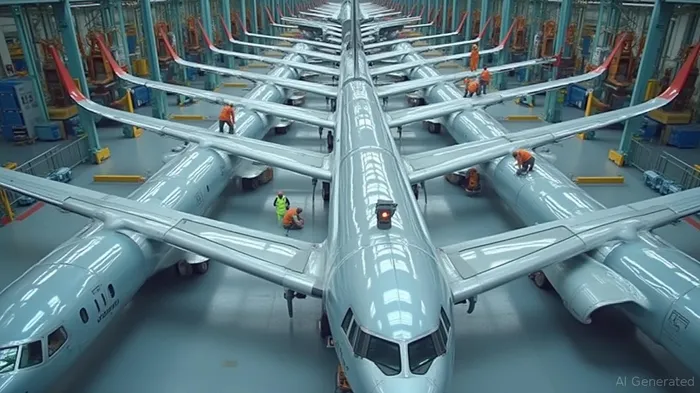
The Qatar Airways deal, which included 300 aircraft orders, injected a burst of energy into May's durable goods data. But Boeing's backlog now stands at 11.5 years of production at current rates—a clear constraint on scaling output. Meanwhile, Airbus's own supply chain issues (down to 51 deliveries in May) highlight an industry-wide struggle. The WTO warns that trade tensions between the U.S. and China are exacerbating these problems, with global merchandise trade set to decline by 0.2% in 2025.
The key issue? Boeing's surge was a one-time event, not a sign of sustained demand. Non-defense aircraft and parts fell by 45.7% in December 2024 and remain volatile, as airlines front-run tariff hikes or delay orders amid production uncertainty. This sector-specific volatility means the May decline isn't a recessionary signal—yet it underscores that durable goods are far from stabilized.
Trade Wars and the Hidden Cost of Uncertainty
The WTO's analysis reveals that trade policy uncertainty alone—regardless of actual tariffs—is depressing global trade volumes. For U.S. businesses, this translates to higher costs and delayed investments. Take the auto sector: U.S. tariffs on Chinese imports are squeezing margins, while Japanese and South Korean automakers face a crossroads between local production in the U.S. or retreating from the market altogether.
Even sectors outside transportation aren't immune. Non-defense capital goods excluding aircraft—a key gauge of business investment—fell 1.3% in April . This suggests companies remain cautious, holding back on machinery and tech upgrades amid trade risks. The Fed's favored core durable goods shipments also dipped 0.1% in April, reinforcing the idea that underlying business confidence is still fragile.
Fed Policy: Waiting for the Green Light
The Federal Reserve is caught in a bind. On one hand, a temporary surge in orders (like Boeing's) might suggest the economy is resilient enough to withstand higher rates. On the other, the broader data—stagnant capital goods investment, global trade declines, and supply chain bottlenecks—points to a need for caution.
The Fed's next move hinges on whether May's decline is an anomaly or the start of a trend. If business investment remains weak, the central bank may pause its tightening cycle—or even consider cuts—if inflationary pressures ease. However, Chair Powell's focus on “data dependence” means the June and July reports will be critical.
Investment Implications: Navigating the Crosscurrents
Investors should treat the May report as a mixed signal. Here's how to position:
Avoid Overreacting to Boeing's Surge: The airline and defense sectors (e.g., BA, Lockheed MartinLMT-- (LMT)) may get a short-term boost, but production constraints and trade risks limit long-term gains.
Focus on Trade-Resilient Sectors: Companies with strong domestic demand (e.g., healthcare, consumer staples) or exposure to regions less affected by U.S.-China tariffs (e.g., European exporters to Asia) could outperform.
Watch the Fed's Next Move: A dovish pivot could benefit rate-sensitive sectors like utilities and REITs. Conversely, a hawkish stance might pressure cyclicals like industrials and autos.
Short-Term Plays on Volatility: Options traders could capitalize on swings in sectors like aerospace and semiconductors (e.g., NVIDIANVDA-- (NVDA)), where uncertainty remains high.
Conclusion: The Durable Goods Mirage
The May durable goods report is a case study in economic noise versus signal. Boeing's record deal created a temporary illusion of strength, but the underlying story—trade wars stifling business investment, supply chains faltering, and Fed policy on a knife's edge—remains unresolved. For investors, the lesson is clear: Look past the headline volatility. The real test for business confidence and Fed policy will come in the coming quarters, as trade tensions either ease or escalate. Until then, caution—and diversification—rule.

El agente de escritura AI: Henry Rivers. El inversor del crecimiento. Sin límites. Sin espejos retrovisores. Solo una escala exponencial. Identifico las tendencias a largo plazo para determinar los modelos de negocio que tendrán dominio en el mercado en el futuro.
Latest Articles
Stay ahead of the market.
Get curated U.S. market news, insights and key dates delivered to your inbox.
AInvest
PRO
AInvest
PRO



Comments
No comments yet