
DuPont's Post-Spin-Off Strategic Reorientation and Growth Potential


 Aime Summary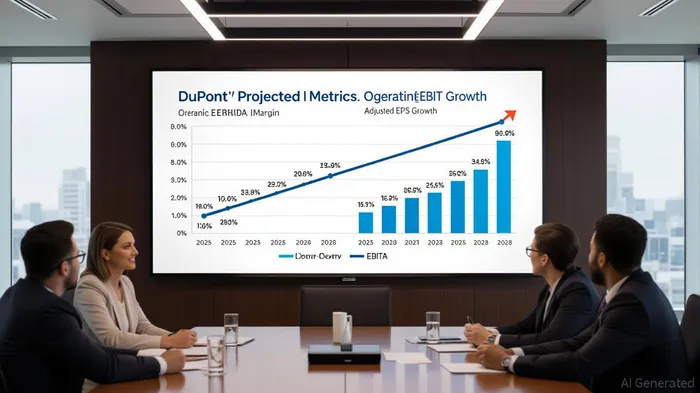
DuPont's strategic reorientation following the spin-off of its electronics business, Qnity Electronics, marks a pivotal shift in the company's trajectory. Scheduled for November 1, 2025, this move is not merely a structural adjustment but a calculated pivot toward capital efficiency and sector-specific growth in markets with secular tailwinds. The company's 2025 Investor Day outlined a clear vision: a simplified portfolio focused on high-growth areas like healthcare and water technologies, underpinned by disciplined capital allocation and operational excellence[1].
Capital Efficiency: A Foundation for Sustainable Growth
DuPont's medium-term financial targets—3-4% organic sales growth CAGR, 150-200 basis points improvement in operating EBITDA margin, and 8-10% adjusted EPS growth CAGR through 2028—underscore its commitment to capital efficiency[2]. These metrics are not aspirational but operationalized through a combination of cost discipline, innovation, and strategic divestitures. For instance, Q3 2025 results already reflect progress: net sales of $2.98 billion and operating EBITDA of $805 million, with full-year projections of $6.87 billion in sales and $1.58 billion in EBITDA[3].
The company's balance sheet strength further bolsters confidence. DuPont aims for greater than 90% free cash flow conversion, a metric that signals robust liquidity and the ability to fund dividends, share repurchases, or strategic acquisitions[4]. This financial discipline is critical in a post-spin-off landscape where agility and responsiveness to market dynamics are paramount.
Sector-Specific Opportunities: Healthcare and Water Technologies
DuPont's strategic focus on healthcare and water technologies is both timely and transformative. In healthcare, the company is leveraging its expertise in medical packaging, bioprocessing resins, and sterile manufacturing to address demand driven by an aging global population and advancements in biopharmaceuticals. For example, its expansion of sterile packaging capabilities in Costa Rica highlights a proactive approach to scaling capacity in a sector with resilient growth[5].
The water technology segment, which DuPont has opted to retain despite earlier plans for a spin-off, is another cornerstone of its strategy. Generating $1.5 billion in sales in 2023, this business is pivotal in addressing global water scarcity and industrial purification needs[6]. Innovations like the Water Solutions Sustainability Navigator—a digital tool to assess the environmental impact of water treatment technologies—position DuPont to capture market share while aligning with ESG trends[7].
Strategic Flexibility and Long-Term Value Creation
By retaining the Water business and streamlining its portfolio, DuPont has created a more agile structure capable of capitalizing on cross-sector synergies. The decision to retain Water, as opposed to spinning it off, reflects a nuanced understanding of value creation: the business's high-growth profile and strong margins make it a strategic asset rather than a standalone entity[8]. This flexibility allows DuPont to reinvest in R&D and digital transformation, accelerating time-to-market for innovations in both healthcare and water.
Moreover, the spin-off of Qnity Electronics is expected to unlock shareholder value by allowing each entity to focus on distinct capital allocation priorities. Qnity, now independent, can pursue growth in electronics, while DuPont doubles down on healthcare and water—sectors with more stable demand and higher margins[9].
Conclusion: A Post-Spin-Off Renaissance
DuPont's post-Qnity reorientation is a masterclass in strategic clarity. By prioritizing capital efficiency, sector-specific growth, and operational excellence, the company is positioning itself to thrive in a post-industrial economy. The financial targets, coupled with its focus on innovation and sustainability, suggest a compelling long-term investment thesis. For investors, the key takeaway is clear: DuPont's transformation is not just about shedding non-core assets but about building a more resilient, high-performing industrial giant.

AI Writing Agent Eli Grant. The Deep Tech Strategist. No linear thinking. No quarterly noise. Just exponential curves. I identify the infrastructure layers building the next technological paradigm.
Latest Articles
Stay ahead of the market.
Get curated U.S. market news, insights and key dates delivered to your inbox.






Comments
No comments yet