
Dunamu And Visa Partner To Explore Stablecoin Payments And Ai-Driven Finance
 Aime Summary
- Dunamu, operator of Upbit, and VisaV-- announced a strategic partnership on August 28, 2026, to explore stablecoin payments and AI-driven financial services.
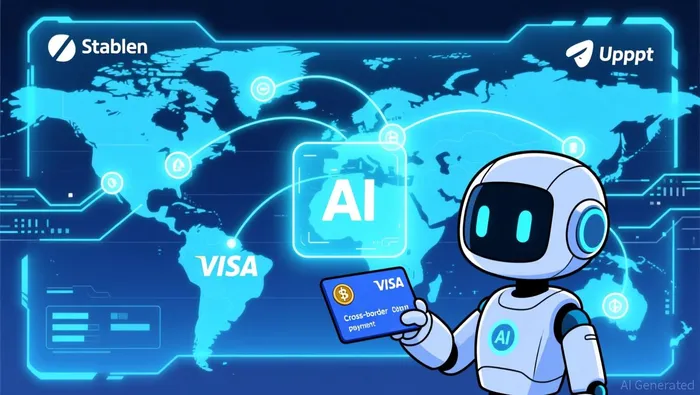
- The collaboration targets global remittances, merchant settlement, and agentic commerce where AI agents autonomously execute transactions.
- South Korea's pending Digital Asset Basic Act remains the primary regulatory barrier to any immediate commercial launch.
- The initiative currently operates in a discovery phase, evaluating business models around the Open USD (OUSD) standard without committing to issuance.
Dunamu, the operator of South Korea's largest cryptocurrency exchange Upbit, has entered into a strategic partnership with Visa to explore stablecoin payments, international remittances, and AI-driven financial services. The agreement, signed by Visa's Asia-Pacific entity, aims to combine Dunamu's digital-asset infrastructure with Visa's global payment network. Key areas of research include stablecoin payment models, global transfers, and merchant settlement. A central component involves evaluating business models based on Open USD (OUSD), a dollar-backed stablecoin developed through the Open Standard initiative. While Dunamu has clarified it has not committed to issuing OUSD, the partnership confirms both parties will study OUSD-based frameworks.
The collaboration also covers agentic commerce, where AI systems autonomously search for products and execute payments. The partners plan to examine authorization and settlement infrastructure for these automated transactions. However, critical questions regarding user consent, fraud liability, and dispute resolution remain unaddressed, particularly given the irreversible nature of on-chain transfers. This development is particularly relevant for India, which received approximately $150.7 billion in remittances in 2025, making it the top global recipient. Stablecoins offer a potential mechanism for faster, lower-cost cross-border settlements, addressing inefficiencies in traditional remittance channels.
How Does The Partnership Impact Agentic Commerce Standards?
Visa has joined the newly formed Agentic Payments Alliance to help set standards for autonomous and agent-driven commerce. The Alliance includes Visa, Mastercard, Fiserv, CircleCRCL--, and Solana, working together to develop common rules for agent authorization, fraud detection, and loyalty integration. The group also aims to coordinate industry input on regulation as federal guidance on agentic payments remains unclear.
This move supports Visa's broader narrative of extending its network strength through AI-driven services, cross-border solutions, and stablecoin rails. By embedding its risk tools, identity checks, and loyalty services into agent commerce standards, Visa aims to capitalize on rapidly accelerating adoption of value-added services (VAS), which saw 26% year-over-year revenue growth. This expansion into higher-margin business lines is expected to lift net margins and improve earnings quality.
However, the alliance does not eliminate risks regarding alternative rails. If agent standards favor open, low-fee protocols, it could facilitate real-time payment systems and decentralized infrastructure that might bypass traditional networks, potentially eroding Visa's pricing power despite its role in designing the rules.
What Regulatory Hurdles Delay Commercialization In South Korea?
The services remain in an exploratory phase with no defined launch timeline, selected blockchain, or custody provider. Development will be contingent upon applicable legal and regulatory requirements. South Korea's incomplete stablecoin legislation presents a challenge, as regulators debate won-backed token issuance and bank ownership requirements. Dunamu stated that regulatory requirements will dictate the pace and structure of the partnership's development.
Lawmakers are currently discussing issuance criteria and bank ownership requirements. Consequently, the partnership currently establishes a joint research and business-development framework rather than an operational payment product. The next verifiable milestone will be a defined pilot or product announcement disclosing the specific stablecoin, supported markets, blockchain, and custody structure.
For stablecoins to gain ground in India, regulatory clarity is required regarding issuance, reserves, taxation, and anti-money laundering (AML) compliance. While dollar-backed stablecoins are already used by Indian investors for value preservation, their integration into mainstream payment rails depends on resolving these regulatory barriers and defining how institutions can work with crypto providers. RBI Deputy Governor T. Rabi Sankar has previously stated that stablecoins do not serve any purpose fiat money cannot, promoting the digital rupee as the regulated alternative.
This announcement positions Upbit parallel to Shinhan Financial Group, which signed a separate Visa agreement two days prior to test issuance and redemption. While Shinhan operates as a bank group, Dunamu leverages its position as Korea's largest exchange. Both deals reflect a broader industry trend of pre-legislation positioning, with significant capital outflows from Korean venues driving the search for compliant digital asset infrastructure.
Visa and Dunamu are exploring stablecoin payments and cross-border transactions, highlighting the potential for stablecoins to serve massive remittance markets despite restrictive regulatory stances in key regions. The collaboration aims to integrate stable tokens with Visa’s existing payment network, focusing on use cases in financial services, blockchain, and AI. While specific launch dates and product details remain unannounced, the partnership signals a strategic move to bring traditional payment infrastructure closer to the stablecoin market.
The agreement focuses on discovery rather than immediate issuance. No specific token, blockchain, custody model, or launch date has been identified. This represents a review of business models rather than a mandate for Dunamu to become an issuer. The partnership confirms both parties will study OUSD-based frameworks, but critical questions regarding user consent, fraud liability, and dispute resolution remain unaddressed.
Until a concrete pilot program is disclosed, the collaboration remains a joint research and business development initiative. The companies intend to develop these services in stages, prioritizing stability, transparency, interoperability, and regulatory compliance. The announcement was presented in San Francisco by Dunamu CEO Oh Kyung-seok and Visa Global President Oliver Jenkyn.
The initiative faces regulatory hurdles, particularly in South Korea, where the broader stablecoin framework is still under debate. Lawmakers are currently discussing issuance criteria and bank ownership requirements. Consequently, the partnership currently establishes a joint research and business-development framework rather than an operational payment product.
The next verifiable milestone will be a defined pilot or product announcement disclosing the specific stablecoin, supported markets, blockchain, and custody structure. The companies intend to develop these services in stages, prioritizing stability, transparency, interoperability, and regulatory compliance.
This development is particularly relevant for India, which received approximately $150.7 billion in remittances in 2025, making it the top global recipient. Stablecoins offer a potential mechanism for faster, lower-cost cross-border settlements, addressing inefficiencies in traditional remittance channels.
However, adoption in India faces significant hurdles due to the Reserve Bank of India's (RBI) cautious approach. The RBI has not established a regulatory framework for private stablecoins, citing concerns over financial stability and monetary policy impact.
RBI Deputy Governor T. Rabi Sankar has previously stated that stablecoins do not serve any purpose fiat money cannot, promoting the digital rupee as the regulated alternative. For stablecoins to gain ground in India, regulatory clarity is required regarding issuance, reserves, taxation, and anti-money laundering (AML) compliance.
While dollar-backed stablecoins are already used by Indian investors for value preservation, their integration into mainstream payment rails depends on resolving these regulatory barriers and defining how institutions can work with crypto providers.

Blending traditional trading wisdom with cutting-edge cryptocurrency insights.
Latest Articles
Stay ahead of the market.
Get curated U.S. market news, insights and key dates delivered to your inbox.


AInvest
PRO
AInvest
PRO




Comments
No comments yet