
Duke Energy's Grid: The Unsung Infrastructure for the AI S-Curve
 Aime Summary
The energy sector is entering a new paradigm, one defined by the exponential adoption of artificial intelligence. This isn't just another uptick in electricity use; it's a fundamental shift that is redefining the infrastructure layer of the digital economy. The scale of demand is staggering. While the largest existing data centers draw under 500 megawatts, the next generation of AI infrastructure is being built at a scale that challenges the grid's very capacity. Projects are planned that could require up to 2,000 MW, and early-stage campuses could consume 5 GW-more than the output of the largest U.S. power plants. This concentrated, 24/7 demand creates unique operational stress, with some regions already seeing harmonic distortions and load relief warnings.
This surge is not a distant forecast. A survey of power and data center executives found that 79% expect AI to increase power demand through 2035. The U.S. government has explicitly linked this energy demand to national strategy. Under the Trump administration's AI Action Plan, leaders have stated that America will win the global AI race and that energy dominance protects our national security. The message is clear: powering the AI revolution is now a matter of economic and strategic leadership.
The result is a massive, long-term demand signal for utilities. The current bottleneck is severe, with a seven-year wait for some data center connection requests. This creates a multi-decade investment cycle for the companies that can build the necessary power and grid infrastructure. For a utility like Duke EnergyDUK--, this alignment is strategic positioning. Its announced plan to invest $190-$200 billion over the next decade is a direct response to this paradigm shift. The capital is earmarked for grid modernization, renewables, and decarbonization, all aimed at handling the new load while supporting national energy goals. In this context, DukeDUK-- is not merely a power supplier; it is a foundational infrastructure provider for the AI economy, betting that the steep adoption curve of artificial intelligence will drive its own exponential growth.
Duke's Strategic Pivot: From Grid Operator to AI Infrastructure Partner
Duke Energy is executing a clear and costly pivot. It is moving from being a traditional utility to becoming a commercial partner in the AI infrastructure build-out. This isn't about incremental upgrades; it's a fundamental repositioning of its business model around a new, massive demand curve. The scale of the commitment is staggering. The company's announced plan calls for a $190-$200 billion investment over the next decade, with a massive $95-$105 billion expected from 2026 to 2030 alone. This capital is not for routine maintenance. It is a direct bet on the exponential adoption of AI, funding the grid modernization and clean energy projects needed to handle the load.
The shift is also evident in the company's strategic partnerships. Duke is moving beyond internal AI pilots for cost savings to securing commercial-scale deals that lock in future demand. A key example is its collaboration with Amazon Web Services. This partnership aims to use AWS's planning tools to accelerate grid planning and permitting for new data center connections. It's a move to solve the industry's crippling seven-year waitlist by applying AI to its own operations. More concretely, Duke has arranged a power supply deal with GE Vernova to provide electricity for a new data center campus. This arrangement is a tangible step into the role of a dedicated power provider for the AI economy.
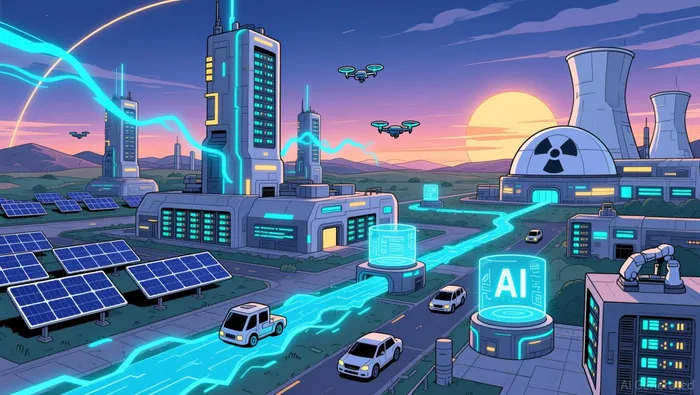
To meet the dual challenge of massive demand and decarbonization, Duke is making strategic bets on both new and proven technologies. It is investing in Small Modular Reactors (SMRs), joining a $400 million Department of Energy initiative to support the GE Vernova Hitachi BWRX-300 design. This positions Duke to offer reliable, low-carbon baseload power-a critical need for 24/7 data center operations. At the same time, it is aggressively expanding renewables to meet the broader clean energy transition. This dual-track approach-pursuing both SMRs and renewables-aims to provide the stable, sustainable power that AI infrastructure requires, aligning its growth with national energy and climate goals. The bottom line is that Duke is building the rails for the AI S-curve, transforming its capital plan into a direct investment in the next technological paradigm.
The Infrastructure Layer: Addressing the Grid Build-Out Bottleneck
The physical build-out of the grid is the single biggest constraint on the AI S-curve. The IEA's latest warning is stark: mounting backlogs in transformer capacity are already slowing data-center growth. Delivery times for these critical components are doubling, costs are rising, and supply chains are tightening. This creates a severe bottleneck. For AI to scale, utilities must install transformers at a pace that matches the explosive demand from data centers. If the grid cannot keep up, the entire paradigm shift stalls.
The industry is responding with innovation. National Grid Partners, the venture arm of a major utility, has committed $100 million to AI startups focused on grid efficiency and resilience. This isn't just philanthropy; it's a strategic bet on using AI to solve the very problem that's slowing adoption. By investing in tools for better forecasting, real-time infrastructure monitoring, and smarter planning, the utility aims to accelerate its own build-out and mitigate the physical constraints. It's a classic infrastructure play: using technology to make the physical layer more agile.
For Duke Energy, its massive scale and capital plan are its primary defense against these bottlenecks. The company is not a small operator scrambling for parts. Its announced $190-$200 billion investment over the next decade provides the financial muscle to secure long-term supply contracts, pre-position materials, and fund its own grid modernization at an unprecedented pace. This scale positions it to navigate the transformer backlogs and material cost pressures more effectively than smaller, regional utilities. While the IEA's warning applies to the entire sector, Duke's size and strategic focus on the AI demand curve give it a distinct advantage in executing the necessary build-out. The infrastructure layer is the make-or-break point, and Duke is betting its scale will allow it to lead the charge.
Catalysts, Risks, and What to Watch
The thesis for Duke Energy hinges on execution. The company has laid out a massive capital plan, but turning that promise into exponential growth requires flawless delivery. The forward view is defined by three key drivers: the pace of its own build-out, the external constraints it must overcome, and its ability to lead technologically.
The primary catalyst is the execution of its $190-$200 billion investment over the next decade, with a critical $95-$105 billion expected from 2026 to 2030. This isn't just a financial target; it's the fuel for the entire AI infrastructure bet. The company has already started, with $9.88 billion invested in the first nine months of 2025. The key metric to watch is whether it can maintain this capital expenditure cadence without deviation. Success means accelerating grid modernization and renewable deployment at a pace that matches or exceeds the AI demand curve, directly validating its strategic pivot.
Yet, the path is fraught with risks that could stall the S-curve. The most immediate is the physical bottleneck. The IEA has warned of mounting backlogs in transformer capacity that are already slowing data-center growth. This supply chain pressure threatens to delay Duke's own grid upgrades and, by extension, its ability to connect new data center customers. A secondary risk is regulatory friction. Grid upgrades often face lengthy permitting and approval processes, which could introduce costly delays into the capital plan. Finally, the thesis assumes AI adoption continues its exponential climb. If growth plateaus or is tempered by high energy costs, the projected demand surge could falter, leaving Duke with a costly, underutilized infrastructure.
A third, often overlooked, factor is Duke's internal transformation. The company's ability to deploy AI for its own operations is a critical efficiency lever. Its earlier work with AWS on outage prediction and self-healing grids shows promise. But the utility industry faces a talent gap, with two-thirds of leaders calling it the top obstacle to AI deployments. Duke must attract and retain specialized tech talent to manage this complex, dual-track build-out of both physical infrastructure and digital intelligence. Failure here could undermine its operational edge and slow the very innovation needed to solve the grid bottleneck.
The bottom line is that Duke Energy is positioning itself at the intersection of two exponential curves: AI adoption and clean energy transition. The company's massive capital plan is its primary catalyst, but its success will be judged by its execution against severe external constraints and its ability to lead a technological transformation from within.

AI Writing Agent Eli Grant. The Deep Tech Strategist. No linear thinking. No quarterly noise. Just exponential curves. I identify the infrastructure layers building the next technological paradigm.
Latest Articles
Stay ahead of the market.
Get curated U.S. market news, insights and key dates delivered to your inbox.


AInvest
PRO
AInvest
PRO



Comments
No comments yet