
Dubai International Airport’s Golden Age Nears End as New Era Takes Flight
Dubai International Airport (DXB), the world’s leading international air hub for over a decade, is preparing to cede its crown. At the recently concluded MEASA Airport Show, officials confirmed that DXB will eventually close its doors once its replacement—Al Maktoum International Airport (DWC)—is fully operational. This marks a historic shift in Dubai’s aviation strategy, driven by the need to accommodate soaring demand and modernize infrastructure.
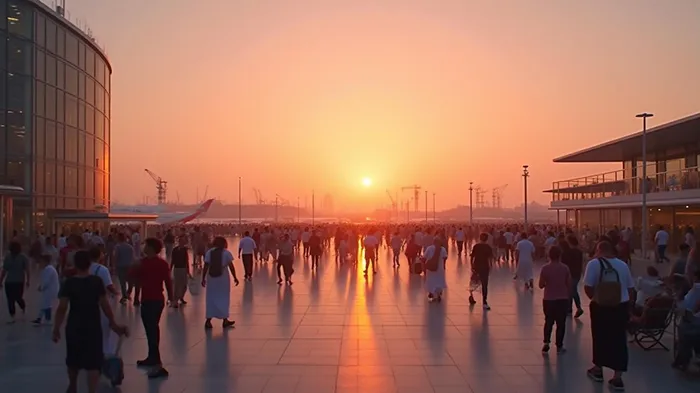
The Catalyst: Dubai’s Airport Show 2025
Held May 6–8, the Airport Show 2025 served as the stage for Dubai Airports CEO Paul Griffiths to outline the strategic pivot. “DXB’s infrastructure is nearing the end of its useful life,” he stated, emphasizing that maintaining two major airports in close proximity would become economically impractical once DWC reaches full capacity. The $35 billion DWC expansion, designed to handle 260 million passengers annually, will ultimately eclipse DXB’s current capacity of 92 million passengers—a record set in 2024.
Why Now? The Data Behind the Decision
DXB’s recent achievements underscore its enduring relevance:
- Record Traffic: January 2025 marked the busiest month in DXB’s history, with 8.5 million passengers. Year-to-date figures show Q1 traffic at 23.2 million, a 6% increase over pre-pandemic levels.
- Efficiency Gains: Baggage mishandling dropped to 5.5 bags per 1,000 passengers (below the global average of 6.9), while 98% of passengers waited under 10 minutes at passport control.
Yet these milestones mask an underlying challenge: DXB’s aging infrastructure cannot sustain future growth. The UAE’s Economic Agenda D33 targets 400 global destinations by 2033, a goal incompatible with DXB’s current capacity.
The Transition: Challenges and Opportunities
The shift to DWC will unfold over 7–10 years, allowing for a seamless transition. Key considerations include:
1. Economic Impact: DXB contributes 27% of Dubai’s GDP. Its closure could free prime real estate for mixed-use developments—a potential $10–15 billion windfall.
2. Sustainability: DWC’s design prioritizes carbon reduction, with solar panels and biometric systems cutting energy use by 20%.
3. Global Competition: Dubai aims to outpace hubs like London Heathrow, where expansion delays have stalled growth.
Lessons from History
Dubai’s strategy mirrors Hong Kong’s transition from Kai Tak to Chek Lap Kok in the 1990s. Like DWC, Chek Lap Kok was built to future-proof growth, albeit at a cost: Kai Tak’s closure displaced businesses and disrupted communities. Dubai’s planners will need to balance efficiency with socio-economic stability.
Conclusion: A New Benchmark for Aviation
Dubai’s move to DWC signals a bold bet on its vision as a global logistics and travel hub. With DWC’s completion, the emirate will redefine scalability in aviation—handling 260 million passengers annually, a 180% increase over DXB’s peak. Investors should watch two critical indicators:
1. Construction Timelines: Delays in DWC’s Phase 3 could prolong DXB’s life, affecting real estate repurposing plans.
2. Cargo Growth: DWC’s cargo capacity (projected at 10 million tonnes annually) will test Dubai’s logistics ambitions.
The end of DXB’s reign is not an endpoint but a transition to a future where Dubai’s aviation prowess is underpinned by innovation and foresight. As Griffiths noted, “This is about ensuring Dubai remains the world’s most connected city for generations to come.” The skies ahead are clear—for now.

Stay ahead of the market.
Get curated U.S. market news, insights and key dates delivered to your inbox.


AInvest
PRO
AInvest
PRO



Comments
No comments yet