
Dubai Creek Gardens' "70% Open Space" Is a Marketing Number — and There's No Stock Behind It
 Aime Summary
The headline does its job: a new residential district on Dubai Creek will set aside roughly 70% of its land for landscaped gardens and open space, ringed by apartments carrying the Westin and Renaissance names. In a skyline market built on towers, that is a deliberate scarcity pitch. Read the small print, though, and the more useful finding appears: the developer is a privately held fund manager, the project is financed through a closed-end fund, and there is no publicly traded security — no ticker, no chart, no way for a U.S. retail investor to buy a slice on an exchange. The 70% figure is a real project feature. Whether anyone outside the fund's investor base can own the story behind it is a different question.
Who is actually building this
The developer is Global Partners, a fund manager regulated by the Dubai Financial Services Authority. Dubai Creek Gardens is its second property fund in the UAE: Global Partners has raised more than US$300 million for the vehicle that will deliver the district. The money is not new to the game either — Fund I already handed over one project, Eden House The Canal, and is still working on another, Eden House The Park. In other words, this is a repeat operator recycling one build-and-sell model into a new, larger site, not a first-time landowner testing the market.
The district sits in Al Jaddaf, near Dubai Creek and healthcare infrastructure, and is built around low-rise, one-to-three-bedroom apartments. The branding is the part aimed at buyers: these will be the first residential towers in the UAE carrying the Westin and Renaissance hotel names. Branded residences — putting a hotel group's name on private condos and running them with hotel-style services — are the mechanism by which a developer tries to justify a premium per square foot over an identical un-branded unit. The open space is part of the same logic: fewer towers and more greenery per hectare means fewer, scarcer units, each capable of asking a higher price. The marketing claims an "urban forest" concept with tree-canopy cooling, which is shorthand for a developer selling a low-density lifestyle rather than raw tower volume.
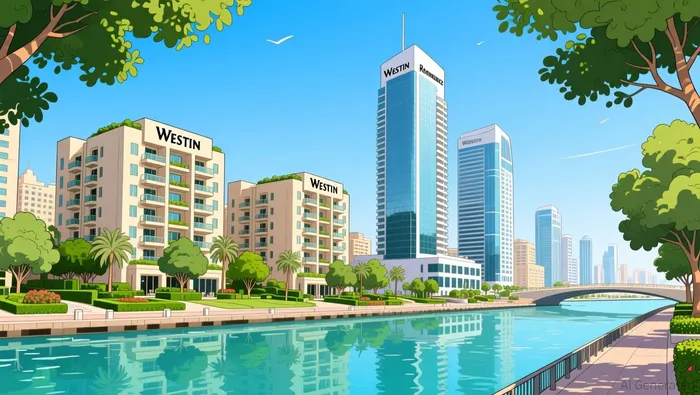
What the 70% actually buys the developer
That is the core of the business model, and it is worth separating from the hype. A masterplan of roughly 127,000 square meters with 70% given to gardens does not yield many apartments — which is exactly the point. Scarce supply keeps each unit's asking price defensible in a market where tens of thousands of off-plan units are launched every year. The branded-name and the greenery are both attempts to let the developer charge a green-and-brand premium and pre-sell units off-plan, meaning buyers commit money before construction finishes and carry the construction risk in exchange for a hoped-for lower entry price.
But a premium ask only holds if end buyers will pay it, and that is where the Dubai market's own tape matters. Housing-market observers described growth moderating in 2026 even while population growth and end-user demand kept a floor under prices. Reuters reported in March that Dubai's property market showed early signs of weakness, with analysts warning a regional conflict could accelerate a correction even as transactions continued. Off-plan sales are a heavy share of the flow — recent market updates put them at roughly three-quarters of transactions in a month like May. A project whose economics rest on pre-selling premium, low-density units is therefore a forward bet twice over: that Dubai prices keep rising, and that off-plan buyers keep committing during construction.
What a U.S. retail investor can actually do with this
Here is the honest answer, and it is the reason this headline should not be treated as an investment lead. You cannot buy Dubai Creek Gardens, and you cannot buy its developer. Global Partners' vehicle is a closed-end fund for its own investors, not an exchange-traded security, and a private fund manager has no public shares. Clicking through to a "register interest" page is registering to buy an apartment in a foreign jurisdiction as an off-plan end-buyer — a very different transaction from owning a stake, with price risk, construction risk, currency risk, and nothing you can sell in a liquid market on a moment's notice.
For a U.S. retail investor who is curious about the Dubai theme rather than about this specific tower, the useful discipline is to check what is actually tradeable before believing any unit-count or open-space statistic. The variables that will decide whether a project like this holds its premium are the same ones to watch for exposure generally: the pace of Dubai off-plan handovers versus headline launches, the direction of recorded resale prices, and whether geopolitical risk in early 2026 turns a moderating market into a correcting one.
Treat the 70% figure as what it is — a scarcity story designed to justify a premium on private, off-plan units inside a closed-end fund. It is not a tradeable signal. If the Dubai property cycle is what interests you, that is a thesis you can research and evaluate through investable channels with their own fees and risks; this particular condo cannot become your trade either way.

Stay ahead of the market.
Get curated U.S. market news, insights and key dates delivered to your inbox.


AInvest
PRO
AInvest
PRO




Comments
No comments yet