
DTE Energy's Strategic Shift: Assessing Valuation and Growth Amid $1.8B Grid and Solar Investment
 Aime Summary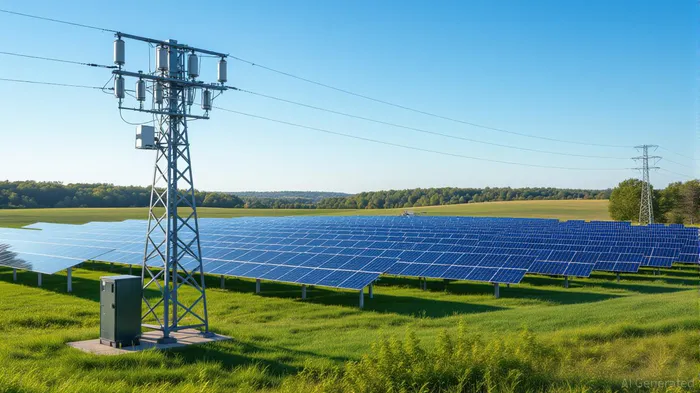
DTE Energy (NYSE: DTE) has unveiled a $1.8 billion investment in grid modernization and solar energy projects, signaling a bold pivot toward the energy transition. However, the company's Q2 2025 earnings report—marked by a 4.9% decline in operating EPS to $1.36 and a $999 million revenue drop—raises critical questions: Does this strategic shift justify DTE's current valuation premium, and can its long-term growth potential offset near-term earnings volatility?
Earnings Context: A Transient Setback or Structural Weakness?
DTE's Q2 performance reflects the challenges of transitioning from a fossil-fuel-dependent utility to a clean-energy leader. While its core DTE Electric segment delivered $318 million in earnings—driven by rate base expansion and operational efficiency—its DTE VantageVNTG-- renewable division nearly doubled operating earnings to $31 million, buoyed by Inflation Reduction Act (IRA) tax credits. Conversely, DTE Gas and Energy Trading underperformed, with earnings declining to $6 million and $24 million, respectively.
The corporate segment reported a $96 million loss, primarily due to rising operational and maintenance (ONM) costs. Yet, DTE's full-year operating EPS guidance of $7.09–$7.23 remains intact, reflecting confidence in its capital allocation strategy. With a $30 billion five-year plan focused on solar (3,200 MW), wind (1,000 MW), and battery storage (430 MW), the company is betting on regulatory alignment and demand growth.
Historical data reveals that DTE's earnings misses have historically been followed by positive short-term performance. From 2022 to the present, investors who bought DTE following an earnings miss achieved a 100% win rate across all time frames (3-day, 10-day, and 30-day), with the most significant gains—7.64%—realized within 30 days. This suggests that while near-term earnings volatility may occur, the market has historically rewarded buy-and-hold strategies post-earnings misses, aligning with DTE's long-term strategic narrative.
Strategic Investments: Aligning with Policy and Market Trends
DTE's grid modernization efforts, including $10 billion in infrastructure upgrades, aim to integrate intermittent renewables while reducing outage durations by 75% since 2023. The company's Infrastructure Recovery Mechanism (IRM) will expand from $290 million in 2025 to $1 billion by 2029, ensuring cost recovery for grid investments.
Equally compelling is DTE's pivot toward data centers. With 3 GW of new load expected by 2032, the utility is positioning itself to capitalize on surging demand from hyperscalers. These partnerships could provide a hedge against slower residential electrification and unlock incremental revenue streams.
Valuation Analysis: A Premium for Future-Proofing?
DTE's trailing P/E ratio of 18.56 and PEG ratio of 3.34—both above 10-year averages—suggest a valuation premium. While this appears high relative to its 6–8% earnings growth guidance, it reflects market recognition of DTE's strategic alignment with decarbonization mandates and data center growth.
Compared to peers, DTE's P/E of 19.8x is below the peer average of 22.9x but above the industry average of 17.8x. Its elevated debt-to-equity ratio (1.97) raises leverage concerns, yet the company's $3.3 billion projected 2025 operating cash flow supports its $4.9 billion capex plan. Minimal equity issuance through 2027 further preserves financial flexibility.
Long-Term Growth Potential: Can the Energy Transition Deliver?
DTE's $30 billion capital plan is designed to future-proof its infrastructure against decarbonization mandates. With 18,000 MW of renewable capacity targeted by 2042 and IRA tax credits extending through 2029, the company is well-positioned to benefit from federal incentives. Analysts project 6–8% operating EPS growth through 2028, with a dividend yield expected to rise to 3.7% by 2028.
The data center segment adds another layer of upside. DTE's 3 GW of contracted load—potentially growing to 7 GW—aligns with Michigan's status as a top IRA-funded state. This demand could accelerate its renewable and storage deployment, creating a virtuous cycle of rate base growth and earnings expansion.
Risks and Mitigants
Regulatory delays in rate recovery and rising ONM costs remain key risks. DTE is mitigating these through performance-based incentives tied to grid reliability and cost-of-service adjustments. Additionally, its disciplined dividend policy (60% payout ratio) provides stability in a sector prone to regulatory uncertainty.
Investment Implications
DTE's valuation premium may appear steep today, but it reflects a strategic bet on long-term growth. For investors with a 5–10 year horizon, the company's alignment with clean energy mandates, data center demand, and IRA incentives justifies the current valuation. However, near-term earnings volatility and leverage risks suggest a patient, long-duration approach.
Final Verdict: DTE Energy's strategic shift toward grid modernization and renewables is a high-conviction play for those seeking exposure to the energy transition. While the earnings dip and PEG ratio highlight short-term challenges, the company's long-term growth levers—policy tailwinds, data center partnerships, and IRA incentives—position it to deliver durable value. Investors who can tolerate near-term volatility may find DTE's valuation premium justified by its future-proofing strategy.
"""

Delivering real-time insights and analysis on emerging financial trends and market movements.
Latest Articles
Stay ahead of the market.
Get curated U.S. market news, insights and key dates delivered to your inbox.
AInvest
PRO
AInvest
PRO



Comments
No comments yet