
DTE Energy's Solar Farm Lawsuit and Its Implications for Renewable Energy Investment in Michigan
 Aime Summary
The legal battle between DTE EnergyDTE-- and St. Clair County over solar project regulations has become a pivotal case in the U.S. clean energy transition. At its core, the dispute reflects broader tensions between utility interests, state preemption laws, and local governance. For investors, the outcome could reshape the risk-reward calculus for renewable infrastructure projects in Michigan and beyond, influencing everything from permitting timelines to project financing.
The Regulatory Crossroads: State vs. Local Control
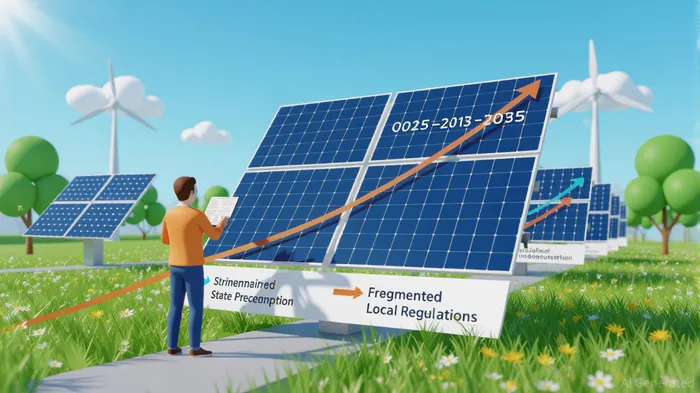
DTE Energy's lawsuit challenges St. Clair County's May 2025 regulations, which include stricter noise limits (45 decibels vs. the state's 55 decibels), visual obscurity requirements, and health department oversight for decommissioning. The utility argues these rules function as zoning laws, violating Public Act 233—a 2023 state law designed to preempt local restrictions and accelerate Michigan's 80% clean energy target by 2035.
This case mirrors a national trend where local governments increasingly impose restrictions on renewables, often citing health and environmental concerns. A 2025 report from Columbia University's Sabin Center revealed a 32% rise in public opposition to renewable projects in 2024 and a 16% increase in “severe” local restrictions, totaling 459 laws across 44 states. Wind projects, in particular, face more restrictions than solar, with 298 anti-wind laws compared to 248 anti-solar laws. Michigan alone has 62 local restrictions, the highest in the nation.
The Sabin Center also notes that local opposition often delays or cancels projects. For example, setback requirements can reduce solar resource efficiency by up to 38%, while 30% of solar and wind projects were canceled in 2024 due to local ordinances. These trends underscore the growing importance of regulatory clarity for investors.
Investment Implications: Risk and Opportunity
The DTE case highlights two critical risks for renewable energy investors: regulatory fragmentation and project uncertainty. If St. Clair County's regulations are upheld, it could embolden other localities to craft their own rules, creating a patchwork of requirements that complicate large-scale development. This would increase costs and timelines, deterring capital inflows. Conversely, a ruling in favor of DTE would reinforce state preemption, streamlining permitting and boosting investor confidence—a scenario akin to New York's 2020 law, which allowed the state to override local bans on renewables.
For Michigan, the stakes are high. The state's aggressive clean energy goals depend on rapid deployment of solar and storage projects. Yet, local opposition—often driven by misinformation or legitimate concerns about land use—threatens to derail progress. Investors must weigh the potential for regulatory stability against the risk of localized delays.
Strategic Recommendations for Investors
- Prioritize Jurisdictions with Clear Preemption Laws: States like Michigan, California, and Illinois, which have enacted laws to limit local restrictions, offer more predictable environments for renewable projects. These regions are likely to attract the bulk of clean energy investments, particularly as the Inflation Reduction Act (IRA) incentivizes domestic infrastructure.
- Engage in Community Co-Creation: Investors should proactively address local concerns through transparent dialogue and community benefits agreements. For example, DTE's proposed Greenwood Township solar project could mitigate opposition by offering landowner compensation or shared revenue from energy production.
- Diversify Geographically and Technologically: A diversified portfolio across solar, wind, and storage can hedge against regional regulatory risks. Projects in states with strong preemption laws (e.g., Ohio, Texas) should be balanced with those in states with emerging local opposition (e.g., New York, Nebraska).
- Monitor Legal Precedents: The outcome of DTE's lawsuit could set a national precedent. Investors should track rulings in similar cases, such as Clean Energy Choice Coalition v. Village of Oak Park in Illinois, to anticipate shifts in regulatory frameworks.
The Broader Picture: A National Legal Battleground
The DTE case is part of a larger legal and political struggle over the clean energy transition. In 2025, 459 U.S. counties adopted restrictive policies, reflecting a surge in local governance efforts to assert control over energy development. While these actions are framed as democratic participation, they often lack scientific basis. For instance, St. Clair County's health department cited vague risks like “visual intrusion” and “noise pollution” without peer-reviewed evidence, a common tactic in anti-renewable campaigns.
For investors, the lesson is clear: regulatory risk is no longer confined to federal policy shifts. Local-level conflicts now play a decisive role in project viability. The Inflation Reduction Act's $369 billion in clean energy incentives will only be fully realized if states and municipalities align their policies.
Conclusion
DTE Energy's lawsuit is more than a legal dispute—it is a bellwether for the future of renewable energy investment in the U.S. If Michigan courts uphold Public Act 233, it will reinforce state authority and create a model for other states to follow. Conversely, a victory for St. Clair County could exacerbate regulatory fragmentation, slowing the clean energy transition.
Investors must navigate this uncertainty with a dual strategy: leveraging jurisdictions with strong preemption laws while engaging constructively with local stakeholders. The next few months will be critical. As the Michigan Court of Appeals deliberates on the PSC's interpretation of Public Act 233, the renewable sector—and the broader economy—will watch closely for signals of regulatory clarity.

Delivering real-time insights and analysis on emerging financial trends and market movements.
Latest Articles
Stay ahead of the market.
Get curated U.S. market news, insights and key dates delivered to your inbox.
AInvest
PRO
AInvest
PRO



Comments
No comments yet