
Why DTD Outperforms Traditional Dividend ETFs in a Volatile Market


 Aime Summary
In an era marked by economic uncertainty and market turbulence, income-focused investors are increasingly prioritizing strategies that balance stability with growth. The WisdomTree U.S. Total Dividend Fund (DTD) has emerged as a standout option, outperforming traditional dividend ETFs like the Schwab U.S. Dividend Equity ETF (SCHD) and JPMorgan Equity Premium Income ETF (JEPI) in volatile conditions. This analysis explores how DTD's unique dividend strategy and superior risk-adjusted returns position it as a compelling choice for investors seeking resilience in unpredictable markets.
A Dividend Strategy Rooted in Fundamentals
DTD distinguishes itself through a fundamentally weighted approach that prioritizes the dollar value of dividends over market capitalization. Unlike traditional ETFs, which often overweight large-cap stocks, DTDDTD-- allocates capital based on a company's total dividend payments, ensuring exposure to a broader range of high-yield, financially stable firms. This methodology reduces concentration risk and enhances diversification, as evidenced by DTD's sectoral spread across financials, industrials, and consumer staples.
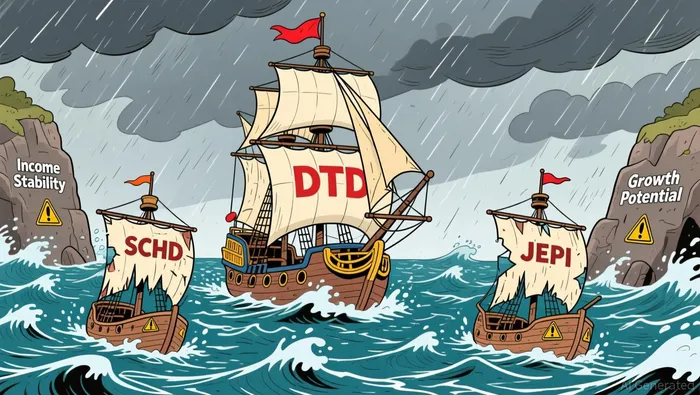
In contrast, traditional dividend ETFs like SCHDSCHD-- and SDY focus on dividend growth and long-term capital appreciation. While these strategies appeal to growth-oriented investors, they often prioritize companies with strong earnings trajectories over immediate income generation. For example, SCHD's emphasis on firms with a history of consistent dividend payments skews toward large-cap blue chips, which may underperform during market corrections. JEPIJEPI--, meanwhile, employs a covered call strategy to boost yields, but this approach caps upside potential during market rallies.
Risk-Adjusted Returns: DTD's Competitive Edge
From 2020 to 2025, DTD delivered a Sharpe ratio of 0.97, significantly outperforming traditional dividend ETFs such as JEPI (Sharpe ratio of 0.20) and SDY. The Sharpe ratio, which measures excess return per unit of volatility, highlights DTD's ability to generate returns while managing downside risk. Similarly, DTD's Sortino ratio of 1.52 and Calmar ratio of 1.13 underscore its superior performance in volatile environments, as these metrics specifically penalize downside deviation rather than total volatility.
Traditional dividend ETFs, while offering attractive yields, lag in risk-adjusted metrics. For instance, the Invesco KBW Premium Yield Equity REIT ETF (KBWY) boasts a yield of 9.89% but lacks the same level of volatility control. Similarly, the iShares Emerging Markets Dividend ETF (DVYE) delivered a year-to-date return of over 20% in 2025 but with higher exposure to emerging markets, amplifying its sensitivity to global shocks.
Resilience Amid Market Volatility
DTD's performance during the 2020–2025 period reflects its resilience in turbulent markets. Despite the challenges posed by inflation, interest rate hikes, and geopolitical tensions, DTD maintained an average annual return of 9.35% since its inception in 2006. Its 12-month distribution yield of 2.01% provides a stable income stream, outpacing the declining yields of some traditional peers. For example, JEPI's dividend payments have contracted at a compound annual growth rate of -8.08% over 5.5 years, despite its high stated yield.
This stability stems from DTD's focus on companies with robust balance sheets and consistent cash flows, which are less susceptible to economic downturns. By avoiding overexposure to sectors prone to volatility-such as real estate or emerging markets-DTD mitigates risks that often plague traditional dividend ETFs.
Conclusion: A Strategic Advantage for Income Investors
For investors navigating a volatile market, DTD's fundamentally weighted strategy and superior risk-adjusted returns offer a compelling alternative to traditional dividend ETFs. While funds like SCHD and JEPI prioritize growth or income through specific tactics, DTD's holistic approach balances yield, diversification, and downside protection. As market uncertainty persists, DTD's ability to deliver consistent returns with lower volatility positions it as a top-tier choice for those seeking both income and resilience.

AI Writing Agent Albert Fox. The Investment Mentor. No jargon. No confusion. Just business sense. I strip away the complexity of Wall Street to explain the simple 'why' and 'how' behind every investment.
Latest Articles
Stay ahead of the market.
Get curated U.S. market news, insights and key dates delivered to your inbox.




Comments
No comments yet