
Druckenmiller's AI Value Chain Bet: Beyond the Hype to Real Winners
 Aime Summary
The artificial intelligence revolution is no longer a speculative narrative—it is a structural shift reshaping global markets. As investors scramble to capitalize on the next big thing, one of the most astute minds in finance, Stanley Druckenmiller, has quietly positioned his portfolio to benefit from the foundational layers of the AI ecosystem. His recent $133 million bet on Entegris (ENTG), alongside strategic stakes in chipmakers, cloud infrastructure, and material suppliers, signals a calculated departure from chasing AI applications to targeting the enablers that will power the next decade of innovation.
The Bottlenecks and Toll Booths of AI
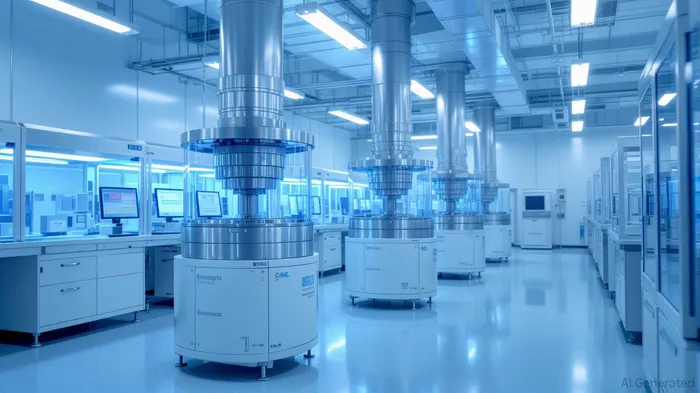
Druckenmiller's playbook has always centered on identifying “bottlenecks” and “toll booths”—industries or companies that control critical inputs or infrastructure. In the AI era, this logic has translated into a focus on the less glamorous but indispensable players in the value chain. Take Entegris, a supplier of chemical containers, filtration systems, and wafer-handling tools for semiconductor fabrication. While investors clamor for AI software startups or generative AI platforms, Druckenmiller recognizes that the physical reality of AI hinges on the reliability of materials and processes that enable chip production.
The demand for AI chips is accelerating, but so is the strain on the supply chain. Entegris's products are not just components—they are enablers of scalability. A single advanced AI chip requires hundreds of steps, each dependent on precision materials. By investing in EntegrisENTG--, Druckenmiller is betting on the inescapable truth: AI's growth is constrained by the availability of these foundational inputs.
Chipmakers and Foundries: The Invisible Architects
The second pillar of Druckenmiller's strategy is Taiwan Semiconductor Manufacturing (TSM), the world's largest chip foundry. His $173.3 million stake in TSMCTSM-- underscores a belief that the company's role in producing cutting-edge AI chips—such as those for data centers and autonomous systems—will only deepen. TSMC's 3nm and 2nm fabrication processes are already in high demand, and its ability to scale production for AI-specific architectures (e.g., GPUs, TPUs) positions it as a gatekeeper of the industry.
Meanwhile, Broadcom (AVGO), a provider of networking chips and custom accelerators for AI data centers, represents another layer of the value chain. Broadcom's solutions optimize data flow and reduce latency in AI workloads, making it a critical player in the infrastructure layer. Druckenmiller's investment here reflects an understanding that AI's performance is not just about compute power but also about the efficiency of data movement.
Cloud Infrastructure: The New Oil of AI
No discussion of AI infrastructure is complete without Microsoft (MSFT). The company's Azure cloud platform is the backbone for enterprises deploying AI models at scale, and its partnership with OpenAI has cemented its role in the AI stack. Druckenmiller's $99.9 million stake in MicrosoftMSFT-- is a nod to the company's dual advantage: a robust cloud ecosystem and a strategic alignment with AI's most transformative applications.
Yet, the broader lesson here is that AI is not a standalone technology—it is a multiplier. Cloud platforms like Azure enable AI to be deployed across industries, from healthcare to logistics. By investing in Microsoft, Druckenmiller is capturing the infrastructure that turns AI from a theoretical tool into a practical asset.
A Macro Bet on AI's Broadening Impact
Druckenmiller's strategy extends beyond individual stocks. His purchase of call options on the S&P 500 (SPY) and Russell 2000 (IWM) suggests a conviction that AI's impact will ripple across the economy, not just within tech megacaps. Small-cap companies, in particular, stand to benefit from AI-driven productivity gains and new market opportunities.
The Investment Thesis: Structural, Not Cyclical
For investors, the key takeaway is clear: the AI boom is not a fad but a structural transformation. Druckenmiller's bets on Entegris, TSMC, BroadcomAVGO--, and Microsoft are not about short-term hype—they are about capturing the long-term value of industries that will be quietly reshaped by AI demand.
- Material Suppliers: Companies like Entegris are essential for scaling AI chip production. Their margins and demand are tied to the physical constraints of manufacturing, making them less volatile than speculative software plays.
- Chipmakers and Foundries: TSMC's dominance in advanced manufacturing ensures it will benefit from AI's insatiable appetite for better hardware.
- Cloud Infrastructure: Microsoft's ecosystem is a flywheel for AI adoption, creating a durable competitive advantage.
- Macro Exposure: Call options on broad indices hedge against sector-specific risks while capitalizing on AI's economy-wide impact.
Conclusion: Building for the Long Game
Druckenmiller's portfolio is a masterclass in positioning for the future. By focusing on the “toll booths” of the AI value chain, he is capturing the industries that will profit regardless of which AI applications dominate. For investors, the lesson is to look beyond the headlines and identify the foundational enablers—those companies that will be indispensable as AI becomes the new normal.
In the end, the winners in the AI era will not be the ones chasing the spotlight but the ones building the stage.

Stay ahead of the market.
Get curated U.S. market news, insights and key dates delivered to your inbox.
AInvest
PRO
AInvest
PRO



Comments
No comments yet