
Drone Wars: How Ukraine's Tech Alliances Could Be the Next Big Play in Defense Tech
The world is witnessing a seismic shift in defense technology, and at the epicenter sits Ukraine—a nation turning wartime necessity into a global tech revolution. From kamikaze drones to AI-driven swarms, Ukraine's drone manufacturing partnerships with European firms like Renault (RENA.PA) are not just about weapons. They're about strategic control of supply chains, geopolitical influence, and the future of energy security. This is a story of resilience, innovation, and risk—all wrapped in a high-stakes investment opportunity.
Why This Matters: Defense Tech as Geopolitical Chess
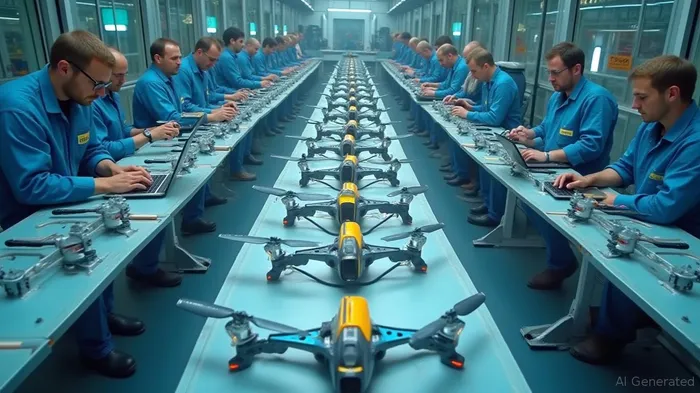
Ukraine's drone production isn't just about blowing up Russian tanks. It's about redefining supply chain resilience in Europe's backyard. Consider Renault's partnership: by leveraging Ukraine's frontlineFRO-- expertise in drone tactics, France is plugging a critical gap in its military tech. France currently fields just 3,000 military drones—Ukraine aims to hit 4.5 million by 2025. This scale isn't just about numbers; it's about creating a localized, agile production ecosystem that bypasses traditional reliance on U.S. or Chinese suppliers.
The geopolitical calculus here is stark: Europe's energy security—think of Nord Stream pipelines or Black Sea shipping routes—depends on Ukraine's stability. By embedding itself in Ukraine's drone industry, Europe is securing both military advantage and strategic leverage over adversaries.
The Winners: Companies Building the New Defense Stack
Renault (RENA.PA): Leading the charge with its Ukrainian drone venture, Renault is pivoting from declining auto sales to high-margin defense tech. Its partnership with an unnamed French defense SME (likely a Thales or Safran spin-off) gives it access to Ukraine's battlefield-tested designs. Look for operating leverage as drone production scales—this could offset its auto division's woes.
Summa Defence (FINLAND): Finland's Summa Defence is a stealth gem. Its joint plant with Ukrainian partners (Kort, Elf Systems) aims to produce drones for NATO allies. With 50% ownership in the venture, Summa stands to profit from Europe's €910M EU Defence Fund allocations. Watch for its subsidiary, Summa Drones, to go public or attract strategic buyers.
Insta (FINLAND): Partnering with a Ukrainian firm on the Steel Eagle ER drone—extended range, heavy payload—Insta is positioning itself as a supplier for critical infrastructure protection. If Ukraine meets its 2025 production targets, Insta's stock (HELSINKI:INSTA) could surge.
The “Tactical Tech” Startups: Ukraine's Brave1 initiative has spun out over 500 defense startups. Firms like Griselda (geospatial AI) and Himera (encrypted comms) are the “Tesla Autopilot” of drone warfare. While private now, their potential for acquisition by European giants is massive.
The Risks: Volatility and Scalability
This is no low-risk play. Geopolitical volatility is existential here. A Russian counteroffensive or sanctions could disrupt production. The proximity of factories to frontline zones (some within “a few dozen kilometers”) is a red flag.
Then there's scalability. Ukraine's drone production relies on fragile supply chains—components like microchips or batteries are still imported. A disruption in semiconductor exports (e.g., from China) could stall progress. The EU's push to localize supply chains via the European Defence Fund mitigates this, but it's a slow process.
Ethical risks loom too. Fully autonomous lethal drones—like Ukraine's “mother drones” launching swarms—raise AI accountability questions. The “human-in-the-loop” requirement may limit their adoption, stifling demand.
Investment Playbook: How to Play This
- Buy the Leaders, Hedge the Risks:
- Long Renault (RENA.PA) for its pivot to defense. Pair it with a short position in traditional auto stocks (e.g., PSA PEA.PA) to hedge against auto-sector declines.
Allocate to European defense ETFs like the SPDR S&P Defense ETF (XAR) to diversify.
Target Tactical Tech Startups:
Look for EU-backed funds investing in Ukraine's Brave1 ecosystem. The European Innovation Council Fund or Nordic Tech VC funds often have exposure here.
Monitor the Ukraine Drone Coalition:
- The UK-led coalition (with Norway, Finland) aims to spend €1.8B on drone tech. Track their procurement timelines—delays could sink stocks, while overperformance could trigger rallies.
Final Call: A High-Reward, High-Risk Bet on the Future
Ukraine's drone partnerships are a paradigm shift in defense tech. They're turning a war-torn nation into a hub for innovation and supply chain resilience. For investors, this is about more than drones—it's about who controls the next era of energy security and geopolitical influence.
The risks are real—war, supply chain hiccups, and tech ethics. But with Europe's €910M funding, strategic alliances like Renault's, and Ukraine's battlefield edge, this could be the Amazon Web Services of defense tech.
Action to take: Start small with a position in Renault, layer in exposure to the XAR ETF, and keep an eye on Brave1's startup pipeline. This is a 3–5 year play—hold tight, but stay vigilant on geopolitical headlines.
This is not for the faint-hearted, but for those willing to bet on resilience, this could be the next megatrend.
Disclaimer: Past performance does not guarantee future results. Consult a financial advisor before making investment decisions.

Delivering real-time insights and analysis on emerging financial trends and market movements.
Latest Articles
Stay ahead of the market.
Get curated U.S. market news, insights and key dates delivered to your inbox.






Comments
No comments yet