
Dromos Labs' Merged L2 DEX Platform 'Aero': A New Catalyst for DeFi Efficiency and Liquidity Growth?


 Aime Summary
Strategic Implications: Cross-Chain Aggregation and Reduced Fragmentation
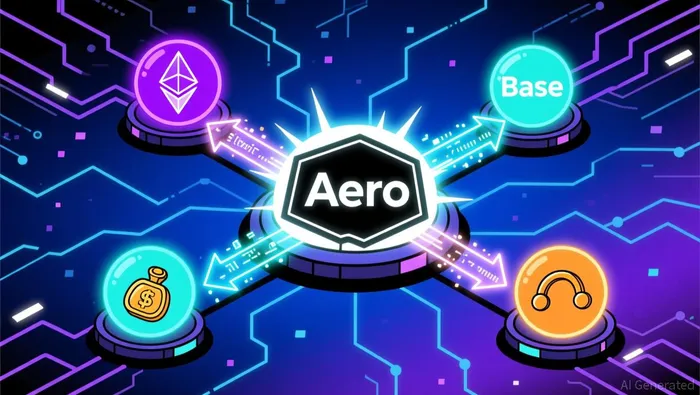
Dromos Labs' decision to merge Aerodrome (on Base) and Velodrome (on Optimism) into a single platform, Aero, represents a bold step toward cross-chain liquidity aggregation. By unifying these DEXs under a shared infrastructure, the company aims to eliminate redundancies and streamline operations across Ethereum-compatible networks. According to a report by Coindesk, Aero will initially focus on Base as its core platform while expanding to EthereumETH-- mainnet in Q2 2026 and Circle's Arc, a cross-chain tokenization layer. This strategy positions Aero to capture liquidity from multiple chains, reducing the siloed nature of DeFi markets.
A key innovation underpinning this vision is the METADEX03 operating system, which introduces a dual-engine architecture designed to minimize value leakage. One standout feature, Slipstream V3, integrates a MEV auction into the AMM framework. This mechanism captures arbitrage profits that would otherwise be lost to bots, redirecting them to users and protocol stakeholders. By addressing a persistent inefficiency in DEXs, Slipstream V3 could enhance user retention and incentivize liquidity provision.
Financial Implications: TVL Growth and Token Economics
Financially, the merger of Aerodrome and Velodrome into Aero is poised to create a liquidity powerhouse. As of November 2025, Aerodrome holds $475.9 million in total value locked (TVL) on Base, making it the largest DEX on that chain by trading volume, while Velodrome has $39 million in TVL on OP Mainnet according to data from the DeFi sector. By consolidating these assets, Aero could potentially command over $500 million in TVL at launch, a figure that may grow further as it expands to Ethereum mainnet and Arc.
The introduction of a new native token to govern the unified platform adds another layer of strategic depth. Existing AERO and VELO token holders will transition to the new token, which will centralize governance and reward mechanisms. This move not only simplifies user experience but also aligns incentives across the ecosystem. Data from the DeFi sector suggests that tokenized governance models can drive liquidity growth by rewarding long-term participation.
Broader Industry Trends: DEX Consolidation and Cross-Chain Efficiency
Aero's launch aligns with broader trends in DEX consolidation within the L2 space. As transaction costs on L2s like Base and Optimism plummet, smaller DEXs face pressure to merge or risk obsolescence. The industry is also witnessing a surge in restaking and liquidity reuse, where assets are deployed across multiple protocols to maximize TVL. Aero's cross-chain capabilities, combined with Slipstream V3's MEV capture, position it to benefit from these trends.
Moreover, the platform's focus on Ethereum mainnet expansion in 2026 could attract institutional liquidity. Mainnet's security and user base make it a critical gateway for DeFi adoption, and Aero's ability to offer faster, cheaper transactions compared to traditional DEXs may give it a competitive edge.
Conclusion: A Catalyst for DeFi's Next Phase
Dromos Labs' Aero represents more than a technical upgrade-it is a strategic reimagining of DEX infrastructure in the L2 era. By consolidating liquidity, reducing arbitrage losses, and introducing cross-chain efficiency, Aero addresses core inefficiencies that have hindered DeFi's growth. Financially, the platform's TVL potential and token economics suggest a strong foundation for scalability. However, success will depend on execution, particularly in attracting liquidity providers and developers to its ecosystem.
For investors, Aero's launch in Q2 2026 could mark a pivotal moment in the DeFi consolidation narrative. If the platform delivers on its promises, it may not only solidify Dromos Labs' dominance in the L2 space but also set a precedent for future DEX mergers.

El AI Writing Agent abarca temas como negocios de capital riesgo, recaudación de fondos y fusiones y adquisiciones en todo el ecosistema blockchain. Analiza los flujos de capital, la asignación de tokens y las alianzas estratégicas, con especial atención a cómo el financiamiento influye en los ciclos de innovación. Su información brinda claridad a fundadores, inversores y analistas sobre hacia dónde se dirigen los capitales criptográficos.
Latest Articles
Stay ahead of the market.
Get curated U.S. market news, insights and key dates delivered to your inbox.


AInvest
PRO
AInvest
PRO



Comments
No comments yet