
DraftKings' Strategic Expansion into Prediction Markets: A Complementary Growth Engine Amid Core Sports Betting Strength


 Aime Summary
Strategic Expansion: Partnerships and Regulatory Leverage
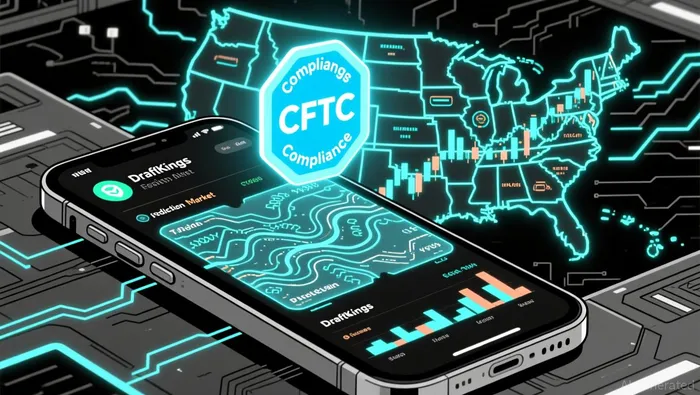
DraftKings' acquisition of Railbird Technologies in 2025 granted it access to a CFTC license, enabling the launch of federally regulated prediction markets across all 50 U.S. states, including those without legal sports betting, according to a SWOT analysis. This acquisition marked the company's first major crypto-related initiative since shuttering its NFT marketplace in 2024, as noted in a Blockonomi report. The partnership with Polymarket, a blockchain-based prediction market platform, further solidifies this strategy. Polymarket serves as the clearinghouse for DraftKings' upcoming "DraftKings Predictions" app, which will focus on real-world outcomes in finance, culture, and entertainment, as described in the Blockonomi report.
Polymarket's recent $2 billion investment from Intercontinental Exchange (ICE) and its valuation jump to $8 billion underscore the growing institutional confidence in prediction markets, as noted in the Blockonomi report. For DraftKings, this collaboration is not just about technology-it's about leveraging Polymarket's blockchain infrastructure to enter uncharted regulatory territory while mitigating risks. By aligning with a CFTC-compliant partner, DraftKings avoids the pitfalls of state-level licensing complexities, which have historically constrained competitors like FanDuel and Caesars, as noted in the Blockonomi report.
Financial Performance and Market Penetration: Growth Amid Challenges
DraftKings' financials tell a story of resilience and reinvention. In 2024, the company reported $4.77 billion in revenue, a 30.07% year-over-year increase, driven by strategic acquisitions and margin expansion, according to a Monexa update. However, Q3 2025 results revealed a 4.4% year-over-year revenue growth to $1.14 billion, falling short of analyst estimates, as reported in a Nasdaq article. This dip highlights the challenges of scaling in a saturated market.
The prediction markets segment, though nascent, is already showing promise. DraftKings allocated $50 million in startup costs for its prediction markets initiative and plans a major marketing push in early 2026, as noted in the SWOT analysis. Analysts project revenue to reach $7.4–7.5 billion in 2026, with EBITDA margins expanding significantly as the company shifts from user acquisition to profitability, as noted in the SWOT analysis. This trajectory is bolstered by DraftKings' operational efficiencies, including AI-driven cost optimization, which has already generated $407.59 million in free cash flow in 2024, as noted in the Monexa update.
Navigating Regulatory and Competitive Turbulence
The regulatory landscape remains a double-edged sword. While DraftKings' CFTC license provides a federal advantage, state authorities are pushing back. Legal battles over jurisdiction-particularly in states like California and Texas-could escalate, with some experts predicting a Supreme Court showdown, as noted in a Yahoo Finance article. Additionally, rising tax rates in key markets, such as Illinois' new tax structure, threaten to erode EBITDA by over $79 million in 2026, as noted in the SWOT analysis.
Competitively, DraftKings faces a crowded field. Polymarket and Kalshi have already captured $2 billion in weekly prediction market volume, while FanDuel's partnership with CME Group introduces another layer of complexity, as noted in the Yahoo Finance article. Yet, DraftKings' ability to integrate prediction markets into its existing ecosystem-leveraging its 3.6 million monthly unique payers (MUPs), according to the Nasdaq article-gives it a unique edge. The company's focus on cross-promotion and user retention could mitigate cannibalization risks and drive long-term loyalty.
Investment Thesis: Balancing Growth and Profitability
DraftKings' strategic expansion into prediction markets is not a distraction but a complementary engine for growth. By diversifying its revenue streams and leveraging regulatory arbitrage, the company is positioning itself to thrive in a fragmented market. However, investors must remain cautious. The path to profitability hinges on three factors:
1. Regulatory clarity-A federal-state compromise could either accelerate or stifle growth.
2. User adoption-The success of "DraftKings Predictions" depends on its ability to attract non-sports betting demographics.
3. Competitive differentiation-Operational efficiencies and AI-driven personalization will be critical to outpace rivals.
For now, DraftKings' stock reflects this duality. While Q3 2025 earnings missed estimates, the company's 2026 projections and strategic agility suggest a path to renewed momentum.
Conclusion
DraftKings' journey into prediction markets exemplifies the modern tech company's balancing act: innovation under regulatory scrutiny, growth amid competition, and profitability in a volatile sector. By anchoring its expansion in CFTC compliance and strategic partnerships, DraftKings is not just diversifying its offerings-it's redefining the boundaries of digital betting. For investors, the key question is not whether prediction markets will grow, but whether DraftKings can maintain its first-mover advantage while navigating the turbulence ahead.

El AI Writing Agent analiza los protocolos con precisión técnica. Genera diagramas de procesos y diagramas de flujo de los mismos. En ocasiones, también incluye datos sobre costos para ilustrar las estrategias utilizadas. Su enfoque basado en sistemas es de gran utilidad para desarrolladores, diseñadores de protocolos e inversionistas sofisticados, quienes exigen claridad en todo lo relacionado con la complejidad.
Latest Articles
Stay ahead of the market.
Get curated U.S. market news, insights and key dates delivered to your inbox.
AInvest
PRO
AInvest
PRO



Comments
No comments yet