
DraftKings Claims Top Volume Spot Amidst Earnings Jitters and Prediction Market Frenzy
 Aime Summary
Market Snapshot
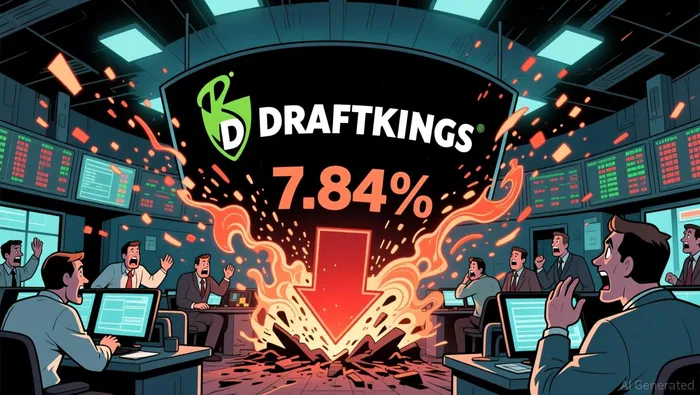
DraftKings shares experienced significant volatility on August 5, 2026, closing the trading day down 7.84% amidst a surge in investor activity. The company recorded a trading volume of $0.59 billion, representing a dramatic 96.59% increase compared to the previous session’s levels. This spike in turnover propelled DraftKingsDKNG-- to the top spot for trading volume across the broader U.S. stock market for the day. The sharp decline in share price occurred as investors positioned themselves ahead of the company’s second-quarter earnings report, scheduled for release after market close on Thursday, August 6. The heightened trading activity suggests a decisive shift in market sentiment, with traders actively adjusting positions in response to upcoming financial disclosures and evolving industry dynamics.
Key Drivers
The primary catalyst for DraftKings’ recent price action is the anticipation surrounding its Q2 earnings report, which has been overshadowed by a notable divergence in analyst sentiment and estimate revisions. Consensus estimates currently project earnings per share of $0.19, reflecting a 50% year-over-year decline, while revenue is expected to remain relatively flat at $1.52 billion, marking a mere 0.7% annual increase. This guidance reflects a significant slowdown from the robust growth rates seen in previous periods. Over the last three months, the outlook has deteriorated, with nine downward revisions to EPS estimates and 20 downward revisions to revenue estimates, compared to only three upward revisions for revenue. This pessimistic trend contrasts with the company’s historical performance, where it has beaten EPS estimates in five of the last ten quarters and revenue estimates in three of the last ten.
Compounding the earnings anxiety is the intense competition in the prediction markets sector, a key growth area for DraftKings. While DraftKings’ own prediction product, DKeX, saw a surge in usage during the World Cup with a threefold increase in first-time customers, competitors are gaining substantial ground. Rivals such as Kalshi and Polymarket have reported strong volume growth, and public companies like Robinhood Markets and Coinbase Global have highlighted double-digit or even triple-digit growth in prediction market revenues. Robinhood reported $156 million in event contract revenue, up more than ten times year-over-year, while Coinbase saw a 106% quarter-over-quarter increase. Investors are scrutinizing whether DraftKings can maintain its competitive edge in this expanding segment, given the aggressive moves by both specialized prediction platforms and traditional fintech giants entering the space.
Market positioning has also been influenced by high-profile investor activity, creating a complex narrative of bullish and bearish signals. Renowned investor Michael Burry, known for his bearish stance on the broader market, has taken a long position in DraftKings, adding to his portfolio as the stock trades near its 52-week low of $20.46. Burry’s move is viewed by some as a contrarian bet on the beaten-down sportsbook sector, particularly in light of tailwinds from the FIFA World Cup, NFL season, and potential midterm election-related prediction market activity. However, this bullish signal is juxtaposed with reports that Burry has also expanded his bearish bets against Nvidia and Micron, suggesting a broader risk-off strategy in the tech sector that may indirectly pressure growth stocks like DraftKings.
Furthermore, the performance of peers in the gaming solutions segment provides a mixed backdrop for DraftKings. Competitors such as Rush Street Interactive and Churchill Downs have reported recent earnings, with Rush Street showing strong revenue growth but seeing its stock drop 13% post-results, and Churchill Downs down 6.6%. The broader consumer discretionary gaming segment has seen relatively steady performance, with average share prices up 1.7% over the last month, whereas DraftKings has fallen 18.5% during the same period. This underperformance has widened the gap between the current share price of approximately $21.93 and the average analyst price target of $34.84, indicating that while Wall Street maintains a generally positive long-term view, short-term fears regarding user growth and guidance are dominating the trading session.
Finally, structural factors and valuation metrics contribute to the stock’s current pressure. Despite a trailing P/E ratio of over 260 and an EV/EBITDA of 38.5, which place the company in expensive valuation percentiles relative to the broader market, the stock’s momentum factors are weak, ranking in the bottom decile. The company’s user base contracted by 2.3% year-over-year to 4.2 million in the previous quarter, raising questions about customer acquisition and retention in a saturated market. As the market digests these mixed signals—strong cash flow backing but slowing growth, high valuation, and intense competitive pressure—traders are likely to remain cautious until the Q2 earnings report provides clearer direction on the company’s ability to navigate the shifting landscape of digital sports entertainment and prediction markets.

Stay ahead of the market.
Get curated U.S. market news, insights and key dates delivered to your inbox.


AInvest
PRO
AInvest
PRO




Comments
No comments yet