
The DPO Revolution: How Direct Preference Optimization is Reshaping AI Infrastructure Investments


 Aime Summary
In the rapidly evolving landscape of artificial intelligence, the alignment of (LLMs) with human preferences has emerged as a critical bottleneck. Traditional methods like (RLHF) have long dominated this space, but a new paradigm— (DPO)—is disrupting the status quo. By simplifying the alignment process, reducing computational overhead, and enabling scalable deployment, DPO is not just a technical innovation but a catalyst for redefining AI infrastructure investments.
The DPO Advantage: Efficiency Meets Performance
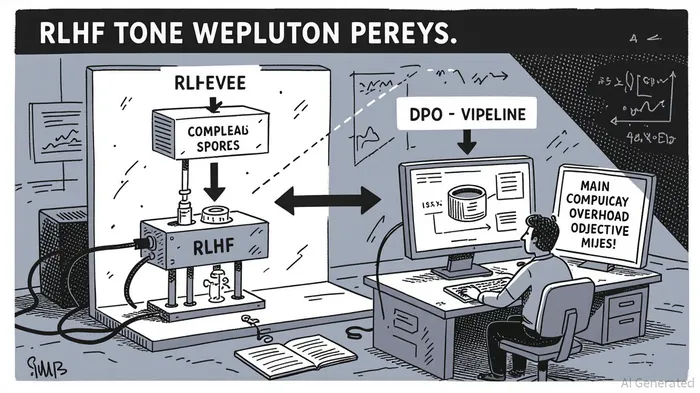
DPO reimagines alignment as a direct classification task, eliminating the need for intermediate reward models and iterative reinforcement learning. , as demonstrated in benchmarks across models like , , and . For instance, DPO-based models achieved , .
The efficiency gains are not just theoretical. , making it a preferred choice for organizations prioritizing scalability. This has spurred adoption in and enterprise-grade models, where rapid iteration and cost control are paramount.
Industry Adoption and Infrastructure Shifts
The 2025 AI infrastructure boom is being driven by cloud providers and hardware innovators leveraging DPO's efficiency. Major players like Microsoft, Google, and Amazon are allocating billions to optimize their AI data centers and chips for DPO-compatible workflows. For example:
- Microsoft .
- Google , with Vertex AI now offering DPO-as-a-Service.
- Amazon is deploying Trainium 2 chips tailored for DPO, .
These investments are not limited to cloud giants. Startups like NVIDIA and H2O.ai are integrating DPO into their AI-as-a-Service platforms, offering privacy-compliant tools that align with regulatory frameworks like . The result? A new generation of infrastructure that prioritizes both performance and compliance.
The Investment Case: Where to Allocate Capital
The DPO-driven shift in AI infrastructure presents three key investment opportunities:
Cloud Providers with DPO-Optimized Hardware
Companies like Microsoft (MSFT) and Amazon (AMZN) are leading the charge in building DPO-ready infrastructure. Their capital expenditures on next-gen data centers and chips are expected to drive long-term revenue growth.Specialized AI Chip Manufacturers
Firms such as NVIDIA (NVDA) and AMD (AMD) are developing GPUs and TPUs tailored for DPO's computational demands. .AI-as-a-Service Platforms
Platforms like Google Cloud's Vertex AI and H2O.ai are democratizing access to DPO, enabling SMEs to adopt advanced alignment techniques without in-house expertise. These platforms are likely to see exponential growth as DPO adoption accelerates.
Risks and Mitigations
While DPO's potential is vast, investors should remain cautious. The technology is still maturing, and early adopters may face integration challenges. Additionally, regulatory shifts—such as the 's 2025 implementation—could impact deployment timelines. However, companies with strong R&D pipelines and regulatory agility (e.g., Microsoft and Google) are well-positioned to navigate these risks.
Conclusion: A New Era of AI Alignment
DPO is more than a technical shortcut—it's a strategic enabler for the next phase of AI infrastructure. By reducing complexity and cost, it democratizes access to high-quality alignment, fostering innovation across industries. For investors, the key is to align portfolios with companies that are not just adopting DPO but redefining the infrastructure around it. , .

Stay ahead of the market.
Get curated U.S. market news, insights and key dates delivered to your inbox.




Comments
No comments yet