
The Downfall of Sonder Hotels: A Cautionary Tale for REITs and Hospitality Investors


 Aime Summary
A Partnership Built on Promise, Unraveled by Reality
Sonder's partnership with MarriottMAR-- International was once heralded as a disruptive force in the hospitality sector. The licensing agreement, inked in August 2024, aimed to integrate over 9,000 Sonder units into the Marriott Bonvoy system, leveraging the latter's global brand recognition and loyalty network, according to a Lodging Magazine report. However, the venture quickly unraveled. According to a report by Skift, Sonder faced "unexpected challenges in aligning our technology frameworks" with Marriott's booking systems, leading to integration costs that eroded margins and disrupted revenue streams, as noted in the Sonder Q2 2025 results. By November 2025, Marriott terminated the agreement due to Sonder's default, citing "severe financial constraints" in the Lodging Magazine report.
The fallout was immediate. Sonder's Chapter 7 bankruptcy filing in the U.S. and insolvency proceedings abroad marked the end of its 8,300-unit portfolio, with guests abruptly displaced and bookings canceled, as reported by the WTSP coverage. For Marriott, the partnership's collapse trimmed its 2025 net room growth forecast to 4.5% from 5%, a small but symbolic blow to a brand known for stability, according to the Jefferson Digital Commons analysis.
The Financial House of Cards
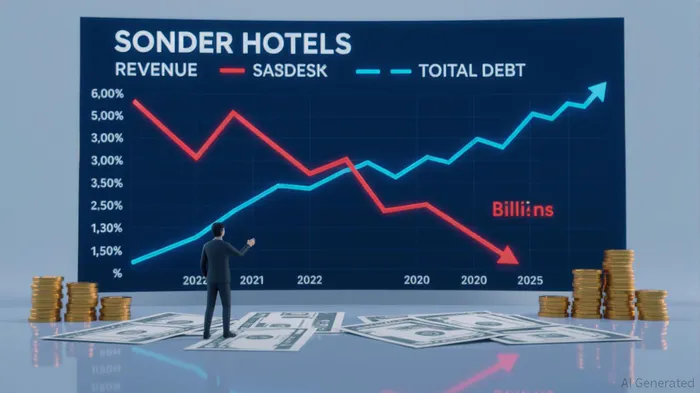
Sonder's demise was not solely a technological misstep but a systemic failure of leverage. By June 2025, the company's debt-to-asset ratio had turned negative: liabilities of $1.49 billion far exceeded its $1.005 billion in assets, as detailed in the Sonder Q2 2025 results. Its debt-to-EBITDA ratio, though unreported, was likely catastrophic, given a Q2 2025 net loss of $44.5 million and a current ratio of 0.25, as noted in the same results. These metrics underscore a business model that relied on speculative growth rather than sustainable cash flow.
The company's hybrid REIT-brand structure-master-leasing apartments and rebranding them as boutique hotels-was inherently risky. As noted by DesignScene, Sonder's "tech-washing" approach masked the operational intensity of managing thousands of units, a point echoed in the Skift report. When the Marriott partnership faltered, the lack of diversified revenue streams left the company with no buffer to absorb the shock, as noted in the Sonder Q2 2025 results.
Broader Implications for Hospitality Investors
Sonder's collapse highlights a broader trend: the vulnerability of over-leveraged hybrid models in cyclical industries. Hospitality REITs, as analyzed in a 2025 Jefferson Digital Commons study, exhibit heightened sensitivity to economic downturns and operational disruptions. During the post-COVID-19 period, these REITs recorded a Sharpe ratio of 0.03-far below the S&P 500's performance-while their Value at Risk (VaR) of −11.46% underscored their fragility, according to the Jefferson Digital Commons analysis. Sonder, with its aggressive debt load and reliance on a single brand partnership, epitomized these risks.
Experts warn that such models require rigorous due diligence. "Licensing arrangements between major hotel groups and financially unstable operators often lack the discipline for long-term sustainability," Skift observed, as noted in the Sonder Q2 2025 results. For investors, the lesson is clear: hybrid structures may offer growth potential but demand meticulous risk management, particularly in aligning technology with operational realities.
A Reckoning for Innovation?
Sonder's story is not just about a single company but about an era of tech-driven disruption in hospitality. Its failure forces a re-evaluation of what works-and what doesn't-in an industry where bricks-and-mortar operations remain irreplaceable. As one analyst put it, "The future belongs to models that balance innovation with financial prudence," a point echoed in the Skift report.
For now, Sonder's liquidation serves as a cautionary tale. Investors in REITs and hospitality ventures would do well to heed its lessons: leverage must be wielded with caution, partnerships with major brands require contingency planning, and operational complexity demands proportionate capital reserves. In a sector as cyclical as hospitality, the margin for error is razor-thin.

Delivering real-time insights and analysis on emerging financial trends and market movements.
Latest Articles
Stay ahead of the market.
Get curated U.S. market news, insights and key dates delivered to your inbox.
AInvest
PRO
AInvest
PRO



Comments
No comments yet