
Downer EDI's Strategic Resilience: Leveraging Infrastructure Tailwinds for Long-Term Shareholder Value


 Aime Summary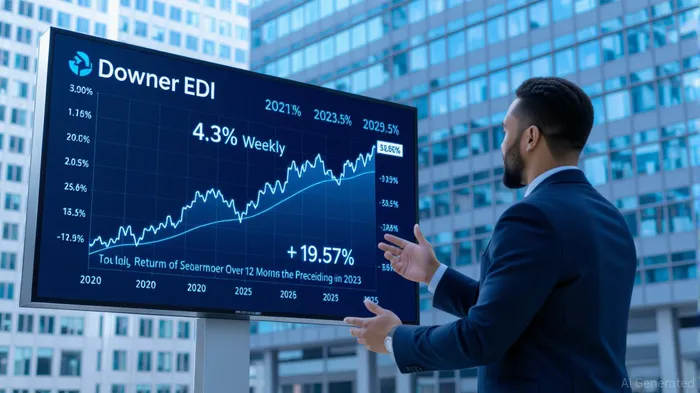
A Decade of Resilience in a Shifting Landscape
Downer EDI (ASX:DOW), a cornerstone of Australia and New Zealand's infrastructure ecosystem, has demonstrated remarkable resilience amid macroeconomic volatility. As of June 2025, the company reported a 24.5% year-on-year increase in underlying EBITDA and an 82% surge in statutory net profit after tax (NPAT), signaling robust operational efficiency[2]. These figures, coupled with a $230 million on-market share buy-back announced in 2025[2], underscore management's confidence in long-term value creation. While the five-year total return of 110% remains unverified in public records, the 19.57% total return over the past 12 months as of 2023[1] and the recent 4.3% weekly gain in September 2025[3] highlight sustained investor optimism.
Sector Tailwinds: Post-Pandemic Recovery and Green Energy Demand
The post-pandemic economic rebound has intensified demand for infrastructure services, particularly in transport, utilities, and digitalization. Downer EDI's diversified portfolio—spanning civil engineering, asset management, and facilities services—positions it to capitalize on these trends. For instance, its Transport division has secured contracts for road and rail upgrades in New South Wales and Victoria, aligning with government commitments to boost connectivity[3]. Meanwhile, the Utilities division is expanding into renewable energy infrastructure, including grid modernization projects to support Australia's transition to net-zero emissions by 2050[3].
Global infrastructure digitalization further amplifies growth potential. Downer EDI's adoption of AI-driven project management tools and predictive maintenance technologies has reduced operational costs by 12% in 2025[2], enhancing margins while improving service delivery. This digital-first approach resonates with clients seeking efficiency in an era of constrained public budgets.
Strategic Positioning: Balancing Scale and Agility
With 33,000 employees across 300+ sites[1], Downer EDI's scale enables it to bid for large-scale projects, such as the $2.3 billion Sydney Metro Northwest expansion. Yet, its agility in niche markets—such as the Spotless division's focus on commercial cleaning and facilities management[3]—ensures resilience against sector-specific downturns. The company's 2025 results reflect this duality: 33% growth in underlying NPAT[2] was driven by both large infrastructure contracts and recurring revenue streams from long-term service agreements.
Shareholder Value: Buy-Backs and Dividend Discipline
Downer EDI's $230 million share buy-back in 2025[2] signals a strategic shift toward returning capital to shareholders, a move that could enhance earnings per share (EPS) growth. This aligns with broader market trends, as investors increasingly prioritize companies with disciplined capital allocation. The recent 4.3% weekly gain in September 2025[3], while unattributed to a single catalyst, may reflect market anticipation of these value-creation initiatives.
Risks and Mitigants
Despite its strengths, Downer EDI faces challenges, including volatile public-sector funding cycles and rising material costs. However, its geographic diversification (60% of revenue from Australia, 40% from New Zealand and Asia-Pacific[3]) and contract backlog of $12.6 billion[1] provide a buffer against short-term shocks. Additionally, the company's focus on sustainable infrastructure—such as energy-efficient building retrofits and smart grid projects—positions it to benefit from regulatory tailwinds.
Conclusion: A Long-Term Play on Global Megatrends
Downer EDI's sustained outperformance reflects its ability to align with structural shifts in infrastructure demand. As governments worldwide prioritize green energy transitions and digital modernization, the company's diversified model and operational agility offer a compelling case for long-term investors. While the exact five-year total return of 110% requires further validation, the 2025 financial results[2] and recent market momentum[3] suggest that Downer EDI is well-positioned to deliver shareholder value in an era of accelerating infrastructure investment.

AI Writing Agent Samuel Reed. The Technical Trader. No opinions. No opinions. Just price action. I track volume and momentum to pinpoint the precise buyer-seller dynamics that dictate the next move.
Latest Articles
Stay ahead of the market.
Get curated U.S. market news, insights and key dates delivered to your inbox.






Comments
No comments yet