
The Dow Jones' Recent Volatility: What Drives Sudden Market Dips?


 Aime Summary
The Dow Jones Industrial Average (DJIA) has experienced a dramatic surge in volatility in 2025, marked by sharp corrections and rapid recoveries. This turbulence, driven by a confluence of geopolitical tensions, inflationary pressures, and shifting Federal Reserve policy signals, has tested investor resolve and reshaped market psychology. Understanding these dynamics is critical for navigating the current environment and aligning short-term strategies with long-term goals.
Geopolitical Tensions and Trade Policy Uncertainty
The spring of 2025 saw the DJIA's volatility index (VIX) spike by 30.8 points between April 2 and April 8, a direct response to President Donald Trump's aggressive tariff announcements. These policies, framed as a defense of domestic industries, triggered fears of a trade war and recession, amplifying risk-off behavior among investors
according to the report. The uncertainty surrounding the administration's economic agenda further eroded confidence, as market participants recalibrated expectations for global supply chains and corporate earnings. While fears of a full-scale trade war have since receded, the psychological scars of this period persist, with investors remaining hypersensitive to policy shifts.
Inflation: A Lingering Drag on Sentiment
Despite a gradual decline in U.S. inflation since 2023,
the core rate remains stubbornly above the Federal Reserve's 2% target, hovering at 2.7% as of July 2025. This persistence, fueled by tariffs and energy price shocks, has shifted consumer behavior toward value-seeking, particularly among lower-income households. For investors, the mixed inflation narrative-cooling but not vanishing-has created a tug-of-war between optimism over easing price pressures and caution about prolonged monetary tightening.
J.P. Morgan Research notes that trade policies are likely to redirect inflationary pressures toward the U.S., adding another layer of uncertainty for asset pricing.
Federal Reserve Policy: Balancing Act and Market Signals
The Federal Reserve's policy trajectory in late 2025 has been defined by a delicate balancing act. Philadelphia Fed President Anna Paulson's remarks-emphasizing labor market concerns over inflation-hinted at a dovish tilt, even as the central bank maintained a cautious stance on rate cuts
according to market analysis. By December 2025, the Fed had executed three consecutive 25-basis-point cuts, bringing the federal funds rate to 3.5%-3.75%. Market expectations, as reflected in the CME FedWatch Tool, now price in a 58% probability of two additional cuts by October 2026
according to market analysis. However, Paulson's warning that each cut raises the bar for the next underscores the Fed's dilemma: easing to avert labor market deterioration risks reigniting inflation, while further restraint could stoke recessionary fears.
Investor Psychology: Fear, Rotation, and Crowded Trades 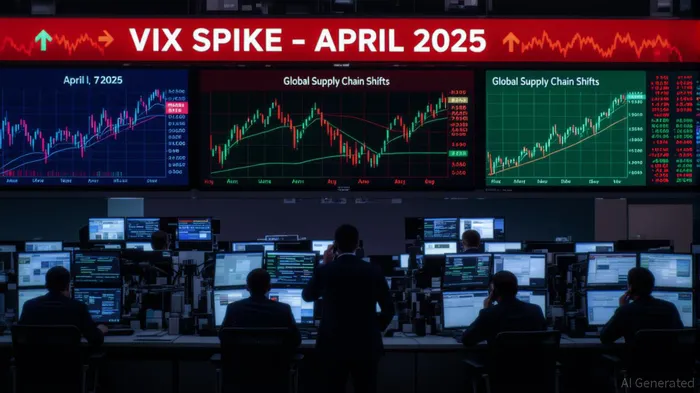
Market psychology in 2025 has been shaped by a duality of fear and optimism. On one hand,
the November 2025 Consumer Confidence Index fell to 88.7, reflecting growing pessimism about job security and economic stability. On the other,
Q4 2025 saw 57% of retail traders adopt a bullish stance, albeit with caution about overvaluation in AI-driven sectors. This tension has led to a rotation into perceived safe havens: European assets, which have benefited from fiscal stimulus and structural reforms, and gold, which has seen sustained upward pressure due to central bank purchases
according to market analysis. Meanwhile, the AI sector, while a growth engine, has become a "crowded trade," with two-thirds of traders viewing it as overextended
according to trader sentiment data.
Actionable Strategies for Navigating Volatility
- Diversification Across Geographies and Sectors: Investors should prioritize portfolios that balance exposure to U.S. AI-driven growth with European value plays and emerging market opportunities.
European equities, supported by fiscal stimulus, offer a hedge against U.S. trade policy risks. - Embrace Defensive and Cyclical Sectors: While AI and tech stocks remain central to long-term growth, defensive sectors like utilities and consumer staples can provide stability during corrections.
Cyclical sectors, such as small-cap stocks, have shown resilience in Q4 2025 and may benefit from Fed easing. - Leverage Precious Metals and Currency Hedges: Gold's role as a store of value has been reinforced by central bank demand, making it a strategic addition to portfolios amid dollar weakness and geopolitical risks
according to market analysis. Currency hedges, particularly against the euro and yen, can also mitigate trade war-related volatility. - Monitor Fed Policy and Inflation Data Closely: Given the Fed's conditional approach to rate cuts, investors should remain agile, adjusting positions based on incoming labor market and inflation data.
The December 2025 rate cut, for instance, was driven by soft employment figures and stable core inflation.
Conclusion
The DJIA's volatility in 2025 is a product of both macroeconomic forces and psychological responses to uncertainty. While geopolitical tensions and inflationary pressures remain headwinds, the Fed's policy flexibility and AI-driven productivity gains offer a counterbalance. For investors, the key lies in balancing defensive positioning with selective exposure to growth opportunities, all while maintaining a disciplined approach to risk management. As the market navigates this complex landscape, adaptability will be the hallmark of successful strategies.

Stay ahead of the market.
Get curated U.S. market news, insights and key dates delivered to your inbox.


AInvest
PRO
AInvest
PRO



Comments
No comments yet