
Dow Jones Hits 50,000: Can Trump's "100,000" Prophecy Become Reality?
Key Takeaways:
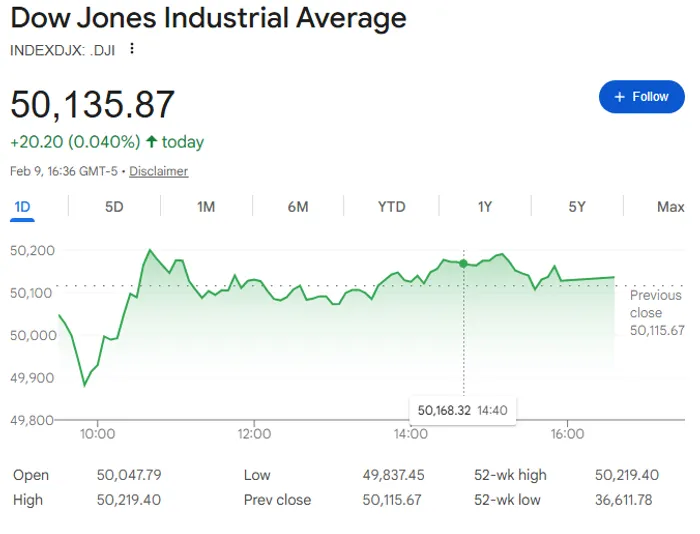
Historic Milestone: The Dow Jones Industrial Average (DJIA) has officially crossed the 50,000 mark as of February 2026, driven by a rotation into industrial and value stocks amid new tariff policies.
The Prediction: President Donald Trump has predicted the index will hit 100,000 by the end of his term (Jan 2029), implying a 100% gain in under three years.
The Challenge: To achieve this, the Dow would need a Compound Annual Growth Rate (CAGR) of approximately 26%, significantly higher than the historical average of ~7-10%.
Market Drivers: The current rally is fueled by strong Q4 2025 GDP growth (5.4%) and investor optimism surrounding protectionist trade policies, though uncertainty looms regarding an upcoming Supreme Court ruling on tariffs.
What is the Dow Jones Industrial Average?
The Dow Jones Industrial Average (DJIA), often referred to simply as "the Dow," is one of the oldest and most widely recognized stock market indices in the world. Founded by Charles Dow on May 26, 1896, it originally tracked just 12 industrial companies. Today, it tracks 30 prominent companies listed on stock exchanges in the United States.
Unlike the S&P 500, which is weighted by market capitalization, the Dow is price-weighted. This means that companies with higher stock prices have a greater influence on the index's movement than those with lower prices, regardless of their total company value. You can find the full methodology and history on Investopedia or Wikipedia.
What do its fluctuations represent?
Rising Dow: Generally indicates investor confidence in the U.S. economy, particularly in the industrial, consumer, and financial sectors.
Falling Dow: Suggests economic pessimism, often triggered by inflation fears, geopolitical instability, or poor corporate earnings.
The Road to 50,000: Why Now?
On February 6, 2026, the Dow Jones Industrial Average closed above 50,000 for the first time, settling at 50,115.67. This historic surge has been attributed to several key factors:
The "Trump Trade" Revival: Following his inauguration in 2025, President Trump's aggressive tariff policies have shifted investor focus from technology stocks to domestic manufacturing and "old economy" sectors—the core of the Dow.
Economic Resilience: Despite fears of inflation, the U.S. economy posted a surprising 5.4% GDP growth in the final quarter of 2025.
Sector Rotation: As highlighted by market analysts, capital is flowing out of high-valuation tech plays and into blue-chip defensive stocks, benefiting the Dow more than the Nasdaq.
According to reports from Reuters and market data from Bloomberg, this rally marks a 4.3% year-to-date gain in early 2026, continuing the momentum from a 15% rise in the S&P 500 during the first year of Trump's second term.
Trump's 100,000 Prediction: A Data-Driven Feasibility Analysis
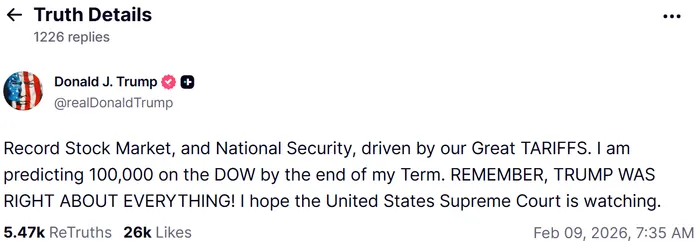
In a recent post on Truth Social, President Trump declared: "I am predicting 100,000 on the DOW by the end of my Term."
Is this mathematically possible, or is it mere political hyperbole? Let's break down the numbers using the Rule of 72 and historical growth rates.
Current Level: ~50,000 (Feb 2026)
Target Level: 100,000
Timeframe: ~3 years (Until Jan 2029)
Required Growth: 100% (Doubling)
To double an investment in 3 years, the market requires an annual return (CAGR) of roughly 26%.
Historical Context vs. The Target
Data sources: Macrotrends, TradingView
The Verdict: While not impossible, hitting 100,000 by 2029 would require an unprecedented sustained bull market similar to the height of the Dot-com bubble or the immediate post-COVID recovery. Most analysts from The Wall Street Journal and MarketWatch would classify this as a "low probability" scenario, especially given the looming risks of inflation from tariffs and the potential for the Supreme Court to strike down key economic policies on February 20.
Frequently Asked Questions (FAQ)
Q1: How does the "Price-Weighted" nature of the Dow affect Trump's goal?
Because the Dow is price-weighted, a massive rally in a few high-priced stocks (like UnitedHealth or Goldman Sachs) can disproportionately lift the index. If the Trump administration's policies specifically favor these heavyweights (e.g., healthcare deregulation or banking incentives), the index could rise faster than the broader economy, making the 100,000 target slightly more plausible than it appears for the S&P 500.
Q2: What is the biggest risk to the 50,000 level holding?
The immediate risk is the Supreme Court decision expected on February 20 regarding the constitutionality of the new tariffs. President Trump explicitly noted, "I hope the United States Supreme Court is watching." A ruling against the administration could unwind the "protectionist premium" currently priced into industrial stocks, potentially causing a sharp correction.
Q3: Has the Dow ever doubled in 3 years before?
Yes, but rarely. It happened during the roaring 1920s and the rebound from the Great Depression (mid-1930s), as well as the recovery from the 2008 Financial Crisis and the 2020 Pandemic crash. However, doubling from a record high (like 50,000) is significantly harder than doubling from a crash bottom due to valuation concerns.
Q4: How do Tariffs actually impact the Dow components?
Theoretically, tariffs increase input costs for manufacturers (bad for profits). However, if tariffs effectively block foreign competition, domestic companies can raise prices and capture more market share (good for revenue). The current market rally suggests investors believe the latter effect—increased domestic market share—will outweigh the higher costs for Dow components like Caterpillar or Boeing.
Conclusion
The Dow Jones Industrial Average standing at 50,000 is a testament to the resilience of the American economy and the impact of the current administration's fiscal shifts. However, President Trump's vision of Dow 100,000 by 2029 demands a "perfect storm" of high growth, deregulation, and favorable monetary policy. As investors watch the Supreme Court and the Federal Reserve, the path from 50k to 100k promises to be one of the most volatile periods in market history.

The AInvest News Editorial Team consists of experienced financial journalists and editors who oversee all published content. While our newsroom leverages advanced AI tools to assist in data gathering and draft generation, every article is reviewed, fact-checked, and approved by human editors to ensure accuracy, clarity, and transparency.
Latest Articles
Stay ahead of the market.
Get curated U.S. market news, insights and key dates delivered to your inbox.


AInvest
PRO
AInvest
PRO



Comments
No comments yet