
Dow Jones and S&P 500 Volatility: What Recent Market Moves Mean for Investors
 Aime Summary
The stock market has been on a wild ride recently, with sharp swings that have left many investors wondering if this is the start of a correction or a temporary blip. The Dow Jones Industrial Average, S&P 500, and Nasdaq Composite all posted significant losses on December 12, 2025, marking one of the most volatile stretches in months. While the Federal Reserve has signaled more rate cuts ahead, investors remain cautious as tech stocks—once the market's star performers—have begun to show signs of strain. Understanding what's happening now is key to making informed decisions in a market that's clearly in transition.
Market Turbulence: A Closer Look at Recent Moves
The December 12 sell-off was one of the worst days for U.S. stocks in three weeks, with the S&P 500 falling 1.1% from its all-time high. The Nasdaq Composite dropped 1.7%, and 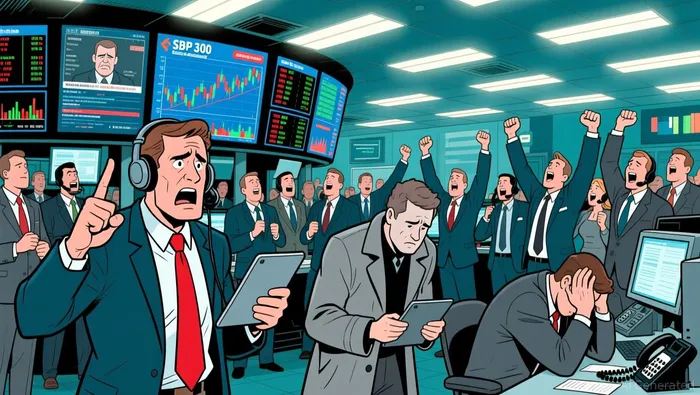 the Dow Jones gave back 0.5% after hitting a record high just a day earlier. The biggest drags on the market were tech stocks, with BroadcomAVGO-- tumbling 11.4% and OracleORCL-- falling another 4.5%. These losses came despite some companies reporting strong earnings—highlighting how investor sentiment can shift quickly in a high-growth sector.
Meanwhile, the 10-year Treasury yield climbed to 4.18%, signaling concerns about inflation and economic growth. That move pushed money into safer assets and further pressured equities. For now, the market appears to be reacting to both near-term earnings reports and the broader macroeconomic backdrop, especially as the Fed continues to adjust its stance on monetary policy.
Tech, the Fed, and the Big Picture
Tech stocks have long been the market's bellwethers, and their recent struggles reflect a shift in investor psychology. For months, the sector has been driven by expectations around artificial intelligence, but recent volatility suggests that some of the hype is being recalibrated. Broadcom's drop is particularly telling—despite beating expectations for the quarter and providing strong guidance, the stock fell sharply, showing how fast sentiment can turn.
At the same time, the Fed's rate cuts are creating a mixed environment. On December 10, the central bank cut its benchmark rate by 0.25% to 3.60%, marking the third cut of 2025. This move was aimed at supporting a slowing labor market and managing inflation, and it helped stocks rebound in the short term. The S&P 500 rose 0.7% after the decision, and the Dow Jones climbed nearly 1%.
However, not all Fed officials agreed—three dissenters signaled differing views on the pace of cuts. The Fed now projects one more rate cut in 2026 and another in 2027, suggesting a slow and deliberate approach. This cautious path means investors should expect a more measured market response to policy changes, especially as the economy remains on a delicate balance between growth and inflation.
What This Means for Retail Investors
For individual investors, the recent market moves highlight a key theme: the importance of diversification. While tech stocks have led the market for much of the year, their recent volatility suggests that overreliance on a single sector can be risky. On the other hand, the broader market remains resilient—especially with the Fed's rate cuts likely to lower borrowing costs and support corporate profits in the near term.
The Russell 2000, for instance, hit record highs in early December as traders priced in the possibility of a Fed rate cut. That index, which represents smaller companies, tends to benefit more directly from falling rates. Meanwhile, sectors like real estate, autos, and retail are historically strong performers during rate-cutting cycles according to financial analysis. This means investors might want to pay closer attention to how different industries respond to changing interest rates.
Still, the market is not without its challenges. The year-to-date performance of 2025 has been mixed, with the S&P 500 down 9% and some top-performing stocks like Tesla, AMDAMD--, and NvidiaNVDA-- falling more than 20%. That's a reminder that no market is immune to corrections, especially when expectations are high and sentiment shifts rapidly.
A Look Ahead: Preparing for 2026
As the market heads into 2026, the key questions will revolve around inflation, the labor market, and how the Fed balances these factors. Charles Schwab's outlook for the year suggests that while the macroeconomic environment will remain unstable, earnings growth is expected to continue. Eight out of 11 S&P 500 sectors are projected to see stronger earnings growth than in 2025, which is a positive sign for overall market resilience.
Looking at the Fed's roadmap, the central bank's next moves will be closely watched. If inflation remains near 3%, rate cuts could continue to support economic activity and corporate earnings. However, if inflation shows signs of rebounding, the Fed may pause or even consider tightening again. This uncertainty means investors should remain agile and ready to adjust to new data.
In the meantime, the market is also digesting the impact of fiscal policy, tariffs, and technological shifts—especially in AI. These factors are likely to shape sector rotations and investment opportunities in the coming months. For now, the message is clear: while the market remains in transition, a balanced approach that considers both macroeconomic shifts and sector-specific dynamics is the best way to navigate the current environment.

Delivering real-time insights and analysis on emerging financial trends and market movements.
Latest Articles
Stay ahead of the market.
Get curated U.S. market news, insights and key dates delivered to your inbox.
AInvest
PRO
AInvest
PRO



Comments
No comments yet