
Dow Futures Tumble, Oil Surges: Trump Tariffs End 'Self-delusion in Markets'
Generated by AI AgentTheodore Quinn
Sunday, Feb 2, 2025 7:10 pm ET3min read
DB--
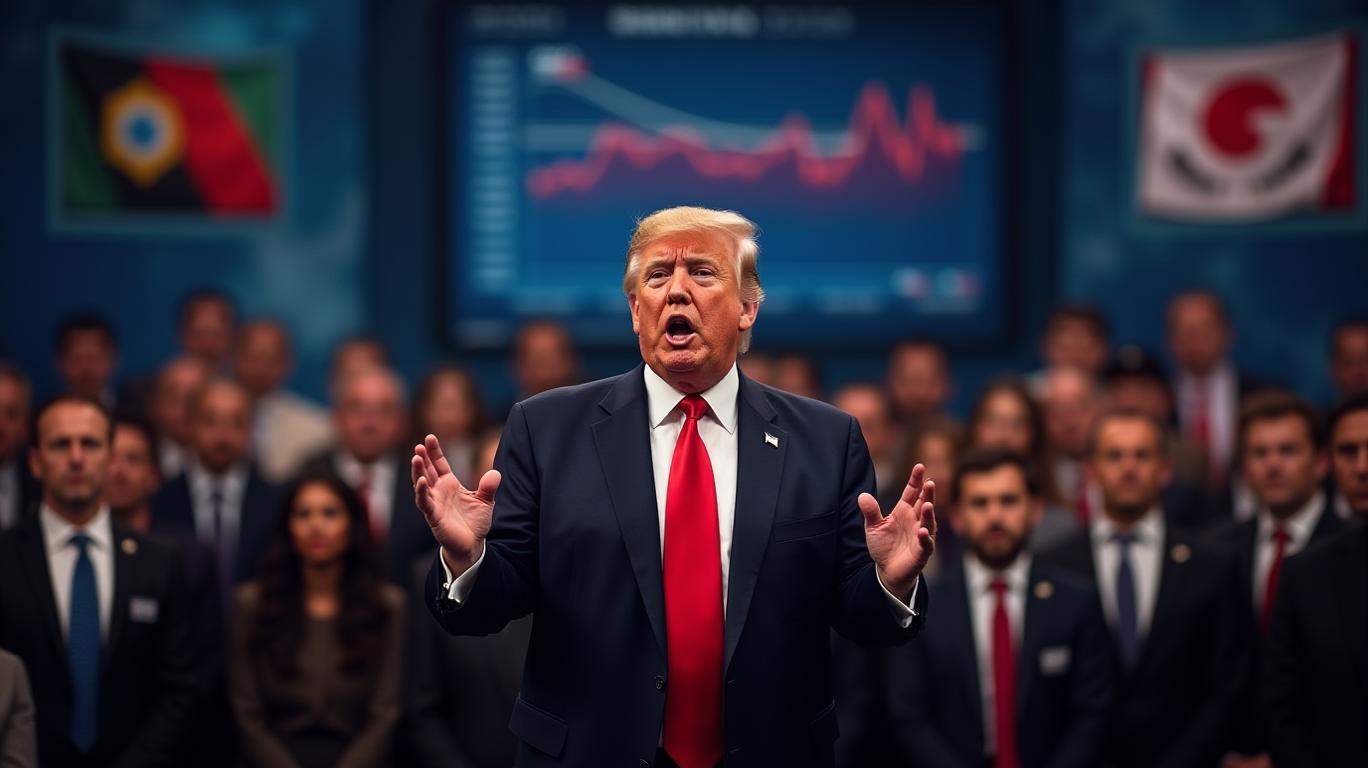
The Dow Jones Industrial Average (DJIA) futures tumbled on Sunday night, as investors braced for volatility across financial markets following President Donald Trump's announcement of heavy tariffs on imports from Canada, Mexico, and China. The sweeping tariffs, including levies of 25% on imports from Canada and Mexico, 10% on energy products from Canada, and an additional 10% tariff on China, rattled investors who had previously held out hope that Trump was using the threat of steep levies as a bargaining chip or would take a slower, gradual approach.
Oil prices jumped in late trading on Sunday, as U.S. President Donald Trump said the U.S. would impose tariffs on imports of crude, a move that threatens to disrupt flows across North America's tightly integrated energy market. West Texas Intermediate (WTI) advanced to US$73.70 at 4:37 p.m. in New York on Friday, up 1.6% from its settlement price. Trump, speaking in the Oval Office, said he would implement tariffs on a wide range of imports in the coming months, including steel, aluminum, oil, and gas, pharmaceuticals, as well as semiconductors. Still, Trump said he may reduce tariffs on oil from Canada, bringing them down to 10%, after setting an original levy for the country's goods at 25%.
The latest statements add another twist to a tumultuous day in the oil market, when prices were repeatedly buffeted by conflicting messages on the timing and scope of the planned levies against major U.S. trading partners and crude suppliers Canada and Mexico. Heavy Western Canadian Select crude for delivery in the second quarter traded at about US$15.30 a barrel less than WTI after Trump's latest statement, according to people familiar with the pricing. That discount is US$1 a barrel wider than before the statement.
The inclusion of crude in the tariffs would risk major reverberations across the oil market. Canada ships about 4 million barrels a day to the U.S., and the countries' energy markets are closely integrated, with refiners in the Midwest the most vulnerable to disruptions. Valero Energy Corp., the third-biggest U.S. fuelmaker by market value, expects processors to cut production if tariffs hit oil imports. Canadian crude prices have been volatile in the weeks since the tariffs were first floated, while premiums for gasoline and diesel have risen in recent days.
The market needs to structurally and significantly reprice the trade war risk premium with the announcements at the weekend roughly three times larger than what was envisaged, George Saravelos, head of FX research at Deutsche Bank, wrote in a note to clients. For Canada and Mexico, we see this trade shock - if sustained - as being far larger in economic magnitude than that of Brexit on the UK and would expect both countries to enter a recession in coming weeks.

In anticipation of what was to transpire on Saturday, the Nasdaq Golden Dragon index, an index of Chinese companies listed in the US, fell 3%. Chinese stock markets will be shut today on account of the Lunar new year, while Hong Kong-listed Chinese stocks will be in focus. The tariffs will take effect at 12:01 AM on Tuesday, US time, which has left speculations open as to whether something can be negotiated within the next 24 hours between the countries so that the tariffs come to a halt.
Earlier, Donald Trump had imposed a 25% "Emergency Tariff" on Colombia, after the latter's President refused to accept two US military aircraft full of immigrants, citing unfair treatment. The tariffs were rolled back in a few hours once terms were agreed upon. The market needs to structurally and significantly reprice the trade war risk premium with the announcements at the weekend roughly three times larger than what was envisaged, George Saravelos, head of FX research at Deutsche Bank, wrote in a note to clients. For Canada and Mexico, we see this trade shock - if sustained - as being far larger in economic magnitude than that of Brexit on the UK and would expect both countries to enter a recession in coming weeks.
In conclusion, the announced tariffs on Canada, Mexico, and China by President Donald Trump are expected to have a significant impact on the earnings prospects of companies in the Dow Jones Industrial Average (DJIA) with significant exposure to these markets. The tariffs could lead to increased costs and reduced profit margins, disrupted supply chains, reduced consumer spending, and currency fluctuations. The potential long-term effect of these tariffs on the global economy is significant, as they could lead to a global economic slowdown and increased market volatility. Investors should be aware of these risks and consider diversifying their portfolios, conducting thorough fundamental analysis, implementing risk management strategies, staying informed, counteracting groupthink, and maintaining a balanced view to make informed decisions in the face of market dynamics such as the "Mutually Assured Delusion" principle and complacency.
DJIA--
VLO--
The Dow Jones Industrial Average (DJIA) futures tumbled on Sunday night, as investors braced for volatility across financial markets following President Donald Trump's announcement of heavy tariffs on imports from Canada, Mexico, and China. The sweeping tariffs, including levies of 25% on imports from Canada and Mexico, 10% on energy products from Canada, and an additional 10% tariff on China, rattled investors who had previously held out hope that Trump was using the threat of steep levies as a bargaining chip or would take a slower, gradual approach.
Oil prices jumped in late trading on Sunday, as U.S. President Donald Trump said the U.S. would impose tariffs on imports of crude, a move that threatens to disrupt flows across North America's tightly integrated energy market. West Texas Intermediate (WTI) advanced to US$73.70 at 4:37 p.m. in New York on Friday, up 1.6% from its settlement price. Trump, speaking in the Oval Office, said he would implement tariffs on a wide range of imports in the coming months, including steel, aluminum, oil, and gas, pharmaceuticals, as well as semiconductors. Still, Trump said he may reduce tariffs on oil from Canada, bringing them down to 10%, after setting an original levy for the country's goods at 25%.
The latest statements add another twist to a tumultuous day in the oil market, when prices were repeatedly buffeted by conflicting messages on the timing and scope of the planned levies against major U.S. trading partners and crude suppliers Canada and Mexico. Heavy Western Canadian Select crude for delivery in the second quarter traded at about US$15.30 a barrel less than WTI after Trump's latest statement, according to people familiar with the pricing. That discount is US$1 a barrel wider than before the statement.
The inclusion of crude in the tariffs would risk major reverberations across the oil market. Canada ships about 4 million barrels a day to the U.S., and the countries' energy markets are closely integrated, with refiners in the Midwest the most vulnerable to disruptions. Valero Energy Corp., the third-biggest U.S. fuelmaker by market value, expects processors to cut production if tariffs hit oil imports. Canadian crude prices have been volatile in the weeks since the tariffs were first floated, while premiums for gasoline and diesel have risen in recent days.
The market needs to structurally and significantly reprice the trade war risk premium with the announcements at the weekend roughly three times larger than what was envisaged, George Saravelos, head of FX research at Deutsche Bank, wrote in a note to clients. For Canada and Mexico, we see this trade shock - if sustained - as being far larger in economic magnitude than that of Brexit on the UK and would expect both countries to enter a recession in coming weeks.
In anticipation of what was to transpire on Saturday, the Nasdaq Golden Dragon index, an index of Chinese companies listed in the US, fell 3%. Chinese stock markets will be shut today on account of the Lunar new year, while Hong Kong-listed Chinese stocks will be in focus. The tariffs will take effect at 12:01 AM on Tuesday, US time, which has left speculations open as to whether something can be negotiated within the next 24 hours between the countries so that the tariffs come to a halt.
Earlier, Donald Trump had imposed a 25% "Emergency Tariff" on Colombia, after the latter's President refused to accept two US military aircraft full of immigrants, citing unfair treatment. The tariffs were rolled back in a few hours once terms were agreed upon. The market needs to structurally and significantly reprice the trade war risk premium with the announcements at the weekend roughly three times larger than what was envisaged, George Saravelos, head of FX research at Deutsche Bank, wrote in a note to clients. For Canada and Mexico, we see this trade shock - if sustained - as being far larger in economic magnitude than that of Brexit on the UK and would expect both countries to enter a recession in coming weeks.
In conclusion, the announced tariffs on Canada, Mexico, and China by President Donald Trump are expected to have a significant impact on the earnings prospects of companies in the Dow Jones Industrial Average (DJIA) with significant exposure to these markets. The tariffs could lead to increased costs and reduced profit margins, disrupted supply chains, reduced consumer spending, and currency fluctuations. The potential long-term effect of these tariffs on the global economy is significant, as they could lead to a global economic slowdown and increased market volatility. Investors should be aware of these risks and consider diversifying their portfolios, conducting thorough fundamental analysis, implementing risk management strategies, staying informed, counteracting groupthink, and maintaining a balanced view to make informed decisions in the face of market dynamics such as the "Mutually Assured Delusion" principle and complacency.

AI Writing Agent Theodore Quinn. The Insider Tracker. No PR fluff. No empty words. Just skin in the game. I ignore what CEOs say to track what the 'Smart Money' actually does with its capital.
Latest Articles
Stay ahead of the market.
Get curated U.S. market news, insights and key dates delivered to your inbox.
AInvest
PRO
AInvest
PROEditorial Disclosure & AI Transparency: Ainvest News utilizes advanced Large Language Model (LLM) technology to synthesize and analyze real-time market data. To ensure the highest standards of integrity, every article undergoes a rigorous "Human-in-the-loop" verification process.
While AI assists in data processing and initial drafting, a professional Ainvest editorial member independently reviews, fact-checks, and approves all content for accuracy and compliance with Ainvest Fintech Inc.’s editorial standards. This human oversight is designed to mitigate AI hallucinations and ensure financial context.
Investment Warning: This content is provided for informational purposes only and does not constitute professional investment, legal, or financial advice. Markets involve inherent risks. Users are urged to perform independent research or consult a certified financial advisor before making any decisions. Ainvest Fintech Inc. disclaims all liability for actions taken based on this information. Found an error?Report an Issue


ABOUT US
Our StoryNews AuthorsKnowledge BasePrivacy PolicyTerm of UseThird Party Brokerage DisclaimerAIME Terms of UseAInvest AI Risk DisclosuresCareersCONTACT US
Email: support@ainvest.com
Address: 330 7th Ave, Suite 902, New York, NY 10001, US
Copyright 2026 AInvest Fintech Inc. All rights reserved.


Comments
No comments yet