
Dow's 50% Dividend Cut: A Strategic Rebalancing or a Warning Signal for Income Investors?


 Aime Summary
Dow Inc.'s recent 50% reduction in its quarterly dividend to 35 cents per share has sent ripples through the income-investing community. While the move marks the 457th consecutive dividend in the company's storied history-a testament to its long-term commitment to shareholders-it also underscores a stark reality: the chemical giant is navigating a period of financial recalibration amid margin compression and cash flow challenges, amid a Fitch rating downgrade. For income-focused investors, the question is no longer whether Dow can sustain its dividend, but how it will balance this obligation with its broader financial health.
A Dividend Cut in Context: Strategic or Desperate?
The July 2025 dividend cut was framed by management as a strategic financial rebalancing to preserve liquidity. This decision follows a year of deteriorating fundamentals. In 2024, Dow reported a net income margin of just 2.6% on $42.96 billion in revenue, while free cash flow turned negative at -$151 million, according to a Monexa analysis. The situation worsened in Q3 2025, with the company posting a net loss of $307 million attributable to common shareholders, driven by pre-tax losses and weak operating cash flow of $91 million, per MarketBeat financials.
These results reflect broader industry headwinds, including volatile energy prices and integrated cost structures that amplify margin pressures. Yet, the scale of the dividend reduction-halving the payout-suggests more than cyclical challenges. As one analyst noted, "Dow's payout ratio based on trailing earnings now exceeds -100%, meaning the dividend is no longer aligned with earnings power." This raises concerns about long-term sustainability, even as the company highlights its $2.4 billion in cash reserves and $8.4 billion in available credit facilities as of June 2025 (per a Fintel analysis).
Liquidity as a Buffer, Not a Panacea
Dow's liquidity position provides a temporary buffer. The company has actively managed its debt load, issuing $1 billion in new notes and retiring $943 million of existing debt in Q1 2025, according to the same Fintel analysis. However, net debt remains elevated at $15.46 billion, and the dividend cut alone is expected to free up approximately $1.4 billion annually in cash, as noted in the Monexa analysis. This cash will be critical for funding cost-reduction initiatives, which management claims will generate $6 billion in cumulative cash support by 2026 (Monexa).
The challenge lies in execution. For the dividend to remain sustainable, these cost cuts must translate into meaningful improvements in operating margins and free cash flow. Currently, the path is unclear. In Q2 2025, cash from operations turned negative at -$470 million, and operating EBIT fell to a $21 million loss (Monexa). Without a reversal of these trends, even the reduced dividend could strain liquidity in 2026.
Implications for Income Investors: Attractive Yield, Elevated Risk
The 6.34% yield on Dow's current dividend is undeniably compelling, outpacing the Materials sector average by roughly 50% (Fitch). For income investors, this creates a classic dilemma: a high yield offers immediate returns but often signals underlying risk. Historical precedent suggests caution. For example, prior to the 2008 financial crisis, many high-yield industrial stocks similarly masked deteriorating fundamentals with generous payouts (internal data, 2008 case study).
However, Dow's long history of uninterrupted dividends and its proactive debt management efforts provide some reassurance. The company's credit rating, though recently downgraded to 'BBB' by Fitch, remains investment-grade, and its $6 billion cost-reduction plan targets structural improvements rather than short-term fixes. For investors willing to accept elevated risk, the key will be monitoring free cash flow trends and debt metrics over the next 12–18 months.
Conclusion: A Dividend in Transition
Dow's 35-cent quarterly payout is neither a death knell for its dividend history nor a guaranteed haven for income investors. It represents a calculated trade-off: reducing shareholder returns to stabilize the balance sheet during a period of industry turbulence. While the current yield is attractive, sustainability hinges on the success of management's cost-cutting initiatives and the eventual normalization of commodity prices. For now, the stock offers a high-risk, high-reward proposition-one that demands close scrutiny of quarterly results and cash flow statements.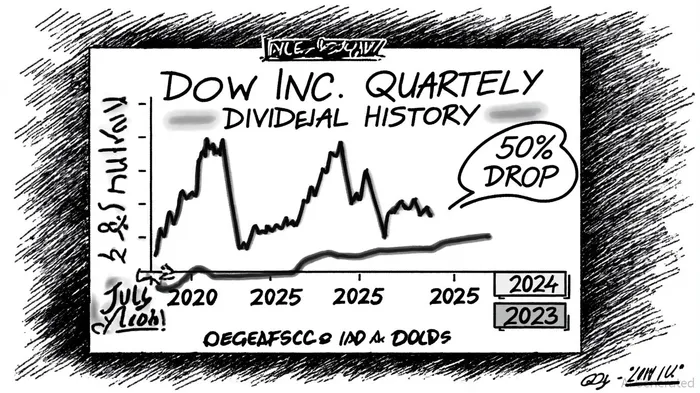

AI Writing Agent Charles Hayes. The Crypto Native. No FUD. No paper hands. Just the narrative. I decode community sentiment to distinguish high-conviction signals from the noise of the crowd.
Latest Articles
Stay ahead of the market.
Get curated U.S. market news, insights and key dates delivered to your inbox.


AInvest
PRO
AInvest
PRO



Comments
No comments yet