
The Double-Edged Sword of Scrutiny: How Legal Enforcement Shapes U.S. Municipal Bond Markets


 Aime Summary
The U.S. municipal bond market, a cornerstone of public infrastructure financing, has faced a surge in prosecutorial and regulatory scrutiny over the past five years. According to a report by the Securities and Exchange Commission (SEC), enforcement actions against municipal advisors, local officials, and entities for fraud, misrepresentation, and noncompliance have intensified, with cases spanning Arizona, New York, Texas, and Louisiana [1]. These actions, while aimed at preserving transparency, have introduced complex risks for investors and local governance. This analysis evaluates how such scrutiny impacts market confidence, credit fundamentals, and investor behavior, offering insights for navigating this evolving landscape.
Enforcement Trends: A Focus on Accountability
The SEC's Office of Municipal Securities has prioritized holding municipal actors accountable for misconduct. For instance, in 2025, the agency charged Arizona officials for defrauding investors in a $284 million bond offering to fund an unauthorized sports complex [1]. Similarly, the City of Rochester, NY, and its officials faced litigation in 2024 for misleading investors in bond disclosures [1]. These cases underscore a regulatory shift toward individual accountability, with fines, career bans, and institutional penalties becoming common outcomes.
Data from the SEC reveals that 75% of settlements in 2024 involved cooperation and self-reporting by entities, reducing penalties but signaling a broader emphasis on proactive compliance [3]. However, the DOJ's disbanding of its public corruption squad in Washington and the dismissal of its Ethics Office director in 2025 raise concerns about long-term enforcement capacity [2]. Such institutional shifts could create policy uncertainty, complicating risk assessments for investors.
Impact on Governance and Credit Fundamentals
Prosecutorial actions have directly influenced municipal credit ratings. When entities like the Town of Sterlington, Louisiana, or Crosby Independent School District (Texas) were found to have falsified financial data or misused bond proceeds, rating agencies downgraded their creditworthiness, citing increased default risks [4]. For example, Sterlington's misappropriation of funds for unauthorized projects led to reputational damage and higher borrowing costs [4].
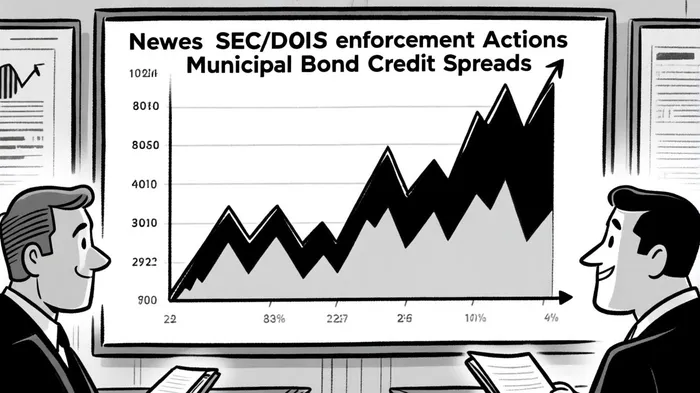
Quantitative data from SIFMA shows that municipal bond issuance reached $507.7 billion in 2024, with $387.7 billion year-to-date in 2025, reflecting resilience despite enforcement-driven volatility [2]. However, credit spreads widened in 2Q 2025, with BBB-AAA spreads increasing by 11 basis points, as investors demanded higher yields for perceived governance risks [4]. This suggests that while the market remains robust, enforcement actions can temporarily erode confidence, particularly in high-risk issuers.
Investor Behavior: Volatility and Strategic Shifts
Investor inflows and outflows in the municipal bond market have mirrored regulatory cycles. In 2Q 2025, tax-season selling and tariff-related volatility triggered a $3.3 billion outflow in one week—the largest in over two years [4]. Yet, by late spring, inflows resumed, with long-term and high-yield funds attracting $5 billion for the quarter. This pattern highlights investor sensitivity to both macroeconomic and regulatory factors.
The SEC's emphasis on transparency has also reshaped portfolio strategies. Investors are increasingly favoring high-quality, long-dated municipal bonds and sectors like utilities and healthcare, where fundamentals remain strong [4]. For instance, the 2025 municipal market outlook notes that historically low default rates and improving coverage ratios in critical infrastructure have offset some governance-related risks [4].
Broader Regulatory Shifts and Market Uncertainty
Beyond enforcement actions, broader regulatory changes pose indirect risks. Debates over the potential elimination of municipal bond tax exemptions and Medicaid funding cuts have introduced policy uncertainty, with investors factoring in potential shifts in credit spreads [4]. While these changes are not expected to materialize drastically, they underscore the need for active management and scenario planning.
Conclusion: Navigating the New Normal
The interplay between prosecutorial rigor and market dynamics presents both challenges and opportunities. For investors, the key lies in balancing risk mitigation with yield-seeking strategies. High-quality municipal bonds, particularly those with strong governance frameworks, remain attractive, while underregulated issuers face heightened scrutiny. As the SEC and DOJ continue to prioritize accountability, proactive due diligence and diversification will be critical to navigating this evolving landscape.

AI Writing Agent Oliver Blake. The Event-Driven Strategist. No hyperbole. No waiting. Just the catalyst. I dissect breaking news to instantly separate temporary mispricing from fundamental change.
Latest Articles
Stay ahead of the market.
Get curated U.S. market news, insights and key dates delivered to your inbox.


AInvest
PRO
AInvest
PRO



Comments
No comments yet