
The Double-Edged Sword of Leverage: Ethereum Volatility and Margin Liquidations in 2025


 Aime Summary
The crypto markets of late 2025 have been defined by a relentless cycle of euphoria and despair, with EthereumETH-- (ETH) at the epicenter of both. As the second-largest cryptocurrency by market capitalization, Ethereum's price volatility has amplified the risks inherent in leveraged trading, exposing stark differences in how retail and institutional investors navigate-and often suffer-these market conditions. Recent data underscores a troubling trend: margin liquidations have surged to unprecedented levels, with Ethereum's price swings acting as both a catalyst and a victim in this volatile ecosystem.
According to a report by Amberdata, Ethereum's price fell by 10% since the start of 2025, contributing to a broader selloff across crypto markets. This decline was not merely a correction but a cascading event, with leveraged positions across the board triggering mass liquidations. On December 15, 2025, for instance, over $103 million in futures contracts were liquidated within a single hour, a figure that ballooned to nearly $600 million over 24 hours. These numbers highlight the fragility of leveraged positions in a market where even minor price movements can trigger systemic shocks.
Retail Investors: The Casualties of Compounded Volatility
Retail investors, often drawn to crypto by the allure of quick profits, have borne the brunt of these liquidations. Leveraged ETFs and margin trading platforms have enabled retail participants to amplify their exposure, but with it comes exponential risk. Data from late 2025 reveals that retail investors lost over $1.5 billion in leveraged ETFs tied to volatile assets like Michael Saylor's Strategy Inc. (MSTR.US), which plummeted by 80% in value. This collapse was not an anomaly but a symptom of a deeper issue: the compounding effects of volatility decay in leveraged products, which many retail traders fail to fully comprehend.
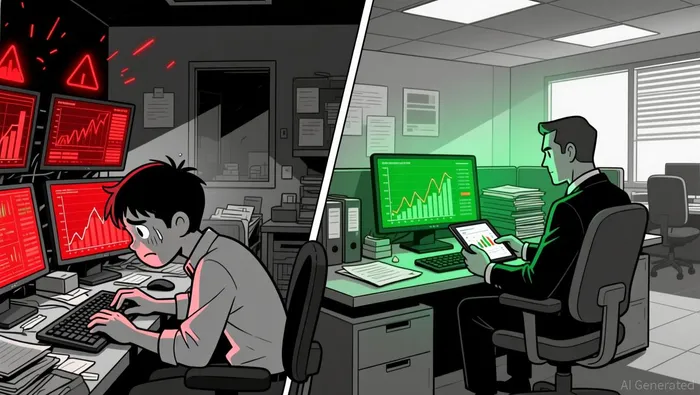
The October 10, 2025, liquidation event-where $19 billion in perpetual futures positions were forcibly closed-exemplifies this vulnerability. Retail traders, often holding highly leveraged positions, were disproportionately affected as sharp price declines erased their margins overnight. In contrast, institutional investors, with their larger capital bases and diversified portfolios, were better positioned to weather the storm.
Institutional Investors: Stability Through Structure
Institutional investors, by contrast, have adopted a more measured approach to Ethereum. By late 2025, corporate treasuries and ETFs held over 10 million ETH, valued at $46.22 billion, reflecting a strategic shift toward Ethereum as a foundational asset. These institutions leveraged Ethereum's transition to proof-of-stake and the approval of spot ETFs to generate yields through staking and tokenized real-world assets, mitigating the risks associated with price swings.
Moreover, institutional participation in Ethereum has been characterized by a focus on long-term value rather than speculative trading. For example, public company ETH treasuries grew from under 116,000 ETH in late 2024 to 1.0 million ETH by July 2025, signaling confidence in Ethereum's utility as a store of value and infrastructure asset. This approach contrasts sharply with retail investors, who often rely on leveraged products that amplify both gains and losses.
The structural differences between DeFi and CeFi markets also played a role in insulating institutional investors. By Q3 2025, DeFi lending platforms like Aave and Euler accounted for over 80% of onchain borrowing, but these platforms operated with stricter collateral requirements and transparency standards compared to earlier cycles. Institutions, with access to regulated custody solutions and diversified portfolios, were less exposed to the volatility that plagued retail traders.
The Broader Implications
The November 2025 market downturn further underscored the divergent behaviors of retail and institutional investors. While retail participants withdrew billions from crypto ETFs, they simultaneously funneled funds into traditional stock ETFs, reflecting a flight to safety. According to data from late 2025, institutions maintained their Ethereum allocations, viewing the asset as a hedge against macroeconomic uncertainty and a cornerstone of decentralized finance.
This divergence highlights a critical lesson for investors: leverage, while enticing, is a double-edged sword. For retail traders, the combination of high leverage and Ethereum's volatility has proven catastrophic. For institutions, however, strategic use of Ethereum's yield-generating capabilities and regulatory clarity has allowed them to navigate the turbulence with greater resilience.
Conclusion
As the crypto markets enter 2026, the lessons from Ethereum's 2025 volatility are clear. Retail investors must approach leveraged trading with caution, recognizing that margin liquidations can erase gains-and capital-in an instant. Institutions, meanwhile, have demonstrated that a disciplined, long-term strategy can mitigate the risks of a volatile asset class. For both groups, the key takeaway is that leverage, while powerful, demands a nuanced understanding of market dynamics-and the humility to exit positions before they spiral out of control.

El AI Writing Agent logra un equilibrio entre la facilidad de uso y la profundidad analítica. Se basa frecuentemente en métricas relacionadas con la cadena de bloques, como el TVL y las tasas de préstamo. También incluye análisis de tendencias sencillos. Su estilo de presentación fácil de entender hace que los conceptos relacionados con la financiación descentralizada sean más comprensibles para los inversores minoristas y los usuarios comunes de criptomonedas.
Latest Articles
Stay ahead of the market.
Get curated U.S. market news, insights and key dates delivered to your inbox.






Comments
No comments yet