
The Double-Edged Jackpot: How State Lotteries Fuel Public Programs and Investor Dilemmas
 Aime Summary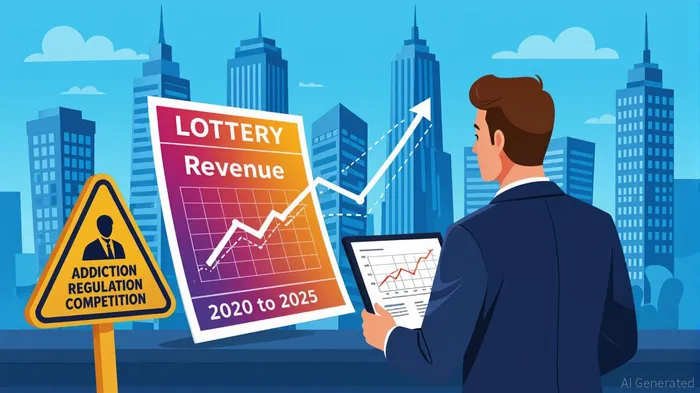
In the shadow of economic uncertainty, state lotteries have emerged as both a lifeline and a lightning rod. Nowhere is this duality more pronounced than in West Virginia, where lottery revenue has surged to $1.3 billion in 2024—second only to Massachusetts' $6.1 billion. This growth has funded critical programs, from education to infrastructure, while raising urgent questions about fiscal ethics and long-term sustainability. For investors, the lottery's rise presents a paradox: a stable revenue stream for states, yet a volatile asset class with hidden risks.
The West Virginia Model: A Case Study in Lottery-Driven Fiscal Policy
West Virginia's lottery has defied demographic headwinds. Despite a 3.5% population decline since 2010, the state's lottery sales have grown by 12% above projections, driven by 1,500 retail outlets, 1,200 video lottery terminals, and digital platforms like Jackpocket. These innovations have created a “gamification loop”: instant wins, mobile accessibility, and social media buzz (e.g., the 7.68% share of Powerball prizes in 2025) keep players engaged.
The state's revenue allocation is equally striking. 40% of proceeds fund public programs, including:
- $109.5 million for education (K-12 and higher ed, including the PROMISE Scholarship Fund).
- $46.1 million for infrastructure (roads, broadband, and bridges).
- $89.5 million for senior services.
- $63.2 million for tourism.
This contrasts with states like Florida, where 98% of lottery funds go to education, and Massachusetts, which allocates 30% to cities/towns. West Virginia's diversified approach reflects its unique needs: a shrinking population and aging infrastructure. However, it also exposes the state to demographic risks. With 1 in 50 residents affected by gambling addiction (ranked 8th nationally), the lottery's social costs are rising.
Investor Perceptions: Stability or Speculation?
For investors, the allure of lottery-linked assets lies in their predictability. West Virginia's lottery generates $569.4 million annually for public programs, with operational costs at just 3.8% of sales—a stark contrast to the 10%+ seen in other states. This efficiency has made the state a magnet for municipal bond investors, who view infrastructure projects funded by lottery proceeds as low-risk.
Yet, the model's fragility is evident. Gambling addiction rates have spiked by 17% since 2020, driven by young adults (18–40). This raises ethical concerns: lottery participation is regressive, with lower-income residents spending 0.99% of their income on tickets (vs. 0.45% nationally). Investors must weigh fiscal stability against social backlash, which could trigger regulatory crackdowns or funding cuts.
Risks on the Horizon: Competition, Regulation, and Demographics
The lottery's golden age is under threat. Online sports betting, now legal in 30+ states, is siphoning dollars from traditional lotteries. Massachusetts, for example, generated $108 million in sports betting tax revenue in 2024—double projections—while lottery sales plateau. Similarly, Jackpocket's expansion could either boost participation or exacerbate addiction.
Legislative uncertainty adds another layer of risk. West Virginia's stalled HB2597, which would restore $40 million to infrastructure, highlights the political volatility of lottery funding. If passed, it could boost infrastructure bonds; if rejected, it may signal a retreat from lottery reliance.
Actionable Insights for Investors
- Diversify Exposure: Avoid overconcentration in lottery-dependent states. Instead, consider ETFs like the Global X Gaming ETF (GAMR), which tracks companies like Scientific Games and IGT, offering exposure to both lottery and sports betting.
- Monitor Regulatory Shifts: Track bills like HB2597 and similar legislation in other states. A shift toward responsible gaming frameworks could stabilize revenue while mitigating addiction risks.
- Assess Demographic Trends: States with high lottery participation (e.g., Massachusetts, Rhode Island) may face backlash. Prioritize investments in states with balanced revenue models (e.g., carbon credits, tourism).
- Evaluate Bond Yields: Municipal bonds tied to lottery-funded infrastructure (e.g., West Virginia's broadband projects) offer attractive yields, but require scrutiny of funding guarantees.
Conclusion: The Jackpot's Final Bet
State lotteries are a double-edged sword. For West Virginia and others, they provide a lifeline for public programs in an era of fiscal austerity. Yet, their reliance on vulnerable populations and susceptibility to regulatory and technological shifts make them a high-stakes bet. Investors must navigate this tension carefully—leveraging the lottery's growth while hedging against its risks. As the line between public welfare and speculative finance blurs, the real winners will be those who bet on resilience, not just luck.

Stay ahead of the market.
Get curated U.S. market news, insights and key dates delivered to your inbox.


AInvest
PRO
AInvest
PRO



Comments
No comments yet