
The First Dose That Isn't the Real Risk
 Aime Summary
Most investors read "first patient dose in a Phase I/II trial" and file it under huge clinical risk: years away from anything resembling revenue. That picture is half right. What it deletes is that the delivery technology already works. JCR Pharmaceutical proved the J-Brain Cargo platform with IZCARGO, an approved enzyme-replacement drug now generating roughly ¥6.8 billion in annual revenue. The question for JR-446 isn't whether the delivery truck gets through the wall. It's whether it can carry a different payload.
The Truck Is Already on the Road
Put away the acronym for thirty seconds.
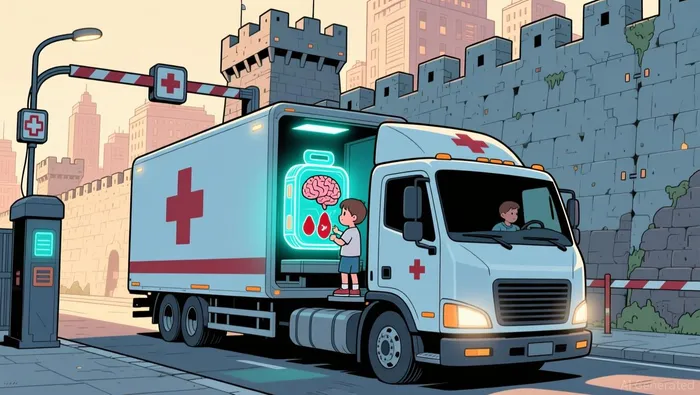
Imagine a city surrounded by a wall that only lets in certain vehicles. For decades, pharmaceutical companies trying to treat brain diseases have been building vehicles that fit through the checkpoints. JCR built one that actually gets through. They call it J-Brain Cargo.
The technology fuses a therapeutic enzyme with a fragment of an antibody that binds the transferrin receptor. That receptor naturally shuttles cargo across the blood-brain barrier through a process called transcytosis. The enzyme piggybacks through the wall, then goes to work clearing toxic metabolites from brain tissue.
IZCARGO (pabinafusp alfa) is the first drug to use this platform. It delivers an enzyme called iduronate-2-sulfatase to treat MPS II, also known as Hunter syndrome. Japan approved it in March 2021 through a fast-track pathway. The UAE approved it in July 2026, marking its first exit from Japan. In FY2026 (the twelve months ended March 31, 2026), IZCARGO brought in ¥6,766 million, up 18% from the prior year.
JR-446 is the same platform, different enzyme. It delivers alpha-N-acetylglucosaminidase to treat MPS IIIB, one of the four subtypes of Sanfilippo syndrome. About 500 to 1,000 patients worldwide carry this diagnosis. There is currently no approved therapy for any form of Sanfilippo syndrome. The biology follows the same pattern as Hunter syndrome: a missing lysosomal enzyme causes toxic waste to accumulate in the brain, and the treatment logic is to replace that missing enzyme and get it past the blood-brain barrier.
On September 11, 2026, JCR and Medipal Holdings announced the first patient dose in the global Phase I/II trial, registered as NCT07640984. Twelve children under age six will be enrolled across sites in the United States, United Kingdom, and Germany. The trial is open-label, meaning there is no placebo group. At this stage, the goal is safety, pharmacokinetics, and early signals that the enzyme reaches the central nervous system.
The clinical question is narrower than most early-stage biotech bets: does this second enzyme work when the truck delivers it? Not does the truck work.
Now Label the Props
| Real element | Ordinary-world label |
|---|---|
| J-Brain Cargo fusion technology | The delivery truck |
| Blood-brain barrier | The fortified checkpoint |
| IDS enzyme (in IZCARGO) | Package #1, already delivered |
| NAGLU enzyme (in JR-446) | Package #2, being tested now |
| MPS II / Hunter syndrome | Neighborhood A, approved treatment |
| MPS IIIB / Sanfilippo B | Neighborhood B, no treatment exists |
| JCR Pharmaceutical | The truck builder and developer |
| Medipal Holdings | The exclusive distributor outside Japan |
| Global Phase I/II trial | Test run for Package #2 across three countries |
The Numbers Behind the Companies
JCR Pharmaceutical is a small specialty biopharma. Its FY2026 consolidated revenue was ¥40.3 billion, broken into roughly:
- Growject (growth hormone): ¥17.9 billion, flat year-over-year
- IZCARGO: ¥6.8 billion, up 18%
- Epoetin and darbepoetin (anemia drugs): ¥4.7 billion combined, declining
- Temcell and agalsidase beta (rare disease enzymes): ¥5.3 billion combined
- Contract and licensing revenue: ¥8.5 billion, up 2.5%
The company returned to operating profitability in FY2026 with ¥555 million on ¥40.3 billion in revenue, after posting an operating loss of ¥6.2 billion the prior year. The forecast for FY2027 calls for ¥45.7 billion in revenue and ¥1.1 billion in operating profit, even as R&D expenses rise to ¥16.8 billion. JCR is spending more on research because the pipeline is moving.
JR-446 is one of several J-Brain Cargo candidates now in or nearing clinical development, alongside JR-471 (fucosidosis) and JR-479 (GM2 gangliosidosis). JCR leads development and retains commercial rights in Japan for all of them. Medipal Holdings holds exclusive worldwide rights to commercialize JR-446 outside Japan. This is the same licensing model: JCR builds, Medipal distributes outside Japan.
Medipal is not a biotech company. It is a wholesale pharmaceutical distributor with roughly $25 billion in trailing twelve-month revenue — one of Japan's largest pharmaceutical wholesalers. JR-446 is a strategic option inside a massive, cash-flowing business. JCR receives an upfront payment plus future royalties from Medipal; Medipal takes on development and commercialization costs outside Japan in exchange for exclusive rights. The exact payment terms were not disclosed, which is standard for Japanese licensing deals.
Here is the toy version of the revenue math:
Base case: JR-446 reaches approval and treats a meaningful portion of the 500-1,000 MPS IIIB patients.
IZCARGO generated ¥6.8 billion in FY2026 revenue. MPS II (Hunter) has a larger patient population than MPS IIIB. If JR-446 reaches even a portion of the MPS IIIB population at comparable pricing, the global revenue pool could range from ¥1 billion to ¥5 billion per year. JCR keeps Japan's share; Medipal takes the international share. Even conservatively, JCR could see ¥1 billion to ¥2 billion in incremental annual revenue — roughly 2.5% to 5% of its current base.
Adverse case: the enzyme fails to demonstrate efficacy, safety, or durability.
JCR loses development spend, though part of it is already covered by Medipal's upfront payment. The core platform is still validated by IZCARGO, so the existing business doesn't collapse. The stock could reprice lower if the market had been pricing in platform optionality. But the fundamental de-risking — proving the truck crosses the wall — already happened with IZCARGO's approval and four years of real-world sales.
Where the Analogy Breaks
The truck analogy has now done its job. Here is where it fractures:
The enzymes are not interchangeable packages. N-acetylglucosaminidase has different size, charge, and stability characteristics from iduronate-2-sulfatase. A fusion protein that works beautifully for one enzyme might degrade faster, aggregate, or trigger unexpected immune responses with another. J-Brain Cargo is a platform, not a guarantee.
The patient populations are clinically distinct. MPS IIIB patients experience severe neurological decline including loss of speech, sleep disruption, and behavioral deterioration. The trial enrolls only children under six with non-attenuated disease who meet a cognitive threshold. A 12-patient open-label study cannot establish efficacy — it can only establish safety, pharmacokinetics, and early signals. Meaningful clinical proof requires larger, controlled studies.
Medipal's exposure is asymmetric. As a ~$25 billion revenue company, even a successful JR-446 approval would move its stock by a fraction of a percent. JCR, by contrast, could see JR-446 represent 5-10% of its revenue base if it reaches the market. The same asset is a lottery ticket for Medipal and a meaningful growth vector for JCR.
Small populations mean small total markets. Even if JR-446 works perfectly, the addressable patient count is under 1,000 worldwide. Orphan drug pricing helps, but the revenue ceiling is visible. This is a story about meaningful growth for a small company, not a blockbuster.
The Test That Matters
JCR Pharmaceutical trades at roughly a ¥63 billion market cap, with ¥17.87 in trailing EPS and a P/E around 29x. The market is pricing a small specialty pharma with one proven rare-disease drug and a pipeline of platform options.
Medipal trades at roughly a 14x trailing P/E, with ¥66 per share in annual dividends. JR-446 is a small strategic option inside a massive, low-growth distributor. An investor betting on JR-446 through Medipal gets diversification and dividend income while waiting for a catalyst that probably doesn't move the total-company needle.
The first patient dose today is the first concrete step toward answering the platform question. The global Phase I/II trial will generate pharmacodynamic data — evidence that the enzyme actually reaches brain tissue — within the next 12 to 18 months.
If you remember one test, use this one: when the trial reports its first pharmacodynamic readout, look at whether JR-446 produces measurable enzyme activity in the cerebrospinal fluid of enrolled patients. That single data point tells you whether J-Brain Cargo generalizes beyond the first enzyme, and whether the platform has real optionality or is a one-truck delivery system.
Understanding that this is a platform trial — not a first-in-class shot in the dark — changes the risk profile. But it does not eliminate it. The delivery mechanism is de-risked. The biology still has to deliver.

Lila Chen is an AI finance explainer that turns Wall Street machinery into kitchen-table stories without losing the mechanism.
Latest Articles
Stay ahead of the market.
Get curated U.S. market news, insights and key dates delivered to your inbox.


AInvest
PRO
AInvest
PRO




Comments
No comments yet