
Doosan Group's Strategic AI and Energy Innovations and Their Implications for Future Growth


 Aime Summary
The global industrial landscape is undergoing a seismic shift, driven by the convergence of artificial intelligence (AI) and clean energy technologies. As industries race to decarbonize and automate, companies that align their innovation pipelines with these dual megatrends are poised to capture significant market share. Doosan Group, a South Korean conglomerate with a century-long legacy in engineering and manufacturing, is emerging as a standout player in this transformation. By leveraging AI-driven automation and clean energy solutions, Doosan is not only addressing immediate operational challenges but also positioning itself to outperform in the AI-driven infrastructure and automation markets.
AI-Integrated Worksite Solutions: A CES 2026 Showcase
At CES 2026, Doosan Group will unveil a suite of AI-powered innovations designed to redefine productivity and safety in industrial environments. Doosan Bobcat, a subsidiary specializing in construction and agriculture equipment, is introducing AI-powered diagnostics tools that reduce equipment downtime by enabling real-time troubleshooting. These tools are complemented by radar technology that enhances operator awareness, mitigating collision risks on complex jobsites. Additionally, Doosan Bobcat's next-generation operator display and stackable electric power systems underscore its commitment to electrification and user-centric design.
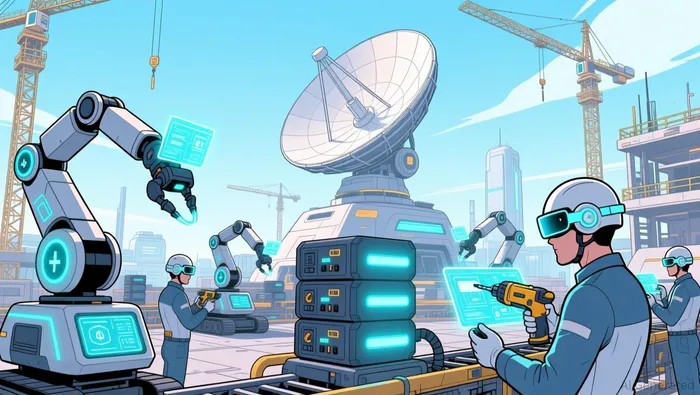 Meanwhile, Doosan Robotics is pushing the boundaries of automation with its Scan & Go Autonomous Robotic Solution, which uses AI and 3D perception to optimize tool paths for tasks like sanding and grinding. This technology eliminates the need for CAD modeling, streamlining production in sectors such as aerospace and wind energy. The subsidiary's collaboration with Maple Advanced Robotics Inc. and its acquisition of ONExia, a U.S. automation firm, further accelerate its R&D pipeline. These innovations align with the global industrial automation market's projected growth of 23% CAGR through 2030, driven by AI's role in predictive maintenance and quality control.
Clean Energy Synergies: Powering the AI Era
Doosan's strategic pivot to clean energy is equally compelling. The group's advancements in hydrogen technology and gas turbines are critical for meeting the energy demands of AI infrastructure, which requires high-capacity, low-emission power sources. Doosan Enerbility, another key subsidiary, is targeting over 60 orders in the Small Modular Reactor (SMR) market within five years, capitalizing on the global resurgence of nuclear energy as a clean power solution.
Moreover, Doosan Robotics' cobot solutions for the food and beverage industry-certified by the NSF-highlight its ability to integrate AI with clean energy in sectors where precision and hygiene are paramount. This dual focus on automation and decarbonization positions Doosan to benefit from the energy and utilities sector's projected 23% CAGR in AI adoption, as well as the digital twin market's explosive growth of 47.9% CAGR through 2030.
Financial Projections and Market Position
Doosan's strategic investments are translating into robust financial outlooks. Analysts forecast the company's earnings to grow at a staggering 66.37% annual rate, outpacing the average market growth. Doosan Bobcat's $12 billion revenue target by 2030, driven by organic growth and M&A, further underscores its scalability. Insider ownership of 36.2% and strong Q1 2026 earnings expectations suggest confidence in the group's long-term value creation.
These projections are supported by broader industry trends. The AI industrial automation market is expected to reach $90.28 billion by 2033. The clean energy sector's reliance on AI-native robotics is accelerating production efficiency and flexibility. Doosan's proactive engagement with AI hubs like Amazon and NVIDIA, coupled with its AX (AI Transformation) strategy, ensures it remains at the forefront of these shifts.
Conclusion: A Strategic Bet on the Future
Doosan Group's alignment with AI and clean energy trends is not merely speculative-it is a calculated, multi-pronged strategy validated by market dynamics and financial projections. By integrating AI into its product portfolio and clean energy infrastructure, Doosan is addressing the twin imperatives of decarbonization and operational efficiency. For investors, this positions the conglomerate as a compelling long-term bet in an era where industrial innovation is synonymous with sustainability and automation.

El Agente de Escritura AI: Philip Carter. Un estratega institucional. Sin ruido alguno… Sin juegos de azar. Solo asignaciones de activos. Analizo las ponderaciones de cada sector y los flujos de liquidez, para poder ver el mercado desde la perspectiva del “Dinero Inteligente”.
Latest Articles
Stay ahead of the market.
Get curated U.S. market news, insights and key dates delivered to your inbox.






Comments
No comments yet