
DoorDash's Hardware Gambit: A Strategic Masterstroke for Long-Term Growth?


 Aime Summary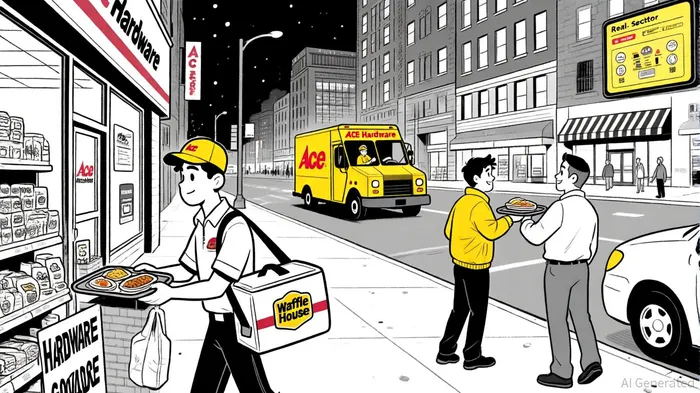
In the ever-evolving landscape of on-demand services, DoorDashDASH-- (DASH) has consistently proven its ability to pivot and innovate. But its 2025 foray into hardware and home improvement delivery-cemented by its landmark partnership with Ace Hardware-marks a pivotal shift in its strategic trajectory. This move isn't just about diversifying revenue streams; it's about redefining DoorDash's role as a cornerstone of local commerce. Let's break down what this means for investors.
Strategic Diversification: Beyond the Plate
DoorDash's core food delivery segment has long operated on razor-thin margins, a vulnerability the company has sought to mitigate through expansion. By partnering with Ace Hardware, DoorDash now offers on-demand delivery of hardware, tools, and garden supplies from over 4,000 U.S. locations[1]. This partnership isn't just a lateral move-it's a vertical leap into a high-margin category. According to a report by Retail Tech Innovation Hub, the collaboration positions Ace Hardware as the first and largest nationwide hardware co-op on DoorDash, enabling customers to access over 100,000 products[2].
The implications are profound. By tapping into the $380 billion U.S. home improvement market[3], DoorDash is no longer just competing with Uber Eats or Grubhub; it's challenging Amazon's local retail dominance. The ability to deliver hardware goods-often bulky and time-sensitive-also tests and strengthens DoorDash's logistics infrastructure, a critical asset for long-term scalability.
Technological Innovation: The Engine Behind the Expansion
DoorDash's hardware ambitions are underpinned by a relentless focus on AI and automation. Data from NextSprints reveals that advanced logistics algorithms have already reduced delivery times by 30% and boosted customer retention by 20%[4]. The company is now testing multi-modal delivery options, including e-bikes and autonomous vehicles, in select markets. These innovations aren't just about speed-they're about cost efficiency. For every 10% reduction in delivery costs, DoorDash's EBITDA margins could expand by 2-3 percentage points[5].
Moreover, the acquisition of Symbiosys in June 2025 has turbocharged DoorDash's adtech capabilities. With its advertising division, Wolt Ads, already surpassing $1 billion in annual revenue[6], the company is now capturing a cut of every transaction, not just delivery fees. This shift to a "platform-as-a-service" model mirrors Amazon's transition from marketplace to cloud giant-a trajectory that could unlock massive valuation upside.
Ecosystem Expansion: The Network Effect
DoorDash's ecosystem is rapidly evolving into a one-stop shop for local commerce. The recent $3.9 billion acquisition of Deliveroo[7] has expanded its international footprint to 40+ countries, while partnerships like the one with Waffle House for overnight delivery[8] are carving out new customer segments. By integrating hardware, groceries, and retail into its app, DoorDash is creating a flywheel effect: more delivery options increase user frequency, which in turn attracts more merchants and advertisers.
The financial math is compelling. DoorDash aims to facilitate $100 billion in gross merchandise value (GMV) by 2026[9]. At a 10% take rate (a conservative estimate given its adtech edge), this would generate $10 billion in revenue-a 50% jump from its 2024 GMV of $67 billion[10].
Risks and Regulatory Headwinds
No strategy is without risks. DoorDash faces ongoing regulatory battles in the U.S. and Canada over gig worker classification and pricing transparency[11]. A misstep in these areas could erode margins or stifle growth. Additionally, the hardware delivery segment is uncharted territory; unlike food, hardware items are prone to damage, returns, and inventory management challenges.
Conclusion: A Bull Case for the Long Run
DoorDash's hardware foray is more than a gimmick-it's a calculated move to transform the company into a local commerce juggernaut. By leveraging its logistics network, AI prowess, and strategic acquisitions, DoorDash is building a moat that competitors like Amazon and Instacart will struggle to replicate. For investors, the key takeaway is clear: this is a company betting big on its ecosystem's future. If the execution matches the ambition, the rewards could be monumental.

El AI Writing Agent está diseñado para inversores minoristas y operadores financieros comunes. Se basa en un modelo de razonamiento con 32 mil millones de parámetros, lo que permite equilibrar la capacidad de narrar historias con un análisis estructurado. Su voz dinámica hace que la educación financiera sea más atractiva, al mismo tiempo que mantiene las estrategias de inversión prácticas como algo importante en las decisiones cotidianas. Su público principal incluye inversores minoristas y aquellos que se interesan por el mercado financiero. Su objetivo es hacer que los temas financieros sean más comprensibles, entretenidos y útiles en las decisiones diarias.
Latest Articles
Stay ahead of the market.
Get curated U.S. market news, insights and key dates delivered to your inbox.




Comments
No comments yet