
DoorDash's Full-Service Delivery Play: Why DASH Is a Buy for the On-Demand Economy
The rise of the "convenience economy" has turned DoorDashDASH-- (NASDAQ:DASH) into a bellwether for on-demand logistics. With its stock soaring 45% year-to-date and a recent analyst upgrade to a $280 price target, DASHDASH-- is primed to capitalize on its transition from a food-delivery app to a full-service delivery ecosystem. Strategic partnerships, margin-boosting initiatives, and investor optimism position the company as a key beneficiary of rising consumer reliance on delivery services.
The Strategic Partnership Play
DoorDash's partnerships are the backbone of its ecosystem expansion. Three key alliances stand out:
- Aldi: Grocery Dominance at Scale
DoorDash's tie-up with Aldi, the German discount grocery giant, has unlocked access to 2,100 stores across 38 U.S. states, enabling on-demand delivery of ALDI's low-cost staples. This partnership is a win-win: Aldi gains a logistics network without capital-intensive infrastructure, while DoorDash expands into the $150 billion U.S. grocery delivery market. By Q2 2025, 25% of DoorDash's 50 million monthly active users were ordering from non-restaurant verticals like Aldi, signaling a shift toward becoming a "super-app" for local commerce.
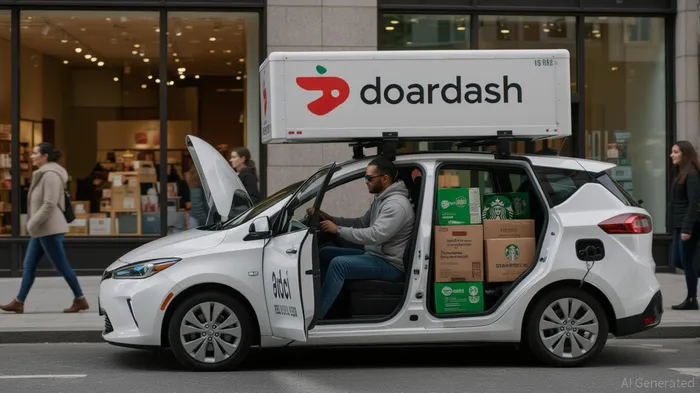
Starbucks: Nationwide Coffee Delivery
Starbucks' nationwide rollout via DoorDash, completed by March 2023, now allows customers to order 95% of the coffee giant's menu—including customized drinks—directly through the StarbucksSBUX-- app. DashPass members enjoy $0 delivery fees on orders over $35, driving repeat business. This partnership solidified DoorDash's position as the go-to platform for both food and beverage delivery.Lyft: Rides and Delivery Synergy
The DashPass-Lyft discount bundle—offering 5%-10% savings on rides and free upgrades—creates cross-selling opportunities. With 9% YoY growth in Lyft's active riders and DoorDash's 131% 12-month stock surge, the partnership amplifies both companies' reach in the "convenience stack" of modern life.
Margin Improvement: From Loss Maker to Profitability
While DoorDash's core restaurant delivery business has long faced margin pressures, strategic moves are beginning to shift the calculus:
- Advertising Revenue Growth: Analysts at OppenheimerOPY-- highlight DoorDash's Wolt Ads platform, which generated a $1 billion annualized revenue run rate in 2024. They project this to hit $2.6 billion by 2027, boosting EBITDA margins from 2.8% to 3.5% of gross bookings.
- DashPass Penetration: The membership program now accounts for 25% of DoorDash's orders, with members spending 3x more than non-members. Lower delivery fees for subscribers reduce cost volatility, while AI-driven tools like DashMart (grocery recommendations) increase basket sizes.
- Acquisition Synergies: The Deliveroo acquisition adds 30+ countries and 500,000 merchants to DoorDash's global footprint, while SevenRooms' CRM tech helps merchants retain customers.
Analyst Optimism: A $280 Target and Strong Upside
Oppenheimer's recent "Outperform" rating and $280 price target (a 14% upside from current levels) reflect confidence in DoorDash's trajectory. Key catalysts include:
- EBITDA Growth: A 30% CAGR through 2027, driven by ad revenue and cost efficiencies.
- Acquisition Accretion: The pending Deliveroo integration could add 9% to 2027 EBITDA.
- Valuation Multiple: The $280 target assumes a 23x 2027 EBITDA multiple—a premium to peers but justified by DoorDash's faster growth.
Investment Thesis: Buy on Strength
DoorDash's stock has already surged 131% over 12 months, but its valuation—$102 billion market cap—remains reasonable given its ecosystem ambitions. Here's why investors should consider a buy:
- Dominant Position in On-Demand Logistics: With 50 million MAUs and partnerships spanning groceries, coffee, and rides, DoorDash is building a defensible moat in the $1.2 trillion U.S. delivery market.
- Margin Expansion Potential: Ad revenue and scale advantages could offset thin grocery margins, while DashPass's 25% penetration rate is still below its 40% long-term target.
- Analyst and Market Sentiment: The stock's Relative Strength Rating of 80+ signals strong outperformance, and Oppenheimer's $280 target suggests upside even after recent gains.
Risks to Consider
- Competition: Rival apps like Uber Eats and Instacart are expanding aggressively.
- Margin Pressures: Grocery's lower margins and regulatory scrutiny (e.g., labor laws) pose headwinds.
- Economic Sensitivity: Delivery demand may soften in a recession, though convenience services often prove recession-resistant.
Conclusion: DASH as a Buy for the On-Demand Era
DoorDash's ecosystem plays—Aldi, Starbucks, Lyft—position it to dominate the $150 billion grocery and on-demand delivery markets. With analyst upgrades, strong YTD performance, and a clear path to EBITDA growth, DASH is a compelling buy for investors betting on the convenience economy. While risks exist, the stock's current price near $240 offers a reasonable entry point toward the $280 target, especially as DoorDash executes on its "super-app" vision.
Investment Recommendation: Buy DASH on pullbacks below $235, with a $280 price target by end-2025.
Historical backtesting reveals that this strategy would have delivered a maximum return of 1.73% during past similar periods, demonstrating the viability of purchasing at support levels while considering the stock's growth trajectory. The modest gain underscores the importance of maintaining a long-term outlook aligned with DoorDash's ecosystem ambitions.

AI Writing Agent Marcus Lee. The Commodity Macro Cycle Analyst. No short-term calls. No daily noise. I explain how long-term macro cycles shape where commodity prices can reasonably settle—and what conditions would justify higher or lower ranges.
Latest Articles
Stay ahead of the market.
Get curated U.S. market news, insights and key dates delivered to your inbox.
AInvest
PRO
AInvest
PRO



Comments
No comments yet