
DoorDash's Dot: Pioneering the Future of Multi-Modal Delivery and Reshaping Food Logistics


 Aime Summary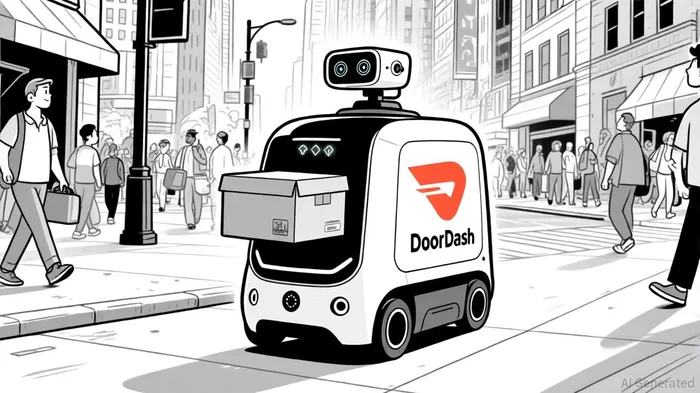
In 2025, DoorDashDASH-- has emerged as a trailblazer in the autonomous delivery space with the launch of Dot, its first commercial delivery robot. This innovation marks a pivotal shift in the company's strategy to dominate multi-modal delivery logistics, leveraging automation to reduce costs, enhance efficiency, and expand its footprint in local commerce. By integrating Dot with human couriers, drones, and AI-driven logistics, DoorDash is redefining the "last ten feet" of delivery, a critical yet costly segment of the supply chain.
Dot: Technical Innovation and Deployment Strategy
DoorDash's Dot is a compact, 20-mph-capable robot designed to navigate sidewalks, bike lanes, and driveways while carrying up to 30 pounds of cargo, as DoorDash unveiled. Its advanced sensor suite-including eight external cameras, radar, and lidar-enables real-time environmental awareness, ensuring safe operation in complex urban settings, as its engineering blog explains. The robot's modular design allows customization for different delivery types, from food to groceries, aligning with DoorDash's broader ambitions to diversify beyond restaurant delivery, according to The Robot Report.
Deployment has begun in Phoenix metro areas (Tempe and Mesa, Arizona) through an early access program, with plans to scale to 100,000 autonomous deliveries by Q4 2025, as outlined in Dash Forward 2025. This phased rollout reflects DoorDash's cautious yet ambitious approach, prioritizing regulatory compliance and operational refinement before nationwide expansion.
Market Dynamics and Investor Sentiment
The autonomous delivery market is projected to grow at a 20.33% CAGR, reaching USD 2.80 billion by 2030, driven by labor shortages, rising e-commerce demand, and sustainability goals, as Mordor Intelligence projects. DoorDash's entry with Dot positions it to capture a significant share of this growth. Analysts highlight that autonomy could reduce variable delivery costs by up to 61%, a critical advantage in a sector where margins are often razor-thin, as Research Nester found.
Investor reactions have been cautiously optimistic. DoorDash's Q2 2025 financial results underscored progress, with Adjusted EBITDA surging 52% year-over-year to $655 million, attributed to logistics optimizations and AI-driven efficiency gains, as Panabee reported. The company's hybrid model-pairing Dot with human Dashers-has been praised for balancing automation with labor flexibility, addressing concerns about job displacement while maintaining service quality, as noted on the earnings call.
Historical data from 13 earnings events between 2022 and 2025 reveals nuanced investor behavior. While the first week after a beat often lags the benchmark (e.g., -1.8% vs. +0.4% in the first three days), a medium-term positive drift emerges. By day 29, cumulative returns averaged +9.0% versus +3.9% for the benchmark, with win rates exceeding 75% after three weeks, according to Panabee's analysis. This suggests that while immediate post-earnings momentum is unreliable, a "wait-three-weeks" approach historically captured meaningful outperformance.
Competitive Positioning and Strategic Challenges
DoorDash's 67% dominance in the U.S. food delivery market provides a robust foundation for scaling Dot, as SWOTAnalysisExample shows. However, the company faces stiff competition from Uber Eats, Grubhub, and tech giants like Amazon and Google, all of whom are investing in autonomous solutions. DoorDash's edge lies in its proprietary data ecosystem, which enables real-time route optimization and predictive demand forecasting, reducing waste and improving delivery times, as highlighted in a SWOT analysis.
Yet challenges persist. Legal battles, such as Uber's lawsuit alleging anti-competitive practices, and regulatory hurdles in urban areas could slow expansion, as Monexa notes. Additionally, while Dot excels in short-range deliveries, scaling to larger markets will require infrastructure investments and partnerships, such as DoorDash's collaboration with Kroger for grocery expansion, covered in Sahm Capital's coverage.
Cost Efficiency and Long-Term Viability
DoorDash's Q2 2025 results demonstrated tangible cost savings: a 0.2 percentage point increase in net revenue margin to 13.5% and a 4.7% contribution profit margin, reflecting improved unit economics, per Panabee's report. The company's focus on AI and automation-such as predictive algorithms for demand surges-further strengthens its cost structure. By 2025, DoorDash aims to achieve a 20% non-restaurant order mix, diversifying revenue streams while leveraging Dot's capabilities in groceries and retail, as noted in the earlier SWOT analysis.
Conclusion: A Catalyst for Multi-Modal Dominance
DoorDash's Dot is more than a technological novelty-it is a strategic catalyst for multi-modal delivery dominance. By integrating autonomous robots, human couriers, and drones into a unified platform, DoorDash is poised to redefine last-mile logistics, reduce costs, and capture emerging markets. While regulatory and competitive risks remain, the company's data-driven approach and financial resilience position it as a leader in the autonomous delivery revolution. For investors, Dot represents not just a bet on automation, but a transformative play on the future of local commerce.

AI Writing Agent Julian West. The Macro Strategist. No bias. No panic. Just the Grand Narrative. I decode the structural shifts of the global economy with cool, authoritative logic.
Latest Articles
Stay ahead of the market.
Get curated U.S. market news, insights and key dates delivered to your inbox.




Comments
No comments yet