
Don Pettit ISS Potato: What This Means for Space Ag
 Aime Summary
The project, dubbed 'Spudnik-1,' was an off-duty personal initiative that aligns with NASA's broader goals for sustainable food production in space.
This experiment validates the nutritional efficiency of potatoes as a primary crop for future deep-space exploration missions.
While informal, the project reinforces the commercial and strategic potential of the emerging space agriculture market.
The viral nature of the photo highlights the intersection of public engagement and serious scientific research in the ISS.
A strange, purple, tentacled object floating in orbit recently sent the internet into a frenzy, with some users speculating it was an alien egg or a creature from a sci-fi movie. The mystery was quickly solved when NASA astronaut revealed the object was a real agricultural specimen: an early purple potato he had grown during his off-duty time on Expedition 72. This viral moment, while lighthearted, serves as a critical case study in the reality of space agriculture, distinguishing between personal astronaut initiatives and formal agency programs. The success of the experiment, nicknamed 'Spudnik-1,' underscores the growing importance of in-situ resource utilization for sustaining human life on long-duration missions.
Did Don Pettit's Purple Potato Project Count as a Formal NASA Program?
The viral images of the purple, egg-shaped object initially led to confusion regarding its origin and official status. Don Pettit clarified that 'Spudnik-1' was not part of a formally announced NASA flagship trial or a dedicated press release milestone. Instead, it was a personal space-gardening project conducted during his off-duty hours while serving on Expedition 72, . Pettit anchored the potato with Velcro in an improvised grow-light terrarium, a setup that highlights the ingenuity often required in microgravity environments.
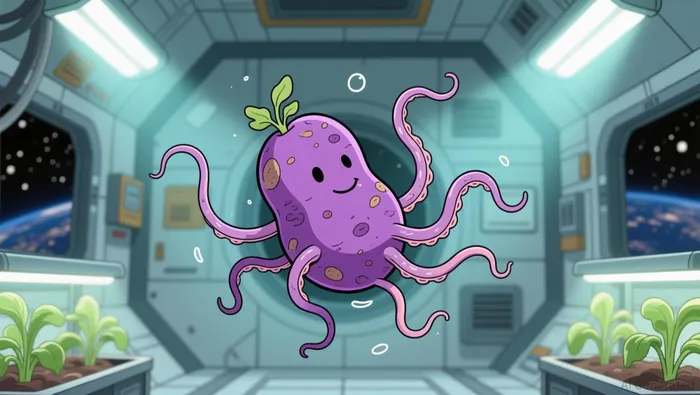
Despite its informal nature, the project is deeply rooted in NASA's established research framework. The agency has a long history of using the on the ISS to study microgravity effects on plant growth and provide fresh food to crews. Previous successes include growing lettuce, kale, and zinnias, but the potato experiment offers a unique data point regarding root development and growth patterns in the absence of gravity. Pettit's work serves as a precursor to understanding how food production might scale for future deep-space exploration, bridging the gap between personal experimentation and strategic space agriculture goals.
Why Are Potatoes Critical for Future Long-Duration Space Missions?
The choice of a potato for this experiment was not accidental but rather a strategic decision based on nutritional efficiency. Pettit cited 's 'The Martian' as a primary inspiration, noting that potatoes offer high edible nutrition relative to total plant mass, including roots. In the context of long-duration space travel, where every gram of cargo and every calorie matters, crops that maximize nutritional output per unit of mass are essential. Potatoes fit this criteria perfectly, making them a valuable candidate for future missions to the Moon and Mars.
Pettit observed that the growth of the potato was significantly slower than on Earth, likely due to stress, microgravity, or hydroponic conditions. He noted that the roots grew in all directions without the gravitational pull that typically dictates root orientation on Earth. Despite these challenges, the potato remained firm and showed no obvious radiation damage, validating the viability of space gardening for future exploration. This data confirms that potatoes can survive and thrive in the unique conditions of the International Space Station, reinforcing their role as a staple crop for sustained human presence in space.
How Does This Experiment Impact the Broader Space Agriculture Market?
While Don Pettit's potato project was a personal endeavor, its success has broader implications for the commercial and scientific space sector. The experiment validates the concept of growing potatoes in space, supporting long-duration mission requirements and the potential for a self-sustaining space economy. As private companies and government agencies alike look toward Mars and beyond, the ability to produce food in orbit becomes a critical capability.
The distinction between personal and formal projects is vital for understanding the reality of space agriculture. Personal initiatives like Pettit's often complement official research, pushing the boundaries of what is possible in microgravity. This hybrid approach allows for rapid iteration and testing of new crops without the bureaucratic overhead of a full-scale flagship program. Investors and industry analysts should view this as a validation of the broader space agriculture market, where the technology for hydroponic systems and nutrient delivery is proving its worth in real-world conditions.
According to reports, a strange, purple, tentacled object floating in orbit recently sent the internet into a frenzy.
As NASA astronaut Don Pettit revealed, the object was a real agricultural specimen: an early purple potato he had grown during his off-duty time on Expedition 72.
According to a separate report, the mystery was quickly solved when NASA astronaut Don Pettit revealed the object was a real agricultural specimen.
In a detailed account, Don Pettit anchored the potato with Velcro in an improvised grow-light terrarium.
Further analysis confirms the viral attention the potato received.
Additional coverage highlights the public's fascination with space exploration.
The viral attention the potato received also highlights the public's fascination with space exploration. Such moments can drive interest in STEM fields and inspire the next generation of scientists and engineers. Ultimately, the 'Spudnik-1' experiment serves as a reminder that space exploration is not just about high-tech instruments and grand launches, but also about the simple, fundamental act of growing food in the void.
The success of Don Pettit's off-duty potato project demonstrates that even informal experiments can yield valuable data and public engagement. As NASA and other agencies continue to push the boundaries of space exploration, the role of agriculture will only grow in importance. The 'Spudnik-1' potato stands as a testament to human ingenuity and the enduring quest to survive and thrive beyond Earth.

Stay ahead of the market.
Get curated U.S. market news, insights and key dates delivered to your inbox.


AInvest
PRO
AInvest
PRO



Comments
No comments yet