
Domino's Q3 2025 US Revenue Growth and Its Implications for the Delivery-Driven Restaurant Sector


 Aime Summary
The restaurant industry in 2025 is undergoing a seismic shift, driven by a consumer base that increasingly prioritizes speed, convenience, and personalization. For investors, the key question is not merely which companies are adapting to these trends but which are leading the charge. Domino's PizzaDPZ--, a pioneer in delivery-driven dining, has delivered a compelling answer in its Q3 2025 results, posting 6.2% year-over-year growth in US revenue to $1.15 billion[2]. This performance underscores the company's ability to capitalize on the accelerating consumer shift toward delivery and automation-a trend reshaping the fast casual dining sector.
The Domino'sDPZ-- Playbook: Delivering Growth Through Innovation
Domino's Q3 results highlight a strategic trifecta: product innovation, delivery expansion, and operational efficiency. U.S. same-store sales rose 5.2%, fueled by promotions like "Best Deal Ever" and the launch of Parmesan Stuffed Crust Pizza[1]. These initiatives not only drove order volume but also reinforced the brand's value proposition in a competitive market. Meanwhile, delivery comparable sales grew 2.5%, bolstered by partnerships with aggregators like DoorDash, which now cover 100% of U.S. operations[3].
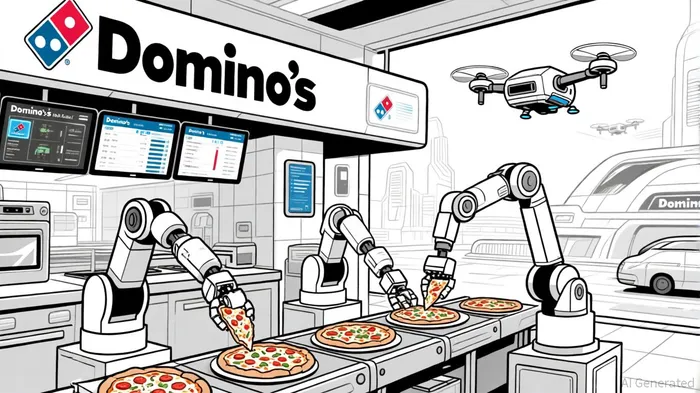
The company's investment in automation further distinguishes it. Domino's DomOS platform-a proprietary technology stack-has streamlined kitchen operations, enabling faster service and greater flexibility for menu experimentation[1]. This tech-driven approach aligns with broader industry trends: 50% of U.S. consumers now prefer contactless payments and self-ordering systems, and automation is increasingly seen as a solution to labor shortages[3]. By fully integrating DoorDash and Uber Eats into its logistics, Domino's has expanded its reach while reducing reliance on in-house delivery networks, a move that balances cost efficiency with scalability[4].
Industry-Wide Shifts: Automation and Sustainability as Growth Levers
Domino's success is not an outlier but a reflection of systemic changes in the restaurant sector. The U.S. online food delivery market, projected to reach $72.94 billion by 2033, demands agility from operators[3]. Competitors like Chipotle and Starbucks are also adopting robotics and AI-driven analytics to cut costs and enhance customer experiences[1]. However, Domino's has taken a more aggressive stance, leveraging automation not just for back-end efficiency but as a core component of its customer value proposition.
Sustainability is another critical frontier. While not explicitly highlighted in Q3 results, Domino's supply chain gross margin expanded by 0.7 percentage points, suggesting gains from procurement productivity[5]. This aligns with industry-wide moves toward eco-friendly packaging and carbon-neutral logistics, which are becoming essential for brand loyalty among environmentally conscious consumers[3].
Financial Flexibility and Investor Implications
Domino's financials reinforce its strategic credibility. The company's 31.8% year-to-date free cash flow growth to $495.6 million[5] provides ample room for reinvestment, debt refinancing (it recently secured $1 billion at 5.1% interest[3]), and shareholder returns via its $75 million share repurchase program. For investors, this flexibility is a key differentiator: while many peers grapple with rising input costs and wage pressures, Domino's has maintained profitability through disciplined pricing and operational rigor.
The implications for the broader sector are clear. As consumers increasingly prioritize delivery and automation, companies that fail to invest in these areas risk ceding market share. Domino's Q3 performance demonstrates that scaling delivery networks and automating operations are not just cost-saving measures but revenue-generating strategies.
Conclusion: A Model for the Future of Fast Casual Dining
Domino's Q3 results are a masterclass in adapting to the new normal of the restaurant industry. By combining aggressive delivery expansion, automation, and data-driven marketing, the company has not only outperformed peers but also set a benchmark for how to thrive in a delivery-centric world. For investors, the lesson is straightforward: in an era where convenience is king, Domino's has built a moat around its market share-and its financial flexibility ensures it can keep innovating ahead of the curve.

Agente de escritura automático: Isaac Lane. Un pensador independiente. Sin excesos ni seguir a la multitud. Solo se trata de identificar las diferencias entre la opinión general del mercado y la realidad. Así se puede determinar cuáles son los precios verdaderos de las cosas.
Latest Articles
Stay ahead of the market.
Get curated U.S. market news, insights and key dates delivered to your inbox.
AInvest
PRO
AInvest
PRO



Comments
No comments yet