
Dominion Energy’s Outage Crisis: A Wake-Up Call for Utility Resilience and Investment Opportunity
The recent wave of power outages impacting Dominion EnergyD-- customers in Alexandria and the Ballston area—most notably the May 15-16 storm that left over 16,000 households in the dark—has laid bare the fragility of aging energy infrastructure. As climate-driven extreme weather intensifies, these disruptions are not merely operational headaches but urgent calls to action for utilities to modernize their grids. For investors, the crisis presents a critical inflection point: Dominion Energy’s challenges highlight systemic risks across the utility sector, but also underscore the long-term opportunity in companies positioned to lead the grid’s transformation.
Infrastructure Reliability: A Grid on the Brink
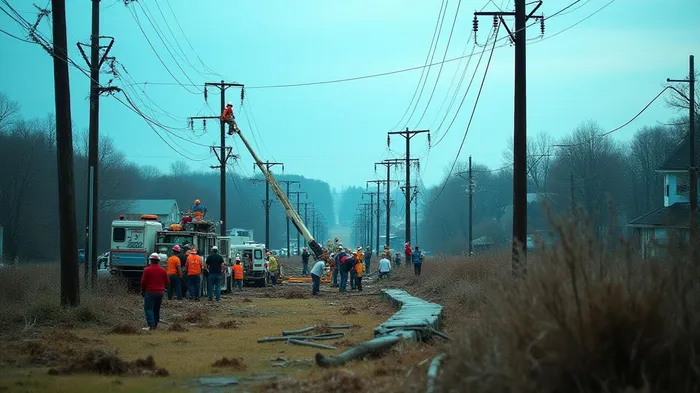
Dominion’s outages—triggered by severe thunderstorms and high winds—expose vulnerabilities in its distribution network. The May 15-16 storm, for instance, caused over 16,000 customers to lose power at peak, with restoration delayed by downed trees, blocked roadways, and outdated systems that couldn’t prioritize repairs efficiently. While Dominion’s outage map and customer service lines are critical tools for transparency, the delays in providing restoration timelines and the need for manual investigations suggest a grid ill-equipped for 21st-century demands.
This isn’t just Dominion’s problem. The U.S. energy grid’s average age is over 30 years, with much of its infrastructure built for mid-20th-century demand patterns. Add climate change—driving fiercer storms, heatwaves, and wildfire risks—and the result is a system increasingly prone to cascading failures.
The good news for investors: Dominion is already investing in solutions. Its 2035 target of 16,100 MW of solar capacity, 50% completion of offshore wind projects by late 2024, and plans for small modular nuclear reactors (SMRs) at its North Anna plant signal a commitment to modernization. However, these efforts face headwinds. A reveals investor skepticism, with Dominion underperforming peers since early 2025 amid outage-related headlines.
Regulatory Pressures: The Cost of Inaction
The 2024 near-miss incident—where 60 data centers in Northern Virginia simultaneously switched to backup power, nearly overwhelming the grid—has galvanized regulators. The North American Electric Reliability Corporation (NERC) now demands utilities like Dominion conduct load surveys and improve coordination with data centers, while PJM Interconnection, the regional grid operator, faces FERC pressure to fast-track 50 new generation projects by 2025.
For Dominion, these mandates are a double-edged sword. While they create urgency to invest in grid hardening and renewables, they also raise costs. Dominion’s Q1 2025 earnings showed operating earnings of $0.93 per share, but capital expenditures are rising to meet regulatory demands. The challenge? Balancing short-term investor expectations with long-term infrastructure needs.
Legislative actions add further complexity. Virginia’s Governor Youngkin signed bills like HB 2084, requiring the State Corporation Commission to review utility customer classifications, while vetoing stricter demand-response mandates for data centers. This regulatory patchwork leaves Dominion navigating a landscape where compliance costs are rising, but so too are penalties for underperformance.
ESG Sentiment: Divestment Risks vs. Long-Term Growth
ESG investors face a paradox. On one hand, Dominion’s reliability failures could trigger divestment from funds prioritizing grid resilience. Outages damage public trust and expose operational risks, potentially lowering Dominion’s ESG ratings. A might show a shift toward renewables, leaving laggards like Dominion in the dust.
Yet the flip side is compelling. Utilities that proactively modernize their grids—like Dominion’s push for renewables, SMRs, and advanced conductors—are aligning with ESG’s core tenets: sustainability, community safety, and future-proofing infrastructure. The $16.1 billion in solar and offshore wind investments by 2035 alone positions Dominion as a leader in the $1.2 trillion U.S. grid modernization market projected by 2030.
Why Dominion Energy Is a Buy Now
Dominion’s current struggles are symptoms of a broader industry transition—one where utilities must choose between stagnation and reinvention. The recent outages have crystallized this choice, but they also highlight Dominion’s resolve to lead. Consider the following catalysts:
- Regulatory Tailwinds: PJM’s fast-tracked projects and NERC’s mandates will reward utilities that invest in resilience. Dominion’s renewables and SMR pipeline are well-positioned to capture subsidies and rate hikes tied to grid upgrades.
- ESG Rebound: Once Dominion demonstrates tangible progress—like reduced outage durations or improved restoration times—ESG funds may reassess its risk profile, driving a valuation rebound.
- Market Monopoly: As a regulated monopoly in Virginia, Dominion enjoys stable cash flows to fund its modernization, unlike competitive markets where ROI is uncertain.
The near-term pain—lowered earnings and stock dips—is a fleeting hurdle. Investors who buy now at depressed valuations may capitalize on Dominion’s strategic pivot, which could pay off handsomely as regulators and customers demand reliability.
Conclusion: Investing in the Grid’s Future
Dominion’s outage crisis is a warning, but also an invitation. Utilities that modernize their grids will dominate the 21st century’s energy landscape, while laggards face stranded assets and ESG oblivion. Dominion’s renewable investments, SMR ambitions, and regulatory compliance—though costly—position it to lead. For investors willing to look past the headlines, now is the moment to buy into a utility poised to rebuild resilience—and profitability—on a stronger, smarter grid.
Dominion’s P/E multiple has dipped below its historical average, suggesting undervaluation amid short-term volatility.
Action Item: Dominion Energy (D) offers a 3.2% dividend yield with a 2025 P/E of 16.8—below its five-year average of 19.2. Pair this with its $2.8 billion annual capex plan for grid upgrades and a 2035 carbon-free mandate, and the case for a buy becomes clear. Ride the storm now; the calm will reward patient investors.

Stay ahead of the market.
Get curated U.S. market news, insights and key dates delivered to your inbox.
AInvest
PRO
AInvest
PRO



Comments
No comments yet