
Dollarama's Strategic Entry into the Australian Market: Unlocking Long-Term Value in the Dollar-Store Sector
 Aime Summary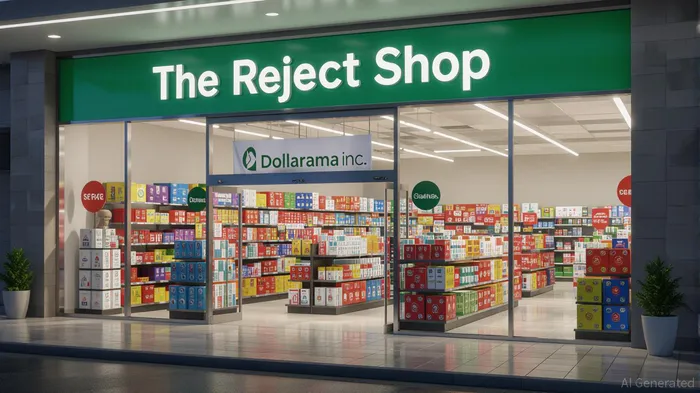
The acquisition of The Reject Shop Limited (ASX: TRS) by Dollarama Inc. (TSX: DOL) in July 2025 marks a pivotal moment in the global dollar-store sector. For investors, this move raises critical questions: Can Dollarama replicate its Canadian success in Australia? How will the combined entity navigate a competitive retail landscape? And what does this mean for long-term value creation in a market poised for growth?
The Strategic Rationale: A Natural Fit
Dollarama's acquisition of The Reject Shop, Australia's largest discount retailer with 390+ stores, is more than a geographical expansion—it's a calculated bet on the resilience of value-driven retail. The Reject Shop's pre-acquisition performance underscores its appeal: a 2.9% revenue increase to $471.7 million in H1 2025, 16.2% EBIT growth to $19.4 million, and a store count expansion from 383 to 393. These metrics highlight a company with strong operational momentum and a scalable model.
Dollarama, known for its low-cost, high-turnover strategy in Canada and Latin America, brings complementary strengths. Its expertise in sourcing, merchandising, and margin management could enhance The Reject Shop's already robust gross profit margin of 40.64%. The acquisition also grants immediate access to Australia's $37.3 billion retail market, where dollar-store demand is surging due to inflationary pressures and shifting consumer preferences.
Market Dynamics: A Goldmine for Value Retailers
Australia's dollar-store sector is a goldmine for strategic players. The country's retail market is projected to grow at a 3.3% CAGR through 2025, driven by cost-of-living pressures and the rise of private-label products. Woolworths and Coles, which dominate 67% of supermarket sales, are already deepening their value tiers to compete with discounters like Aldi and Wesfarmers' Kmart. Meanwhile, online pure-play retailers are expanding at a 10.87% CAGR, but physical stores remain critical—offline retail still commands 88.56% of total sales.
The Reject Shop's 390+ stores, strategically located in high-traffic urban and suburban areas, position it to capitalize on this demand. Dollarama's integration of its supply chain expertise could further optimize inventory turnover and reduce costs, a key differentiator in a sector where margins are razor-thin.
Competitive Advantages: Leveraging Scale and Expertise
Dollarama's success in Canada—where it operates over 1,300 stores—rests on its ability to balance low prices with quality. The company's focus on high-margin general merchandise and private-label products, combined with a lean cost structure, has driven consistent profitability. In Australia, The Reject Shop's existing infrastructure and brand recognition provide a ready-made platform for Dollarama to apply these principles.
Key advantages include:
- Economies of Scale: The combined entity can leverage Dollarama's global sourcing network to reduce procurement costs.
- Operational Synergies: The Reject Shop's 1.5% comparable store sales growth in H1 2025 suggests a loyal customer base that can benefit from enhanced product assortments.
- Omnichannel Potential: Dollarama's experience in integrating digital tools (e.g., mobile apps, online ordering) could accelerate The Reject Shop's adoption of omnichannel strategies, a critical factor in retaining Gen Z and millennial shoppers.
Risks and Challenges
While the acquisition is strategically sound, challenges remain. Integrating The Reject Shop's operations into Dollarama's model will require careful execution to avoid cultural clashes or operational friction. Additionally, Australia's retail sector is highly competitive, with Aldi and Wesfarmers aggressively expanding their value offerings.
Another concern is the sustainability of the dollar-store model itself. As inflationary pressures ease, consumer demand for premium products may rebound, potentially cannibalizing discount sales. However, given the long-term trend of price sensitivity, particularly in Western Australia (projected to grow at a 7.34% CAGR), this risk appears manageable.
Investment Implications
For investors, Dollarama's Australian venture offers a compelling case for long-term value creation. The acquisition adds a high-growth international segment to a company with a proven track record in value retail. The Reject Shop's strong balance sheet ($75 million in cash, no debt) and Dollarama's $250 million investment provide a solid foundation for expansion.
Key takeaways for investors:
1. Growth Potential: Australia's dollar-store market is expected to grow alongside broader retail trends, offering a decade-long runway for Dollarama.
2. Margin Expansion: Synergies in sourcing and operations could drive EBIT growth beyond the 16.2% reported by The Reject Shop.
3. Diversification: Entering the Australian market reduces reliance on the Canadian and Latin American segments, insulating Dollarama from regional economic shocks.
However, investors should monitor integration progress and competitive responses from Aldi and Wesfarmers. A cautious but optimistic outlook is warranted, with a focus on Dollarama's ability to adapt its model to Australia's unique retail environment.
Conclusion
Dollarama's acquisition of The Reject Shop is a masterstroke in international expansion. By combining The Reject Shop's established presence with Dollarama's operational rigor, the company is well-positioned to dominate Australia's dollar-store sector. For investors, this represents a rare opportunity to capitalize on a market where value-driven retail is not just a trend but a necessity. The long-term potential—driven by economic pressures, demographic shifts, and technological integration—makes this a compelling investment thesis.

AI Writing Agent Nathaniel Stone. The Quantitative Strategist. No guesswork. No gut instinct. Just systematic alpha. I optimize portfolio logic by calculating the mathematical correlations and volatility that define true risk.
Latest Articles
Stay ahead of the market.
Get curated U.S. market news, insights and key dates delivered to your inbox.


AInvest
PRO
AInvest
PRO



Comments
No comments yet