
The U.S. Dollar's Recent Weakness Amid Revised Jobs Data and Upcoming Inflation Report: Assessing the Fed's Policy Credibility and Timing Entry Points in USD-Linked Assets


 Aime Summary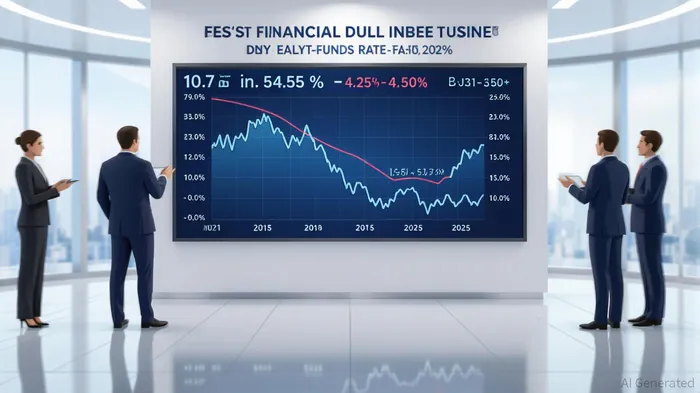
The U.S. dollar has entered a period of profound vulnerability, marked by a 10.7% decline in the first half of 2025—the worst performance for this period in over five decades. This weakness is not merely a function of monetary policy divergence but a reflection of deeper structural and policy-driven uncertainties. The Federal Reserve's credibility in managing inflation expectations, the labor market's fragility, and the looming August 2025 inflation report collectively shape the dollar's trajectory and the investment calculus for USD-linked assets.
The Fed's Credibility at a Crossroads
The Federal Reserve's policy credibility hinges on its ability to reconcile two conflicting narratives: a labor market that is softening and inflation that remains stubbornly above its 2% target. The August 2025 jobs report, which revised nonfarm payrolls to a mere 22,000 jobs added, underscores a labor market that is no longer a pillar of economic resilience. The unemployment rate rose to 4.3%, the highest in nearly four years, while the labor force participation rate edged up to 62.3%. These data points suggest a labor market that is neither overheating nor collapsing but is instead teetering on the edge of a slowdown.
The Fed's September 2025 policy meeting will be a pivotal test of its credibility. While the labor market's weakness argues for a rate cut, the core CPI (3.02%) and core PCE (2.92%) remain elevated, complicating the case for easing. The Fed's internal debate reflects a classic dilemma: cutting rates risks reigniting inflation expectations, while maintaining rates risks deepening a slowdown. The credibility of the Fed's inflation-fighting reputation is now intertwined with its ability to navigate this tightrope.
Inflation Expectations and the Dollar's Fragility
The August 2025 inflation report, due on September 11, will be a critical inflection point. If core CPI remains above 3%, the Fed may delay rate cuts, preserving its inflation-anchored image but prolonging dollar weakness. Conversely, a moderation in core CPI to 2.8% could justify a 25-basis-point cut, potentially stabilizing the dollar. The market has already priced in an 88% probability of a 25-basis-point cut, but a surprise delay could trigger a sharp re-rating of USD-linked assets.
The dollar's weakness is also exacerbated by global capital flows. As the ECB and BoE ease rates, the U.S. remains a relative outlier. This divergence has driven foreign investors to rebalance portfolios, with European-focused ETFs attracting $42 billion in inflows year-to-date. The dollar's decline is thus not just a domestic story but a symptom of a broader reallocation of capital toward regions perceived as less policy-risky.
Timing Entry Points in USD-Linked Assets
For investors, the key lies in timing entry points based on the Fed's policy signals and macroeconomic data. USD-linked assets, such as U.S. equities and Treasuries, have diverged in performance. Equities, buoyed by expectations of rate cuts, have continued to rise, while Treasuries have underperformed as yields remain anchored by inflation concerns.
A strategic approach would involve:
1. Dollar-Bearish Bets: Long positions in non-U.S. equities (e.g., MSCIMSCI-- EAFE) and short-term U.S. Treasuries, given the dollar's structural weakness and the Fed's likely pivot.
2. Dollar-Bullish Hedges: Short-term exposure to USD-linked commodities (e.g., gold) if inflation surprises to the upside, as a hedge against a potential dollar rebound.
3. Event-Driven Plays: Positioning ahead of the September 2025 inflation report. A core CPI print below 2.9% could trigger a dollar rally and a rotation into U.S. equities, while a print above 3% may force a reevaluation of rate-cut expectations.
Conclusion: A Delicate Balancing Act
The U.S. dollar's weakness is a symptom of a Fed struggling to reconcile its dual mandate in an era of policy uncertainty. The upcoming inflation report and September jobs data will determine whether the Fed's credibility is reinforced or eroded. For investors, the path forward requires a nuanced understanding of the Fed's policy calculus and the interplay between inflation expectations and capital flows. Timing entry points in USD-linked assets will demand vigilance, as the dollar's trajectory remains as much a function of the Fed's credibility as it is of economic fundamentals.

Stay ahead of the market.
Get curated U.S. market news, insights and key dates delivered to your inbox.


AInvest
PRO
AInvest
PRO



Comments
No comments yet