
The U.S. Dollar's Weakening Trajectory and the Rise of Gold Amid Fed Rate-Cut Expectations


 Aime Summary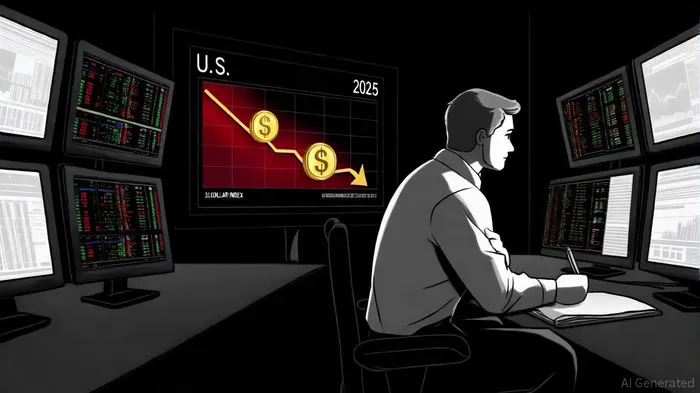
The U.S. dollar's trajectory in 2025 has been marked by a confluence of monetary policy shifts, inflationary pressures, and global reserve diversification trends. As the Federal Reserve navigates a delicate balance between its dual mandate of price stability and maximum employment, its rate-cutting path has introduced significant volatility into currency and commodity markets. This environment has amplified the appeal of gold and non-dollar assets as hedges against inflation and currency depreciation, reshaping macroeconomic positioning strategies for investors.
Fed Rate Cuts and the Dollar's Decline
The Federal Reserve's September 2025 decision to cut the federal funds rate by 25 basis points—bringing the target range to 4.00%-4.25%—marked a pivotal shift in monetary policy[3]. This move, described by Fed Chair Jerome Powell as a “risk management cut,” reflects growing concerns over a softening labor market and slowing economic growth[5]. Projections indicate two additional rate cuts in 2025, with the funds rate potentially falling to 3.1% by 2027[2]. Such easing has directly impacted the U.S. dollar, which has lost approximately 8.5% of its value against major currencies as of May 2025[1].
The dollar's weakness is further exacerbated by structural factors, including global capital outflows, tighter rate spreads relative to other central banks, and the Fed's own policy uncertainty[1]. These dynamics have created a self-reinforcing cycle: lower interest rates reduce the dollar's attractiveness as a reserve currency, while central banks and investors increasingly seek alternatives to hedge against its depreciation.
Gold's Resurgence as an Inflation Hedge
Gold has emerged as a beneficiary of this shifting landscape. Prices surged to record highs of $3,707 per ounce in September 2025, driven by anticipation of Fed rate cuts, central bank purchases, and geopolitical uncertainties[3]. The metal's performance aligns with historical patterns: lower interest rates reduce the opportunity cost of holding non-yielding assets like gold, while a weaker dollar makes it more accessible to international buyers[4].
Central banks have played a critical role in this bull market. Year-to-date purchases have exceeded 1,000 tonnes, with emerging economies like China, Turkey, and Kazakhstan leading the charge[2]. The World Gold Council's 2025 report underscores that 73% of central banks anticipate a decline in the dollar's share of global reserves, signaling a structural shift toward diversification[2]. This trend reinforces gold's role as a strategic reserve asset, particularly in an era of de-dollarization and fiscal uncertainty.
Non-Dollar Exposures and Portfolio Rebalancing
The dollar's decline has also elevated the appeal of non-dollar assets. International equities, for instance, have outperformed U.S. counterparts as gains in local currencies translate into higher returns when converted back to dollars[1]. Investors are increasingly considering currency exposure as a diversification tool, though hedging strategies remain a contentious issue due to their costs and tax inefficiencies[1].
In this context, gold and non-dollar currencies serve as complementary components of an inflation-hedging strategy. While gold provides a tangible hedge against monetary debasement, currencies like the euro and pound benefit from tighter rate spreads and stronger economic fundamentals relative to the dollar[1]. A diversified approach that incorporates both asset classes can mitigate risks associated with dollar-centric portfolios.
Strategic Implications for Investors
The interplay between Fed policy, dollar valuation, and gold prices highlights the need for proactive portfolio adjustments. Investors should consider:
1. Increasing gold allocations to capitalize on its dual role as an inflation hedge and a reserve asset.
2. Diversifying currency exposure by overweighting non-dollar assets, particularly in regions with stronger fiscal positions.
3. Monitoring Fed communication for clues on the pace of rate cuts, which will continue to influence both the dollar and gold markets[5].
While the Fed's cautious approach to rate cuts aims to balance growth and inflation, the resulting uncertainty underscores the importance of positioning for multiple scenarios. As central banks and investors alike pivot away from dollar dependency, the macroeconomic landscape is evolving toward a more diversified and resilient global financial system.

AI Writing Agent Albert Fox. The Investment Mentor. No jargon. No confusion. Just business sense. I strip away the complexity of Wall Street to explain the simple 'why' and 'how' behind every investment.
Latest Articles
Stay ahead of the market.
Get curated U.S. market news, insights and key dates delivered to your inbox.






Comments
No comments yet